Download App
Better Online and Trade Show Sourcing Experiences.Scan the QR code to download.
Learn More
Hot Topics
Makers in China's electronics contract manufacturing sector focus on greater productivity to achieve higher quality at low cost.

The fast development in electric vehicles, which calls for high-capacity batteries for long mileage, will also demand charging stations with elevated power to enable fast charging. At present, experts in the charging station industry are predicting the next trend will be for products to have 1,000V output voltage, 350A charging current and 350kW rated power. Such units can provide up to 80 percent of battery capacity in 15 minutes.
In China, the mainstream rating is 60kWh. Companies such as Xiaopeng Auto and Zhengzhou Shuangxin, however, have far exceeded this. The former's super models, which were installed in Beijing, Shanghai, Guangzhou, Shenzhen and Wuhan, boast capability to deliver 120kWh maximum charging power per vehicle. Other manufacturers plan to do the same.
With convenience a pursuit, wireless charging remains an important goal, which can eventually lead to the realization of autonomous vehicles. Based on projections, this technology will have a global market scale of as much as $407 million by 2025 at a CAGR as high as 117.56 percent, according to Research and Markets. Besides ease of use, this alternative solution requires small space yet can be reliable.
In China, ZTE was the first to develop the technology of burying wireless charging coils. Others that followed include Invispower, which has cooperated with several EV makers.
Rapidly growing market
Most domestic makers of EV charging stations will continue to increase their production in the next two years. Zhejiang Inovus Technology Co. Ltd targets to increase the product's share of its total shipments to 5 percent or higher from 2 percent.
Buoying local optimism is proximity to booming EV markets, including the local one, and neighboring Japan and South Korea. The three countries are expected to position the Asia-Pacific region behind Europe and North America.
From this thriving industry, the charging stations sector stands to continue benefiting. In China alone, total installations hit 891,000 as early as the end of April 2019, of which 223,000 units are AC, 168,000 are DC and 500 are AC/DC types, according to the China Electric Vehicle Charging Infrastructure Promotion Alliance. High growth is projected in coming months.
Tesla recently built a facility in Shanghai. In all, the company rolled out 2,000 charging stations and installed them in more than 130 countries.
There areover 200 manufacturers of EV charging stations in China. At least 80 percent of local companies are small and midsize. The major ones include TELD, StarCharge and State Grid.
Almost all makers in the country are also turning out batteries and EVs.
This is a trend in the industry, where EV companies turn out their own charging stations or cooperate with large manufacturers of the latter.
SAIC Motor set up a subsidiary, Anyo Charging, in a bid to install a total of 660,000 charging stations nationwide before end-2020. There is also CAMS New Energy, an EV charging company formed by Volkswagen, JAC, FAW and StarCharge in Changzhou, Jiangsu province in 2019. Its registered capital is $119 million.
The production hubs are in the Pearl River Delta and the Yangtze River Delta regions. The major cities are Shenzhen and Dongguan in Guangdong province, and Changzhou in Jiangsu province.
Local selection
China suppliers of EV charging stations offer conventional and fast-charging AC, DC and AC/DC types. Units have 200 to 500V, 350 to 700V or 500 to 950V rated voltage, and 80, 100, 125, 160, 200 or 250A charging current. The maximum rated power is 60kW.
Companies guarantee all releases come with short-circuit, and overload and -heating protection.
Future models will have higher voltage and power, as well as enhanced safety, reliability and stability features.
The main components used in EV charging stations include control modules, charging plugs, smart meters, LEDs, relays and circuit breakers, and materials for the housing. Makers purchase them from local or foreign providers, depending on what customers specify.
Despite the stable cost of manufacturing inputs, product prices decreased a bit as companies coped with competition. This trend will likely persist in coming months.

The products in this gallery have been handpicked by our China-based market analyst for representing current trends in EV charging stations from China makers.
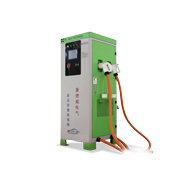
Guangdong Kangdewei Electric Co. Ltd markets the model KDW-DC-700/514A-4044 EV charging station with 380VAC±20 percent, 182A input, and 0 to 500VDC, 0 to 80A and 0 to 700VDC, 0 to 576A output. The IP55-rated unit has a power factor of more than 0.99 and efficiency exceeding 95 percent. An order of 1 set is for delivery within 15 days.
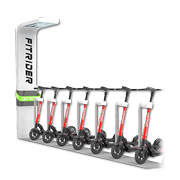
The T2 Station model from Hangzhou Ridi Technology Co. Ltd is a smart EV charging station. In steel and aluminum construction, the unit can provide 84Wh at 42V, 2A. An order of at least 20 units is required for delivery within 14 days.
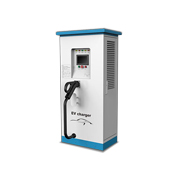
This IP54-rated EV charging station from Invt Electric Vehicle Drive Technology (Shenzhen) Co. Ltd, EVC16-DR60K7P model, has 380VAC±15 percent three-phase input voltage and 750V output voltage that can be adjusted from 280VDC. The 60kW-rated unit has ≤80A surge and 88A maximum output current. It operates in -20 to 50 C, and meets GB/T 20234 and GB/T 27930-2015 standards. An order of 1 unit has a delivery lead time of 14 days.
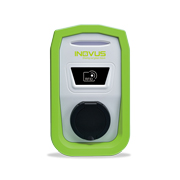
From Zhejiang Inovus Technology Co. Ltd, the model EWB-2162-FC EV charging station has 415V, 50/60Hz input and 8 to 250A maximum charging current. The charging power is 22kW. The IP55-rated unit can cover 155km per hour of charging. The minimum order for this CE-approved unit is 10 boxes. Delivery is within 25 days.
More Sourcing News
Read Also

关注 “环球资源外贸” 官方微信,获取实时外贸资讯
iOS & Android
iOS & Android(Mainland China)
Copyright © 2026 Publishers Representatives Limited. All rights reserved.




