




Starting an Amazon business can be incredibly lucrative, but many sellers underestimate the true costs involved. Whether you're a manufacturer looking to reach consumers directly, a wholesaler expanding into e-commerce, or a retailer diversifying sales channels, understanding Amazon's fee structure is essential for maintaining healthy profit margins. The question "how much does it cost to sell on amazon" doesn't have a simple answer—it depends on your business model, product categories, fulfillment methods, and sales volume.
This comprehensive guide breaks down every fee you'll encounter as an Amazon seller, from the obvious monthly subscriptions to the hidden costs that can erode your profits. By the end, you'll have a clear picture of what it really costs to operate on the world's largest e-commerce platform and how to calculate whether your products can be profitable there.
Table of Contents
Amazon Seller Account Types and Their Costs
Referral Fees: The Biggest Cost Component
How to Calculate Your Total Amazon Selling Costs
Tips to Minimize Amazon Selling Costs
Is Selling on Amazon Worth the Cost?
Amazon Seller Account Types and Their Costs
Before you can list a single product, you need to choose between two seller account types. This decision affects not only your monthly costs but also the tools and features available to grow your business.
The Individual Selling Plan charges $0.99 per item sold with no monthly subscription fee. This might sound appealing, but it's really only suitable for sellers moving fewer than 40 units per month. Beyond the per-item fee, Individual sellers face significant limitations:
- No access to bulk listing tools or inventory management features
- Cannot use advanced advertising options like Sponsored Brands
- Restricted from certain product categories
- No API integration with existing business systems
- Ineligible for top placement in the Buy Box in many competitive categories
For most serious B2B sellers, this plan is too restrictive to support meaningful growth.
The Professional Selling Plan costs $39.99 per month regardless of how many items you sell. Once you're selling more than 40 units monthly, the math clearly favors this option. More importantly, Professional sellers gain access to Amazon's full suite of business tools:
- Bulk listing and inventory management capabilities
- API integration for seamless connection with your existing systems
- Eligibility for the Buy Box, which is critical for competitive categories
- Advanced advertising campaigns including Sponsored Brands and Stores
- Ability to create promotions, coupons, and lightning deals
- Access to detailed business reports and analytics
- Eligibility for Amazon Brand Registry
For wholesale suppliers and manufacturers, the Professional plan is essentially mandatory. The break-even point is straightforward—if you sell 40 or more items per month, you're already saving money compared to the Individual plan. But the real value lies in the operational capabilities that allow you to scale efficiently. When considering how much does it cost to sell items on amazon at a professional level, that $39.99 monthly fee is just the entry point.
Referral Fees: The Biggest Cost Component
Referral fees represent Amazon's commission for connecting you with customers, and they're typically your largest expense. These fees are calculated as a percentage of the total sale price, including the item price plus any shipping or gift wrap charges you collect.
Amazon charges different referral fee percentages depending on the product category. These fees typically range from as low as 8% to as high as 45% for certain categories, with most common categories falling between 8% and 15%.
Major Product Categories Include:
- Electronics & Accessories
- Clothing, Shoes & Accessories
- Home & Kitchen
- Books, Music, Video & DVD
- Jewelry & Fine Jewelry
- Sports & Outdoors
- Toys & Games
- Beauty & Personal Care
- Automotive & Powersports
- Office Products
- Pet Supplies
- And many more specialized categories
Each category has its own specific referral fee structure set by Amazon. Some categories may also have tiered pricing based on the item's sale price, while others maintain a flat percentage regardless of price point.
Important considerations:
- Referral fees are calculated as a percentage of the total sale price, including the item price and any shipping or gift wrap charges
- Amazon periodically updates these fee structures, so it's essential to check the current rates for your specific product category
- Certain subcategories within main categories may have different fee percentages
- Some categories have minimum referral fees that apply even if the percentage calculation results in a lower amount
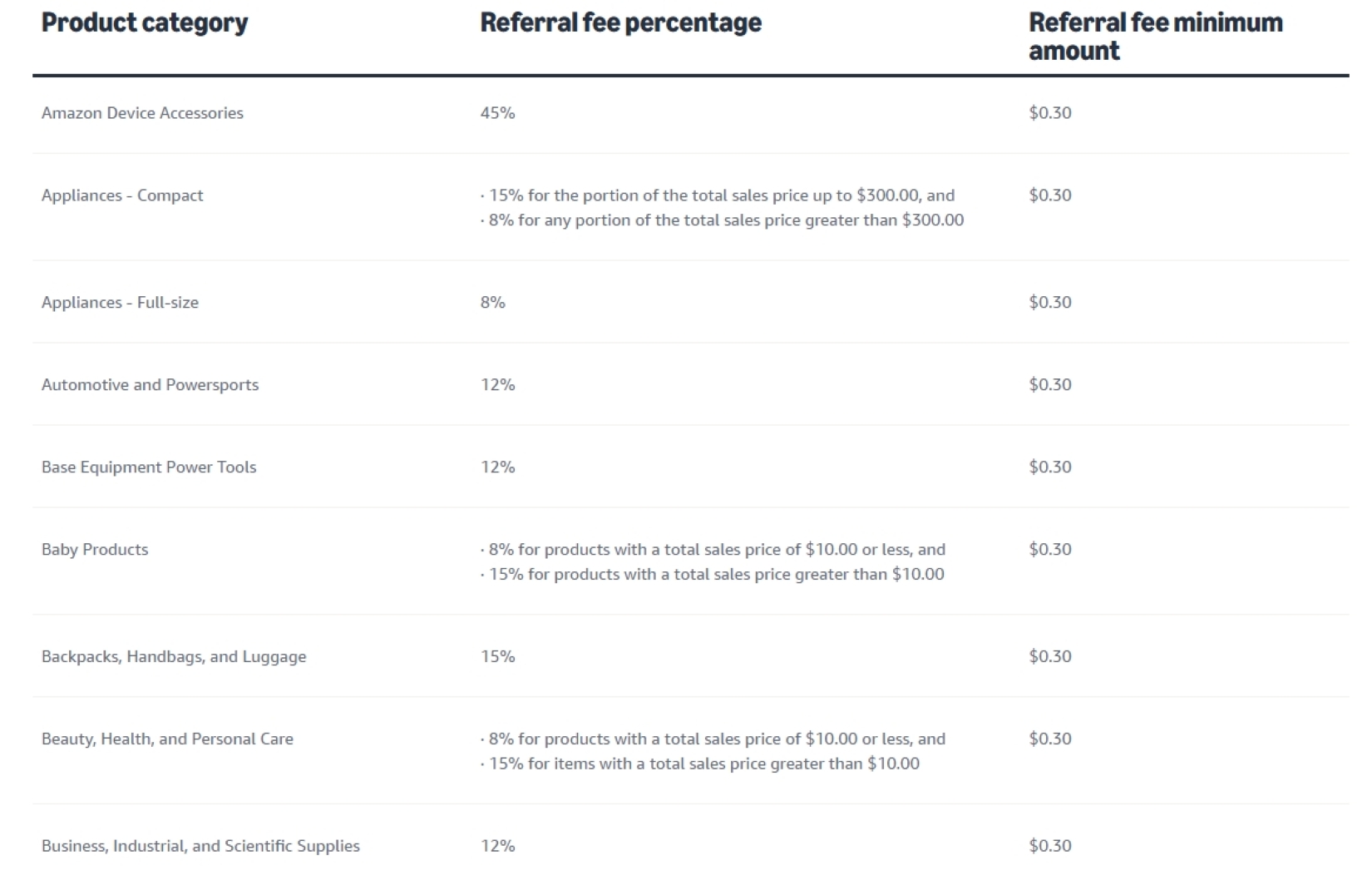
There's also a minimum referral fee of $0.30 per item across most categories. This particularly impacts sellers of low-priced items—if you're selling a $2 product with a 15% referral fee, you'd expect to pay $0.30 in fees, which represents 15% of your sale price. However, understanding which category your product falls into is crucial for accurate profit calculations, as referral fees often represent one of the largest costs when determining how much does it cost to sell items on amazon.
Fulfillment Fees: FBA vs. FBM
How you fulfill orders dramatically impacts your costs and operational complexity. Amazon offers two primary models, each with distinct financial implications.
Fulfillment by Amazon (FBA) means you ship your inventory to Amazon's warehouses, and they handle everything from storage to customer service. FBA fees cover:
- Picking and packing each order
- Shipping to customers with Prime eligibility
- Customer service inquiries and support
- Returns processing and management
- Gift wrapping services when requested
The convenience is substantial, but so are the costs. FBA fees are based on product size and weight using a tiered system:
- Small standard-size items (like phone cases or small accessories) under 10 ounces might cost around $3.22 to fulfill
- Large standard-size items (like kitchen appliances or medium electronics) between 1-2 pounds could run $5.42 or more
- Large bulky items (like furniture or large home goods) can incur fees of $20, $30, or even higher
- Special oversize products sometimes reach $75+ per unit depending on dimensions and weight
What many sellers don't anticipate is how dimensional weight affects costs. Amazon calculates fees based on both actual weight and dimensional weight (length × width × height ÷ 139), using whichever is greater. A lightweight but bulky item can cost as much to fulfill as something much heavier but more compact. This makes packaging efficiency a critical profit factor.
FBA fees also fluctuate seasonally. During the peak holiday season from October through December, Amazon adds surcharges to handle increased volume. If you're planning major Q4 sales, factor these temporary increases into your pricing strategy.
Beyond fulfillment, FBA storage fees accumulate monthly based on cubic feet:
- Standard-size items cost less to store than oversize items
- Rates increase significantly during peak season (October-December)
- Products sitting for 271-365 days incur aged inventory surcharges
- Items over 365 days face even steeper monthly charges
For B2B sellers with seasonal products or testing new items, these long-term storage costs can quickly become problematic.
Fulfillment by Merchant (FBM) means you handle everything yourself. There's no FBA fulfillment or storage fee, but you're responsible for:
- All shipping costs and carrier negotiations
- Packaging materials and supplies
- Labor for picking, packing, and shipping
- Warehouse or storage space
- Customer service inquiries
- Returns processing and restocking
The question of how much does it cost to sell stuff on amazon using FBM depends entirely on your operational efficiency.
FBM makes financial sense in several scenarios:
- Large, heavy items where FBA fees would be prohibitive relative to product value
- Existing warehouse operations with efficient shipping processes already in place
- High-margin products that can absorb shipping costs while maintaining profitability
- Custom or made-to-order items that can't be stored in advance
- Fragile products requiring specialized packaging and handling
The trade-off is that FBA products typically win the Buy Box more often, qualify for Prime shipping (a major conversion driver), and free you from logistics management. For most wholesale and manufacturing businesses entering Amazon, FBA offers the best path to competitive positioning despite higher costs.
Additional Amazon Seller Fees
Beyond the major costs, several smaller fees can add up depending on your product mix and business model.
Closing fees of $1.80 apply exclusively to media items—books, music, video games, DVDs, and software. If you're in these categories, add this to your per-unit cost calculations alongside referral fees.
High-volume listing fees affect Individual plan sellers who maintain more than 100 active listings. Since most serious sellers use the Professional plan, this rarely comes into play, but it's another reason the Individual plan doesn't work for growing businesses.
Refund administration fees recover some of Amazon's costs when a customer returns a product. Amazon refunds the customer's full purchase price but keeps 20% of the original referral fee (capped at $5.00) to cover processing. If you have a 10% return rate, factor this into your profit margins—it's not just the lost sale, but also the partial fee you still pay.
Some categories have variable closing fees or other category-specific charges. These are less common but worth checking for your particular products in Seller Central's fee schedule.
Optional Amazon Seller Costs
While not mandatory, certain investments can significantly impact your success and should be considered part of your true cost structure.
Amazon Advertising (PPC) has become almost essential for visibility in competitive categories. Sponsored Products campaigns operate on a cost-per-click model, where you bid on keywords and pay only when shoppers click your ads.
Key advertising considerations:
- Average CPC varies widely by category—anywhere from $0.30 to $3.00 or more per click
- Modest advertising budgets typically start at $300-500 monthly
- Competitive categories often require thousands in monthly ad spend
- Target a profitable Advertising Cost of Sales (ACoS)—if you spend $15 in ads to generate $100 in sales (15% ACoS), and your profit margin is 30%, you're still netting 15% after ad costs
Brand Registry is free to join but requires a registered trademark, which costs $250-750 to obtain. For manufacturers and brand owners, this investment is worthwhile because it provides:
- Enhanced brand protection against counterfeiters and hijackers
- Access to A+ Content (formerly Enhanced Brand Content) for richer product pages
- Eligibility for Amazon's Brand Analytics tools with search term data
- Ability to create Amazon Stores (custom storefronts)
- Sponsored Brands advertising options
These features improve conversion rates and provide competitive advantages that can quickly offset the trademark investment.
Professional product photography shouldn't be underestimated. Amazon is a visual marketplace, and high-quality images directly impact conversion rates. Professional photography typically costs $100-500 per product depending on complexity, but the difference between amateur and professional images can mean a 20-30% conversion rate improvement. For B2B sellers with extensive catalogs, this becomes a significant upfront investment, though images can be reused across multiple channels.
Inventory management software becomes necessary as you scale. Third-party tools that integrate with Amazon and your other sales channels cost $50-300+ monthly depending on features and volume. These systems help:
- Prevent stockouts that hurt rankings and sales velocity
- Optimize reorder timing based on sales trends
- Manage multi-channel inventory across platforms
- Forecast demand for seasonal planning
- Track profitability by SKU
These capabilities become essential once you're moving significant volume.
Hidden and Unexpected Costs
Several costs catch new sellers off guard because they're not immediately obvious in Amazon's fee documentation.
Returns and refunds cost more than just the lost sale. When a customer returns an FBA product, Amazon may deem it unsellable and dispose of it, meaning you lose both the sale and the inventory. Even if the item is returned to your available inventory, it may have been damaged or opened. High return rates in certain categories (especially apparel, which can see 20-30% returns) must be factored into your pricing strategy.
Inventory removal and disposal fees apply when you need to get products out of FBA warehouses:
- $0.50-0.60 per unit to return items to you
- $0.15-0.30 per unit to dispose of them
- Can exceed potential revenue from steep discounting for slow-moving inventory
For slow-moving inventory, these fees can exceed what you'd make selling the items at a steep discount.
Unplanned storage fees hit sellers who exceed their storage limits. Amazon assigns storage capacity based on your Inventory Performance Index (IPI) score, which measures how efficiently you manage inventory. If your IPI drops below 450 and you exceed your limits, overage fees can be substantial—$10 per cubic foot or more. This particularly affects:
- Sellers with seasonal inventory that spikes at certain times
- Those testing many products without clear winners
- Businesses with slow inventory turnover
Chargeback fees occur when you violate Amazon's operational requirements:
- Boxes not properly labeled when shipping to FBA
- Contents don't match shipping manifests
- Packaging doesn't meet Amazon's standards
- Products arrive damaged due to inadequate prep
These typically range from $0.10 to $1.00+ per unit and are entirely avoidable with proper procedures.
Real-World Cost Examples
Let's examine three realistic scenarios to see how these fees combine in practice.
Example 1: Small Standard-Size Item (Fitness Accessory)
Imagine you're selling a resistance band set priced at $24.99. The product weighs 8 ounces and fits in a small box. Here's your cost breakdown:
- Professional seller subscription: $0.40 per unit (if selling 100 units monthly)
- Referral fee (15%): $3.75
- FBA fulfillment: $3.30
- Monthly storage: $0.15 per unit
- Total Amazon fees: $7.60 per unit
If your product costs $8.00 to manufacture and ship to Amazon, your all-in cost is $15.60 against a $24.99 sale price, leaving $9.39 in gross profit—a 37.6% margin before advertising. This is healthy enough to support a modest advertising budget while remaining profitable.
Example 2: Large Standard-Size Item (Kitchen Appliance)
Consider a countertop blender priced at $79.99, weighing 4 pounds with moderate dimensions.
- Professional plan fee: Negligible at scale
- Referral fee (15%): $12.00
- FBA fulfillment: $6.50
- Storage costs: $0.40 per unit monthly
- Total Amazon fees: $18.90 per unit
If your manufacturing and inbound shipping costs are $28.00, your total cost is $46.90 against $79.99, leaving $33.09 gross profit—a 41.4% margin. This stronger margin gives you more room for advertising and promotions while maintaining profitability. The higher price point also means percentage-based fees, while larger in absolute terms, leave more dollars of profit.
Example 3: Large Bulky Item (Home Storage Cabinet)
Now consider a storage cabinet priced at $149.99, weighing 35 pounds with dimensions that classify it as large bulky.
- Referral fee (15%): $22.50
- FBA fulfillment: $18.00
- Storage costs: $1.50 per unit monthly
- Total Amazon fees: $42.00 per unit
If your product costs $55.00 to manufacture and ship to Amazon, your all-in cost is $97.00 against $149.99, leaving $52.99 gross profit—a 35.3% margin. While the margin percentage is lower than the previous examples, the absolute dollar profit is higher. However, the substantial fees mean there's less flexibility if you need to discount or increase advertising spend.
These examples illustrate why understanding fees for amazon seller accounts at different price points and size tiers is crucial for product selection. The sweet spot for many sellers is products that are compact enough to minimize fulfillment and storage costs while commanding prices high enough that percentage-based fees still leave meaningful profit dollars.
How to Calculate Your Total Amazon Selling Costs
Accurately projecting your costs requires a systematic approach:
Step 1: Select Your Selling Plan
For most businesses, the Professional plan at $39.99 monthly is the right choice.
Step 2: Identify Your Product Category
Your exact category and subcategory determines your referral fee percentage. Use Amazon's official fee schedule in Seller Central to find the current rate.
Step 3: Calculate Referral Fees
Multiply your intended sale price by the category percentage, ensuring it meets the minimum fee threshold of $0.30.
Step 4: Determine Fulfillment Method
For FBA, use Amazon's Revenue Calculator tool—input your product dimensions, weight, and price, and it will calculate fulfillment and storage fees based on current rates. This tool is invaluable because it accounts for dimensional weight and size tier classifications that can be tricky to determine manually.
Step 5: Include Optional Costs
Factor in expenses that apply to your business model:
- Advertising budget: Estimate monthly spend and divide by expected sales volume
- Professional photography: Amortize one-time costs across expected product lifetime sales
- Trademark registration: Spread the $250-750 cost across your first year's sales
- Software tools: Add monthly subscription costs divided by unit sales
Healthy profit margins for Amazon sellers typically fall between 20-40% after all fees and costs:
- Below 20% margins: Little room for advertising, promotions, or unexpected costs
- 20-30% margins: Sustainable with careful management
- 30-40% margins: Healthy flexibility for growth investments
- Above 40% margins: Excellent cushion, but verify pricing remains competitive
The key is finding the balance where you're competitive on price while maintaining enough margin to invest in growth.
Tips to Minimize Amazon Selling Costs
Smart sellers find ways to reduce fees without compromising service quality.
Optimize Product Size and Weight
Packaging efficiency can dramatically impact fulfillment costs:
- Redesign packaging to reduce dimensions—sometimes just an inch or two moves a product into a lower size tier
- Use lightweight but protective packaging materials
- Consider product design changes that reduce shipping dimensions
- Test different box configurations to find the most cost-effective option
Maintain Healthy Inventory Levels
Prevent costly storage fees through smart inventory management:
- Use Amazon's inventory management tools to track your IPI score
- Target 30-60 days of inventory in FBA for most products
- Replenish regularly based on sales velocity rather than large infrequent shipments
- Monitor aged inventory reports and liquidate slow-movers before surcharges kick in
- Avoid stockouts which hurt rankings, but don't overstock which ties up capital
Choose the Right Fulfillment Method
Some sellers use a hybrid approach for optimal costs:
- FBA for: Fast-moving items, competitively priced products, items where Prime eligibility drives conversions
- FBM for: Slow-moving inventory, oversized items with prohibitive FBA fees, high-margin products, custom/made-to-order items
This requires more operational complexity but can significantly improve overall profitability.
Leverage Free Tools
Amazon provides robust features that reduce the need for paid software:
- Seller Central includes analytics, inventory management, and performance tracking
- New sellers often qualify for $50-200 in promotional advertising credits
- Brand Analytics (with Brand Registry) provides valuable search term data
- Automated pricing rules can help maintain competitiveness
Monitor Fee Changes
Stay ahead of cost increases:
- Amazon typically updates fee structures annually, often in February
- Subscribe to Amazon Seller Central announcements
- Review fee schedules quarterly to catch changes
- Adjust pricing proactively when fee increases are announced
Improve Product Performance
Reduce indirect costs through operational excellence:
- Lower return rates: Better product descriptions and images set accurate expectations
- Optimize listings: Higher conversion rates reduce advertising cost per sale
- Improve product quality: Better reviews drive organic sales and reduce paid advertising dependence
- Enhance customer service: Faster response times improve seller metrics and Buy Box eligibility
These improvements compound over time, making your business progressively more profitable.
Is Selling on Amazon Worth the Cost?
After reviewing all these fees, you might wonder whether Amazon's costs justify the investment. The answer depends on your business model and growth objectives, but for most B2B sellers, the value proposition remains strong.
What Amazon Provides for the Fees:
- Access to hundreds of millions of active customers actively searching for products
- Customers already in purchase mode, unlike social media where you're interrupting
- Sophisticated logistics network through FBA without building your own infrastructure
- Payment processing and fraud protection
- Customer service and returns management
- A trusted marketplace where customers feel confident buying
When you calculate what it would cost to acquire customers, process payments, handle fulfillment, and manage returns independently, Amazon's fees often compare favorably.
Success Factors Beyond Fees:
Success on Amazon requires treating it as a serious sales channel with proper investment in:
- Product selection with sufficient margins
- Competitive pricing strategy
- Listing optimization for conversions
- Strategic advertising investments
- Inventory management discipline
Sellers who approach it casually, hoping to list products and watch sales roll in, typically struggle. Those who understand the fee structure, calculate margins carefully, and invest strategically in growth tend to find Amazon highly profitable.
The Scalability Advantage:
Perhaps Amazon's greatest advantage is scalability. Once you've established profitable products and efficient operations:
- Growing from 100 to 1,000 to 10,000 monthly sales doesn't require proportionally more effort
- The infrastructure scales with you automatically
- Per-unit costs often improve as you qualify for better storage rates
- Advertising becomes more efficient with accumulated data
For Different Business Types:
- Manufacturers: Direct-to-consumer access that bypasses traditional retail relationships
- Wholesalers: Immediate credibility and massive customer access for e-commerce expansion
- Retailers: A substantial additional sales channel beyond owned websites
In each case, understanding how much does it cost to sell on amazon and building that into your pricing strategy is essential, but the opportunity typically justifies the investment.
Conclusion
Understanding how much does it cost to sell stuff on amazon requires looking beyond simple fee percentages to the complete picture of how these costs interact with your specific products, business model, and growth strategy.
Core cost components:
- Professional selling plan: $39.99 monthly
- Referral fees: Typically 8-15% of sale price
- FBA fulfillment: $3-8 for standard items
- Storage fees: Accumulate monthly based on inventory volume
- Advertising spend: Variable but increasingly essential
- Optional tools and services: Enhance efficiency and growth
Add advertising spend, optional tools, and hidden costs like returns and storage overages, and the total investment becomes substantial.
Yet Amazon remains one of the most powerful sales channels available to businesses of all sizes. The key to profitability is approaching it strategically:
- Select products with sufficient margins to absorb fees while remaining price-competitive
- Optimize packaging and inventory to minimize fulfillment and storage costs
- Invest in listing quality and advertising to drive sales velocity that spreads fixed costs across more units
- Monitor performance metrics to continuously improve efficiency
Before launching products on Amazon, use the Revenue Calculator to model your complete cost structure. Factor in every fee, include realistic advertising costs, and ensure you're maintaining at least 20-25% profit margins after all expenses. This discipline in the planning phase prevents the disappointment of generating sales only to discover you're barely breaking even or losing money.
Amazon's fee structure rewards efficiency, quality, and scale. Sellers who continuously optimize their operations, maintain healthy inventory levels, reduce return rates, and improve conversion rates find their profitability improving over time. Those who treat Amazon as just another sales channel without understanding its unique economics struggle to compete.
Start with clear cost expectations, price your products appropriately, and commit to treating Amazon as a serious business channel requiring ongoing investment and optimization. With this approach, the fees become not obstacles but the cost of accessing the world's largest and most sophisticated e-commerce platform—an investment that, when managed well, delivers substantial returns.

