




by Melanie Victoriano (Content Editor)
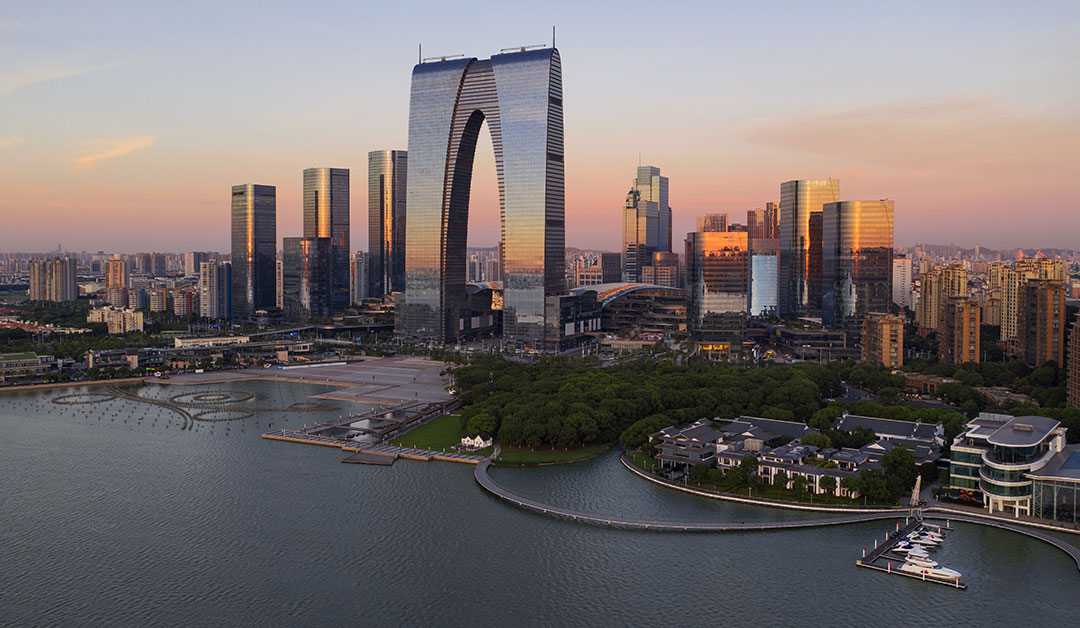 Image source: Getty
Jiangsu, located in the Yangtze River Delta on the eastern coast of China, is one of the smallest but also richest provinces in the country.
An economic and cultural powerhouse since China’s dynastic times, Jiangsu is a leading exporter among Chinese provinces and is stepping up as a major sourcing center for textile, electronics, telecommunication, and chemical products, among other products.
In 2023, according to research by the Observatory of Economic Complexity (OEC), Jiangsu exported $524 billion worth of products, making it the third largest exporter of all China's provinces and territories. Top exports from Jiangsu included smartphones ($31B), integrated memory circuits ($14.2B), lithium-ion accumulators ($13B), and photovoltaic modules/panels ($12.1B).
Jiangsu has trade relations with at least 230 regions and countries worldwide. Its top export destination in 2021 was the United States, which received 18.6 percent of annual export volume. Other key destinations for Jiangsu exports were Hong Kong (7 percent), Japan (6.6 percent), Korea (6.4 percent), and Vietnam (4.5 percent). The Netherlands, Taiwan, German, India, and the United Kingdom are also in the list of top 10 export partners.
Why source from Jiangsu?
Jiangsu has several traits that make it an ideal sourcing center and major exporter of quality and innovative products:
- Long history of industrial development and productivity
Since the Sui and Tang dynasties, Jiangsu has been a national economic and commercial center, well-known for its trade in grain, salt, and fish – sometimes called the “Land of Fish and Rice.” Jiangsu is historically oriented toward light industries such as textiles and food production. After 1949, the province began developing heavy industries such as chemicals and construction materials. Later, it established machinery, electronic, automobile, and other industries.
Jiangsu covers 107, 200 square kilometers, about one percent of China’s entire land area, and a population of about 85.05 million (ca 2021), a sixth of the country’s total. In 2021, Jiangsu accounted for RMB 11.64 trillion -- 10.17 percent -- of China’s GDP. It is within the so-called Yangtze River Economic Belt -- comprising 11 provinces and municipalities including Shanghai, Zhejiang, Anhui, Hubei, Jiangxi, Hunan, Sichuan, Yunnan, and Guizhou -- which accounts for more than 40 percent of China’s population and total GDP and is a focus of the country’s development plans.
2. R&D and manufacturing partner of tech and industry giants
Jiangsu boasts a total of 170 national and provincial-level economic and technological development zones across 13 prefecture-level cities.
The city of Suzhou tops the list with 21 economic and technological development zones, including the 80,000-square-meter Suzhou Industrial Park, the largest in the province, which focuses on new-generation information technology, nanotechnology, and artificial intelligence.
Hundreds of tech giants and industry leaders such as Siemens, Samsung, Philips, BMW, Huawei, TSMC, Trina Solar, and iFlytek have operations in Jiangsu.
Examples of partnerships with tech leaders include that which began in 2019 between Siemens Digital Industries Software and Tianmu Lake Institute of Advanced Energy Storage Technologies (TIES), to develop advanced battery technologies. TIES was set up jointly by the Jiangsu Zhongguancun Technology Park (Z-Park) and the Institute of Physics, Chinese Academy of Science to develop new battery technologies and provide high-quality customized services.
Another example is the Spotlight Automotive Factory in Zhangjiagang, Jiangsu, which broke ground in 2020. A joint investment of GWM and BMW Group, the factory is intended for joint R&D and production of pure electric vehicles, including the Mini.
Jiangsu’s R&D, manufacturing and export partnerships are driving the development and production of quality products in a wide range of industry fields including electronic information, precision equipment, auto, textile and apparel, as well as emerging sectors such as new-generation semiconductors, new energy, new materials, and biomedicine.
3. Multiple shipping options
Jiangsu has dependable and extensive transportation systems whether by road, rail, sea, or air. High-speed trains connect the province to major cities like Shanghai, a major export hub. It has an international airport that connects it to major cities in Europe, the United States and Asia. For shipping, Jiangsu has eight major ports which were integrated in 2017.
The port of Suzhou is considered a wing of the top port in China – Shanghai. Amid challenges faced by the shipping industry in the last two years, an alternative to shipping by container emerged in the form of China-Europe Express trains. Multiple choices ensure that buyers have failsafe shipping options from Jiangsu.
4. Taking steps toward green manufacturing
Jiangsu has a competitive advantage in the manufacture of products with a lower carbon toll on the environment because it has been taking steps to make processes in its industrial centers more environmentally sustainable.
As early as 2015, the province worked with the United Nations’ Partnership for Action on Green Economy (PAGE) on a sustainable development agenda.In a study by PAGE dated 2019, UN researchers noted the concrete steps taken by Jiangsu toward green manufacturing. The research covered three major industrial parks in Jiangsu -- Suzhou Industrial Park (southern Jiangsu), Taixing Economic Development Zone (central Jiangsu) and Huai’an Economic and Technological Development Zone (northern Jiangsu). The report noted that the three industrial parks implemented policies that enabled them to decrease chemical oxygen demand and sulfur dioxide emissions by 81 percent.
PAGE is optimistic that Jiangsu is “well positioned to transition to an inclusive green economy.” This is due to Jiangsu’s high level of economic development and lower pollution intensity and resource consumption per unit of GDP than most provinces in China.
This is a positive development especially as the world moves toward more eco-friendly manufacturing and consumers become more environmentally conscious in their purchase of goods and services. Sourcing green products will become the trend in the future and Jiangsu
has been preparing to meet this demand.
Summing Up
China’s Fourteenth Five-Year Plan (2021–2025) envisions Jiangsu as a globally recognized and internationally competitive industrial and sci-tech innovation center with an advanced manufacturing base.
Jiangsu’s macroeconomic context and its experience and strengths as a manufacturing and innovation hub give it a leg-up as a premium source of quality products now and in the future. Buyers who want to maintain their competitiveness should not miss out on the opportunity to source from Jiangsu.
If an in-person visit to Jiangsu is a challenge, the next best thing is a virtual sourcing trip. Global Sources has launched the Jiangsu Online Show with more than 1,100 qualified Jiangsu suppliers and 200-plus products. Don’t miss out on your chance to vet products and suppliers from Jiangsu, China’s next major sourcing center. Come and visit the online now.

