Download App
Better Online and Trade Show Sourcing Experiences.Scan the QR code to download.
Learn More
Hot Topics
If the Neptune Suite becomes even partially successful, it may open up a wide variety of opportunities for buyers and sellers who can offer screens with better battery life or different screen sizes.
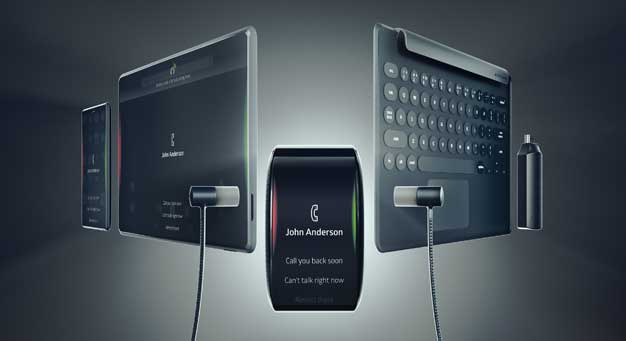
Neptune’s vision of the computing ecosystem of the future puts a wearable at the center.
(Image source: Neptune)
Current generation smart watches typically require a smartphone to work to their full potential. While some new wearables have data connections like 3G or LTE working independently, their computing power and displays are too weak or too small to replicate the capabilities of their larger, more capable brethren. However, one company is working toward a device ecosystem controlled by a wearable band that can interface with any screen.
The company, Neptune, is running a successful Indiegogo crowd sourcing campaign to produce an ecosystem of devices with a wearable at the center. Rather than being the source that powers other connected devices, the “smartphone” is nothing more than a 5in touchscreen with a pair of cameras and little to no processing power of its own. The same applies to the “tablet” component – it’s just a bigger screen for the wearable to send images and receive feedback from. The company does not even call them smartphones or tablets, but “Pocket Screen” and “Tab Screen”. One of the components of the suite is a wireless dongle that allows any HDMI-equipped monitor to become another screen.
The wrist-based wearable, on the other hand, is not a watch, but a wider band with a quadcore processor, LTE, Wi-Fi, GPS, Bluetooth and other wireless communication protocols. Without virtual keyboards, the user can “write” words with their fingers similar to a pen and paper or use a voice dictation interface through Android Lollipop. The screen itself is much larger than a smart watch.
With battery life being one of the key problems facing smart watches, the most novel issue addressed by the system is the way it manages power. A full color screen draws a lot of power from a very small battery, and upcoming wearables have battery life estimates of less than a day. Worse, they do not even have an independent cellular data connection. The Neptune system remedies this by making the now dumb screen of the “smartphone” and “tablet” additional power sources. So while the wearable component only has a 1,000mAh battery capacity, the Pocket Screen has another 2,800mAh and the Tab Screen 7,000mAh. In addition, the headphones that are a part of the system also act as the cord used to transfer power between the devices. This leads the company to claim that the Neptune Suite, which is the combination of all of the devices, can “easily last multiple days of usage on a single charge without needing to use any wall outlets.”
While the Indiegogo funding has been far beyond the target goal – a modest $100,000 target has been exceeded tenfold at the time of this writing – the system is not on the market yet. The Neptune Suite includes the band, Pocket and Tab screens, headset, HDMI dongle, and a wireless keyboard that can be physically attached to the Tab Screen to create an ad-hoc laptop. Backers of the crowdfunding project can opt to pre-purchase the system for $599, but the expected retail price is about $899. Delivery to backers is promised in February 2016.
It remains a project still in development, but one thing that is unclear is if components of the suite can be swapped out with third-party components. While the whole package is being sold as a single SKU at the moment, it is conceivable that users could buy third-party screens to either supplement or replace the components currently in the package. This in turn could lead to another kind of ecosystem – a large number of low-cost “screens” manufactured and sold not by the largest companies but by those who can compete for the lowest price. After all, if Neptune’s attempt to turn the mobile ecosystem on its head is even partially successful, it opens up a wide variety of opportunities for buyers and sellers who can offer screens with better battery life or different screen sizes that may not be as practical today.
More Sourcing News
Read Also

关注 “环球资源外贸” 官方微信,获取实时外贸资讯
iOS & Android
iOS & Android(Mainland China)
Copyright © 2026 Publishers Representatives Limited. All rights reserved.