Download App
Better Online and Trade Show Sourcing Experiences.Scan the QR code to download.
Learn More
Hot Topics
The VR Go comes from the Macau-based company Zotac, joining Taiwan's MSI to compete in the latest iteration of gaming PCs.
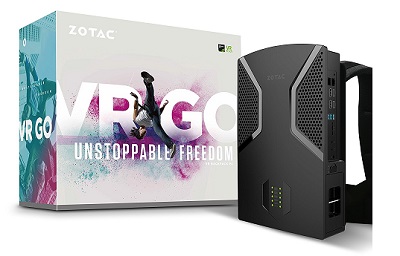
The Zotac VR Go is a robust gaming PC with plenty of ports, which slimmer PCs often forgo (Source: Zotac/Amazon)
One area of the virtual reality market that is just starting to emerge is portable VR Go. There are not many global brands that have products already for sale in this area yet, although some well-known brands such as HP have said they are working on such devices. Now, the Macau-based Zotac is joining Taiwan's MSI as one of the only brands with a backpack PC currently for sale. Zotac's VR Go is listed for $2,000 on Amazon, although the first batch sold out quickly, as the product is already "temporarily out of stock."
The VR Go comes with all the high-end specifications users should expect in machines capable of running PC-connected VR headsets such as the Oculus Rift and HTC Vive. It runs an Intel Skylake Core i7-6700T, a quadcore chip capable of operating at 3.6GHz, and an Nvidia GeForce GTX 1070 graphics card. The PC also includes a 240GB SSD and 16GB of DDR4 RAM. Another thing that is lacking in many slim gaming PCs these days is a suite of ports, but the VR Go has plenty. It has four ports for USB 3.0 and two each for RJ45 Ethernet, HDMI and DisplayPorts, and a bay for an additional 2.5in SATA HDD or SSD.
Given VR Go's unique form factor, it is surprising that its price aligns closely with other gaming PCs with similar specs. The high-end specs are critical for top-notch performance, but some China makers are looking to compete with more midrange backpack PCs. Emdoor, for example, teamed up with Intel to create the Fire Pack. The company showed off the product at the Global Sources Mobile Electronics show in October. While the Fire Pack does have the option for a Core i7, it also has a Core i5 version. It runs Nvidia's GTX 980 GPU with 4 or 8GB RAM and 128 or 256GB of storage. Since not everyone needs or wants to play the latest games at the highest resolution, some of these lower-end options could suit a specific portion of the market that companies such as Zotac and MSI are currently overlooking.
More Sourcing News
Read Also

关注 “环球资源外贸” 官方微信,获取实时外贸资讯
iOS & Android
iOS & Android(Mainland China)
Copyright © 2026 Publishers Representatives Limited. All rights reserved.




