Download App
Better Online and Trade Show Sourcing Experiences.Scan the QR code to download.
Learn More
Hot Topics
by Cecile de Veyra (Managing Editor)
Image from Getty
Market recovery is slow and still nowhere near pre-pandemic levels, weighed down by increased inflation and higher energy prices, but there have been improvements albeit precariously achieved.
More electronic components are available now at shorter lead times and lower prices, but this is because of reduced demand, notably in the consumer electronics sector. Global shipments of desktop and notebook PCs took a dive in Q3 2022, falling by 18 percent, according to Canalys, while smartphones dipped 9.7 percent YoY in the same quarter based on IDC’s report.
In the automotive sector, demand continues to grow but component shortages are likely to persist through 2023. Industry analysts say demand for automotive ICs can possibly counteract the losses in the consumer segment, but that remains to be seen. “It is unlikely we will know the extent of the decline as well as the possibility of a rebound until it happens,” according to Sourcengine.
“The multitier electronics supply chain exists within a complicated and volatile environment in which ever-evolving, unforeseen events continue to impact capacity, costs, lead times and other considerations,” said Steve Flagg, CEO and founder of Supplyframe, a leading intelligence platform for the global electronics value chain. “Constraints and shortages are not over. And a rebalancing of inventories and component market corrections is in play.”
 Image from Pexels
Another form of correction has been ongoing in China. Despite its zero-COVID policy, which meant recurring lockdowns in key locations such as Shenzhen, Shanghai, Guangzhou’s Baiyun district and Foxconn’s Zhengzhou facility, national lockdowns are no longer the norm. Isolation periods have been shortened to eight days from 10, with the last three in homes, and international travelers allowed back in with just a negative test result 48 hours before arrival.
Despite US sanctions, China remains the global center for electronic product manufacturing at present and the biggest source of certain components widely used and marketed as entry-level and midrange alternatives, according to IBISWorld.
The country’s plan for its electronic components industry, announced in 2021, is officially still in place. The strategy of staying out of range of global leaders with production facilities in China has kept Chinese companies afloat, but the opportunity to venture into bigger territory is at hand. The stated aim is to achieve sales of $325.1 billion in 2023 by cultivating “internationally competitive local electronic components companies, with at least 15 of them having a revenue of over 10 billion yuan each by 2023,” according to China Daily.
A key area in China’s science and technology innovation corridor in the Greater Bay Area, Dongguan has come a long way from being the “world’s factory” of cheap products. Now an important sourcing hub in China’s electronics manufacturing industry, it continues to invest in boosting its industries, especially in the high-tech sector, as part of its industrial transformation and the advancement of the Made-in-Dongguan brand.
Dongguan has attracted more than 4,000 national high-tech enterprises and 31 provincial innovative scientific research teams as early as 2021, according to China Briefing. The China Spallation Neutron Source (CSNS), one of the top such facilities in the world, is also there, and Dongguan has partnered with various universities and research institutions. One such collaboration is with the Dongguan University of Technology and City University of Hong Kong (CityU) to establish a CityU campus in Songshan Lake Science City, which will open in September 2023. It will be joined by the Greater Bay Area University, which is building two campuses, one in the Songshan Lake High-Tech Zone and the other in the Binhaiwan New Area, both due for completion in 2026.
China’s third-richest province, Zhejiang is home to various industries, including electromechanical components. This coastal powerhouse aims to achieve smart manufacturing in the near future, initially listing 36 industrial clusters for the project.
As reported by Zhejiang’s official website, the province has 470 national-level "little giants” or what the Ministry of Industry and Information Technology calls SMEs with “outstanding innovation abilities, cutting-edge core technologies, and a considerable market share for niche products.”
China will continue to ramp up efforts to harness its foothold in certain industries.
The world’s largest EV market, China will boost its manufacturing sector for charging stations. The China Electricity Council worked with CHAdeMo in 2020, paving the way for the release of CHAdeMO 3.0. This protocol requires chargers “using the brand-new, identical plug with China’s GB/T protocol, allowing for maximum current of 600A,” according to the Japan-based association.
There were up to 2.617 million EV charging stations installed in China in 2021, a rise of 224.3 percent YoY, according to Global Info Research. This is expected to increase to 6.543 million units by 2025, at 25.7 percent CAGR from 2021.
 Image from Pixabay
In terms of public EV stations, the total was 1.419 million as of May 2022, as reported by the China Electric Vehicle Charging Infrastructure Promotion Alliance. There are 613,000 DC, 806,000 AC and 485 AC-DC integrated stations. Most are found in Guangdong, Jiangsu, Zhejiang, Hubei, Shandong, Anhui, Henan, Fujian, Shanghai and Beijing. Based on this, China has a 1:2.1 ratio of charging stations to EVs. This will likely improve further as installations continue.
China has also begun shifting its focus to LiFePO4 batteries for the EV market, relegating ternary lithium types to second place in terms of output. It is also positioning this category for the energy storage market.
In ferrite cores, a staple component in home appliances, computers, mobile electronics, communications equipment, wireless chargers, LED lights, EVs and solar power systems, Chinese manufacturers are leveraging the country’s advantages of an abundant supply of materials and low labor costs. Key players are investing in projects to boost capacity. By 2025, China’s soft ferrite core market is projected to reach $2.19 billion, according to the China Electronic Components Industry Association.
Having wrested control of the LCD market, Chinese display manufacturers are keeping production lines running, with some investing in additional facilities to boost their output. A 1980s technology, TFT-LCD modules remain ubiquitous in TVs, mobile phones, tablet, notebook and desktop PCs, gaming devices, as well as automotive, medical and navigation instrument panels. Their OLED rival, while popular in wearables and a high-end differentiator in flagship devices, will not change that anytime soon due to the cost barrier.
SMDs have led to more compact, thinner yet still powerful devices, and will remain an important trend as applications require high-performance electronic parts with space and weight benefits in dense circuits.
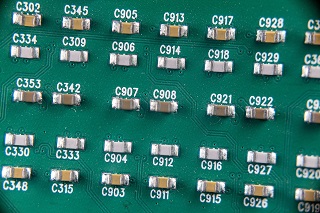 Image from Pixabay
To take advantage of this trend, Chinese manufacturers will persist in efforts to release more components in smaller packages. They are also pursuing a number of initiatives to expand their range of PCB solutions to HDI types while addressing signal, heat and interference issues associated with electronics miniaturization.
In the PCB assembly sector, upgrades to production and testing equipment continue in order to handle various SMD sizes at high speed and with accuracy. The current placement capability in China is from 0201 to 01005 chip packages.
Category buildup
Driven by the opportunity to level up against the competition, Chinese suppliers are allocating resources for R&D. They are looking to beef up capability for data collectors or sensors for IoT, servo motors for industrial robotics, MEMS microspeakers for mobile and wearable electronics, and mini-LED and micro-LEDs for future displays. There are also upstream projects to produce third-generation GaN and SiC semiconductor materials for mini-LEDs and micro-LEDs.
These initiatives, while limited to a few key domestic players, are expected to gather steam and lead others to follow suit in the coming years.
More Sourcing News
Read Also

关注 “环球资源外贸” 官方微信,获取实时外贸资讯
iOS & Android
iOS & Android(Mainland China)
Copyright © 2026 Publishers Representatives Limited. All rights reserved.




