Download App
Better Online and Trade Show Sourcing Experiences.Scan the QR code to download.
Learn More
Hot Topics
Qualcomm’s share in the LTE market is being eroded by competitors in China, Taiwan and elsewhere.
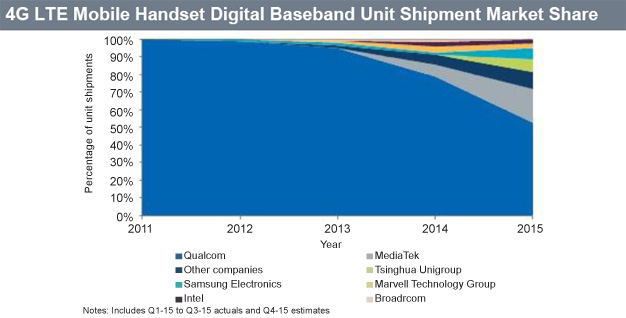
In a four-year span, Qualcomm went from having a monopoly on the LTE SoC market to
controlling closer to half of it (Image: IHS)
Now that smartphones have effectively become commoditized, growth has slowed. The market is expected to see a CAGR of 2.39 percent between 2014 and 2019. This is down from 7 percent growth in the previous five years. However, the commoditization is spurred by more affordable components. LTE radios are the latest component to face increasing diversification and falling prices, according to a report from IHS. China firms such as Spreadtrum and Tsinghua Unigroup have joined the fray with market staples Qualcomm, MediaTek and Samsung still going strong in the LTE market. Some of the smaller and medium-sized smartphone companies are also now moving away from larger producers, notably Qualcomm. HTC has recently made phones using SoCs from MediaTek, while Xiaomi has turned toward Leadcore, with whom it intends to design chips in the future. Huawei now designs and produces its own SoCs.
An increase in the number of players in the LTE space has led to declining prices as Qualcomm's market share erodes. LTE phones can be found for less than $100 from companies such as Microsoft, Samsung, LG and HTC, among others. IHS projects this segment will make up a third of the global smartphone market in 2016. Smartphone makers are also turning away from thin modems, preferred by the likes of Apple and Samsung, to integrated modem-application processors.
The writing is now on the wall for 3G phones. It does remain an important segment in developing markets, but LTE is getting cheaper by the day and the technology is meant to replace the combined 2G/3G solution that has been used for years to provide both voice and data.
LTE phones coming out of China are on the rise. Listings of 4G phones on GlobalSources.com increased nearly 3 percent between October and January, while posts for 3G phones declined about 8 percent in the same time frame. In the areas where 3G phones still dominate, the main hindrance now is probably infrastructure rather than cost of devices.
More Sourcing News
Read Also

关注 “环球资源外贸” 官方微信,获取实时外贸资讯
iOS & Android
iOS & Android(Mainland China)
Copyright © 2026 Publishers Representatives Limited. All rights reserved.