Download App
Better Online and Trade Show Sourcing Experiences.Scan the QR code to download.
Learn More
Hot Topics
MIT's new versatile robot can be used for various applications.
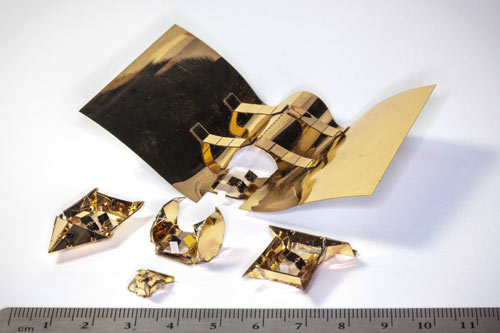
Primer’s task-optimized exoskeletons are sheets of plastic that self-fold into specific shapes when heated. Immersion in water dissolves the exoskeleton after Primer completes the job. Source: MIT CSAIL via EETimes
BOULDER CREEK, Calif. — MIT has invented a robot that swaps out water-soluble, recyclable exoskeletons to perform different tasks by walking, rolling on wheels, gliding, or floating. Daniela Rus, director of MIT’s Computer Science and Artificial Intelligence Laboratory (CSAIL), led the engineering team that developed the robot, dubbed Primer.
Although robots that can change their form or function have been created at larger sizes, building smaller-scale self-reconfiguring robots is difficult, partly because of the size and weight of onboard electronics. The cube-shaped Primer robot is controlled remotely via magnets. Its exoskeletons, or skins, are heat-activated, rectangular plastic sheets that self-fold into different shapes to customize the robot for various tasks. Immersion in water dissolves the exoskeleton after Primer completes the job.
This article was originally published in EETimes. To read the rest of the article, click here.
More Sourcing News
Read Also

关注 “环球资源外贸” 官方微信,获取实时外贸资讯
iOS & Android
iOS & Android(Mainland China)
Copyright © 2026 Publishers Representatives Limited. All rights reserved.




