Download App
Better Online and Trade Show Sourcing Experiences.Scan the QR code to download.
Learn More
Hot Topics
Singapore is using robots to make up for tightening immigration restrictions while US companies are preparing for a smaller workforce.
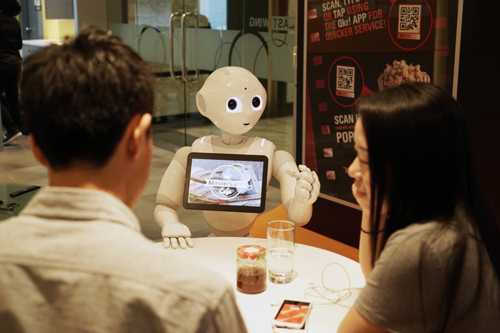
SoftBank's Pepper scored a nice PR boost by acting as a cashier at a Pizza Hut chain
Robot automation is slowly becoming part of many people's lives. This might be in a small way, such as using a digital assistant like Siri on a smartphone or talking to Alexa through the Amazon Echo. More full-featured robots continue to enter the home, especially ones that can perform household chores. Another big driver of robot innovation these days, however, is fear. Businesses are afraid of slowing productivity when workers are uninterested in certain jobs or simply do not exist.
The latter situation is one that is most pressing for Singapore these days. The Financial Times reported that restrictions on foreign workers in the small city-state has companies scrambling to automate jobs. Robots can already be seen in Singapore restaurants and hospitals, and are even getting government support. One trial involving robots from Unitech Mechatronics that sell for more than $37,000 is subsidized by the Singapore government, covering nearly 70 percent of the cost.
Robots in restaurants is nothing new in Asia. China has been tinkering with robot waiters for a few years now and recently SoftBank's Pepper got a nice public relations boost by appearing in Pizza Hut. KFC has also used robots in some locations.
In the US, companies that have to maintain warehouses are also preparing for a labor crunch. Warehouse work does not appeal to younger workers, so companies like Target are looking to automate more of what happens in these locations. The company recently signed a deal with the Boston-area company Symbotic LLC, which specializes in warehouse automation, according to the Wall Street Journal. Symbotic promises robots that can move products about a warehouse untethered to anything like rails, which many warehouse robots today use. They can also coordinate with other robots within the warehouse.
Other grocery chains and retailers are increasingly relying on robots as well. Symbotic has talked to Wal-Mart and Coca-Cola, and Amazon's use of such machines in its massive warehouses is well-known by now. Manufacturers such as Boeing also rely on automation. This is why China is so keen on getting ahead in this area by spending millions on industrial and service robots.
More Sourcing News
Read Also

关注 “环球资源外贸” 官方微信,获取实时外贸资讯
iOS & Android
iOS & Android(Mainland China)
Copyright © 2026 Publishers Representatives Limited. All rights reserved.




