Download App
Better Online and Trade Show Sourcing Experiences.Scan the QR code to download.
Learn More
Hot Topics
Embedded with optoelectronic semiconductors, the fabric MIT researchers developed is soft and washable.
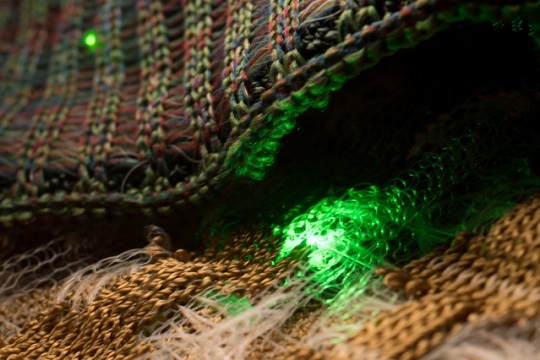
Image source: MIT
Researchers from Massachusetts Institute of Technology, in collaboration with industry group Advanced Functional Fabrics of America, has produced semiconductor-embedded fibers flexible enough to be woven into soft fabrics used in smart apparel. They believe this innovation can accelerate the development of wearable technology.
South Carolina-based technical textile manufacturer Inman Mills helped the group embed high-speed optoelectronic semiconductors in the fibers, which were then woven into soft washable fabrics. These textiles the researchers called "soft hardware that people can wear" have a variety of potential uses, including high-tech communication systems, lighting and physiological monitoring.
To test suitability for clothing, the scientists laundered the fabrics 10 times. Photo-sensing fibers were also placed in a fish tank full of water for week and still retained their functionality.
The researchers are confident they can bring the first semiconductor-embedded textiles to the commercial market as early as next year because of their partnership with the AFFOA, Inman Mills and several other industry players. They are set to introduce the smart fabrics in the fields of communication and safety.
The group is also exploring military applications, with cooperation with the US Department of Defense already in the works. In the biomedical field, the textiles can be utilized in wearable technologies that can help measure vital statistics and monitor healing such as pulse meters and smart bandages.
A recent study by US-based business intelligence firm Grand View Research predicted that increasing adoption in the sports, fitness, military and medical fields will propel the global smart textiles market to a $9.3 billion industry in 2024.
Annual smart clothing shipments, meanwhile, is expected to reach 31 million units by 2022 according to a separate study by ABI Research.
More Sourcing News
Read Also

关注 “环球资源外贸” 官方微信,获取实时外贸资讯
iOS & Android
iOS & Android(Mainland China)
Copyright © 2026 Publishers Representatives Limited. All rights reserved.




