Download App
Better Online and Trade Show Sourcing Experiences.Scan the QR code to download.
Learn More
Hot Topics
South China has turned to technological innovations faster than predicted just a few years ago.
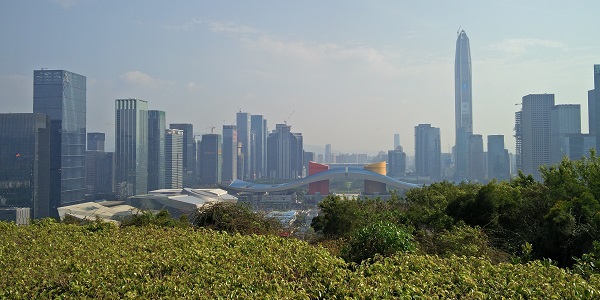
Shenzhen (Source: Matt Haldane/Global Sources)
Just after "The End of Copycat China" hit bookshelves in the fall of 2014, author Shaun Rein told a room full of buyers at the Global Sources Mobile Electronics show that China is currently in the business model innovation stage of its economic evolution. It will be another 10 to 15 years before China is the most inventive country in the world. Shenzhen, the country's southern hardware hub, seems intent on hastening that process. "Copycats are out, innovators are in," the Economist declared in a recent special report on China's Pearl River Delta region.
The PRD, and Shenzhen especially, might best be known in western countries for its Foxconn factories. Foxconn is the Taiwan company that manufactures smartphones for top brands like Apple and Samsung. The close proximity of manufacturing prowess in Shenzhen has recently led to the development of businesses that are innovative in their own right. The city has especially seen a race in the mobile electronics space among the likes of Huawei, ZTE and OnePlus. Shenzhen is also home to DJI, the world's largest consumer drone supplier, and BGI, the world's largest genome sequencing center.
The pace of innovation is so quick in Shenzhen that hardware entrepreneurs often can't afford to be anywhere else. Keeping to a tight schedule can be the difference between getting to market first or losing out to a China firm on price and availability. That's what happened with the Fidget Cube craze when people started sourcing similar products from China immediately after the original cube's Kickstarter campaign launched.
Shenzhen invites entrepreneurs from all over China and the world. It has less restrictions on who can move to the city than other parts of the country. Technology incubators around the city work to attract foreign talent. The best known incubator is HAX Accelerator. Getting into HAX is competitive, but companies that are accepted get access to mentorship and funding.
Startups aren't the only companies looking east, though. Multinational companies are opening up research and development centers in Shenzhen. Apple announced last year that it wouldopen an R&D facility in the city. It also has plans for new facilities in Beijing, Shanghai and Suzhou, amounting to an investment of over $500 million.
A joint venture between Foxconn and its subsidiary Sharp in Guangzhou involves a new $8.8 billion facility to develop and manufacture advanced LCDs. The facility is expected to be operational by 2019.
As Rein told that audience three years ago, China is an innovator now. Huawei, China's largest smartphone brand worldwide, spent nearly 15 percent of its 2016 revenue on R&D, which is large even by US standards. Huawei's $11 billion R&D investment even surpassed Apple's $10.4 billion. Apple's investment was less than 5 percent of its 2016 revenue, though.
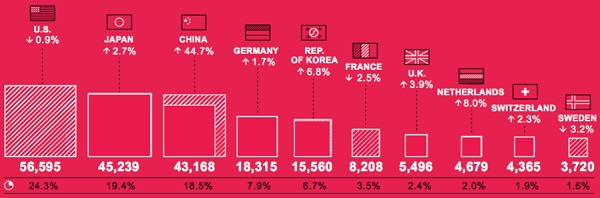
The number of international patent applications filed through the World Intellectual Property Organization. (Source: WIPO)
Other aspects that used to be weaknesses for innovation in China are now changing faster than some expected. China patents have been criticized in the past for not being high-quality. A common shorthand for determining the quality of a patent is checking whether it's filed internationally. By this metric, Shenzhen is a hotbed of innovation. Two Shenzhen firms alone, ZTE and Huawei, filed more international patents than the UK in 2016, according to the World Intellectual Property Organization. China as a whole has filed 43,168 patents, which was beaten only by Japan and the US.
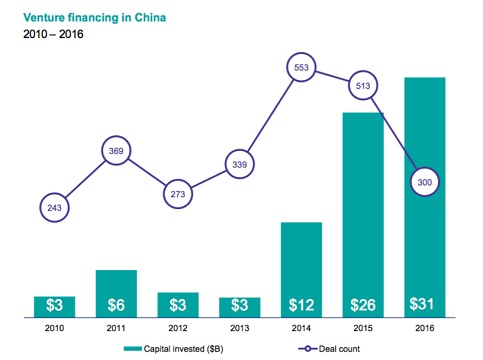
Venture capital in China increased 150 percent between 2014 and 2016. (Source: KPMG)
Venture capital is another area that was long considered a weakness in China, which Rein mentioned in 2014. Since that speech, however, VC has exploded in the country. It jumped from $12 billion in 2014 to $26 billion the next year and increased again to $31 billion in 2016, according to a KPMG Venture Pulse report. The number of investment rounds dropped during that period, though, from 553 to 300 rounds.
Much of Shenzhen's story over the last few years has centered on the fact that China is helping make decent quality devices at very affordable prices. High-quality smartphones, drones, headphones, speakers and so many other electronic products are cheaper than ever before largely because of China. What gets lost in this narrative, though, is that the process of reducing costs and differentiating products is starting to result in real innovation in China. This, along with the other rapid changes such as an increased R&D spending, more venture capital and foreign firms moving in, is helping drive evermore innovation in the country.
The bottom line is that if you're sourcing from China, you should no longer be thinking cheap. It's better now to think about what's new and what's unique. Or as Rein told the trade show audience, "It would be a real mistake for you to underestimate the level of innovation in China." Only by avoiding that trap can buyers can find a diamond in the Shenzhen rough.
More Sourcing News
Read Also

关注 “环球资源外贸” 官方微信,获取实时外贸资讯
iOS & Android
iOS & Android(Mainland China)
Copyright © 2026 Publishers Representatives Limited. All rights reserved.




