Download App
Better Online and Trade Show Sourcing Experiences.Scan the QR code to download.
Learn More
Hot Topics
As the core domains of automobile intelligence, two things have extended the role of cars from travel tools to “mobile third space” – the smart cockpit and automated driving. This is the subject of a recent report published by Beijing-based firm Minsheng Securities, a company that provides securities brokerage, securities underwriting and other services. In this article, we summarize some of the report’s key findings.
The traditional supply chain landscape will transform in future as the value driver of the automobile industry shifts from hardware to software. The supply chain will develop from its pre-existing linear structure to a flat, reticulated form centering on OEMs, whose role will change – from manufacturers to service providers, seeking out the high-profit opportunities at different points along the supply chain. The future competition of OEMs will focus on the intelligent performance of their smart cars and their ability to provide continuous service for customers.
Automobiles will gradually be transformed from primarily being mechanical vehicles into being seen as electronic products with mechanical functions, as their performance shifts from hardware-dominated to software-hardware co-dominant. According to McKinsey’s forecast, by 2030, the proportion of software and hardware in the global auto market will reach 30% and 41% respectively. The proportion of software has nearly tripled from 2016.
Smart cockpit: starting with the Internet, embracing the Metaverse
The smart cockpit’s evolution is marked by configuration upgrades and architecture integration, which will take place through innovation, iteration and subversion, and move toward the Metaverse concept.
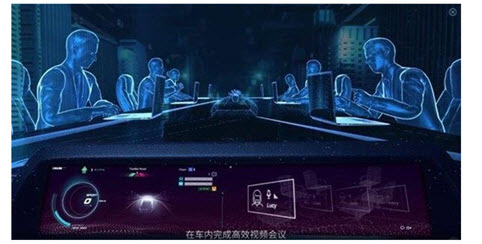
A Metaverse meeting from inside the car (image source: Minsheng Securities Research Institute)
Autonomous driving: the deconstruction of “perception-decision-execution” technologies
Autonomous driving equips the car with an “invisible driver” and makes it a “mobile third space” with the design of the smart cockpit. Autonomous driving technology can be sub-divided into three elements: perception, decision-making, and execution.
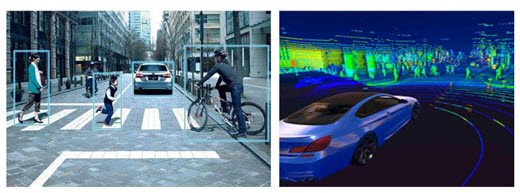 Camera image acquisition vs lidar
(image sources: Cheyun, Minsheng Securities Research Institute)
Camera image acquisition vs lidar
(image sources: Cheyun, Minsheng Securities Research Institute)In conclusion, this article provides just an overview of the ways in which industry insiders and experts expect the smart car – a potentially epoch-defining product of the Internet era – to develop in the coming years. Self-driving and smart cockpit features will be changing the fabric of the industry around the world, sooner rather than later. Whether you are on the cusp of stepping into the automotive industry, or already an auto-sector veteran, these are trends and developments that you can’t afford to ignore.
More Sourcing News
Read Also

关注 “环球资源外贸” 官方微信,获取实时外贸资讯
iOS & Android
iOS & Android(Mainland China)
Copyright © 2026 Publishers Representatives Limited. All rights reserved.




