




Table of Contents
What Does "In Transit" Mean in Shipping?
What Does “In Transit” Mean in USPS?
What Does in “In Transit” Mean in FedEx?
What Does “In Transit” Mean in Shein?
Troubleshooting and Next Steps if a Package is Stuck "In Transit"
Leveraging Global Sources for Efficient Logistics Management
FAQs: Deepening Shipping and Transit
Exploring the mysterious realm of "in transit" in shipping, this revelation guide comes in handy to both senders and receivers. The experience of the industry is taken from renowned logistics companies, such as FedEx, which helps to understand where difficulties arise in the transportation of packages and what does in transit mean in shipping. Let's start with comprehending the impact of shipping transit and then progress to applying solutions to resolve the issues.
What Does "In Transit" Mean in Shipping?
"In transit" is a term that signifies a package's journey from the sender to the recipient through complex logistics and transportation systems. When a package is marked as "in transit," it means that it is on its way, navigating through various checkpoints, sorting centers, and modes of transportation such as trucks, planes, ships, or trains. This status indicates that the package is moving through the logistics network but does not provide specific details about its exact location or the stage of its journey.
What Does “In Transit” Mean in USPS?
A "Transit" status line means that the package is being delivered within the USPS network.
USPS begins the shipping process, as soon as the package is handed over for delivery. This shipping process includes a clear workflow. This journey starts with the parcel acceptance, at which moment it is entered into the USPS (United States Postal Service) system and given a tracking ID number for tracking purposes. After that, the package goes through processing which includes sorting, labeling, and categorizing according to its destination and its choice of shipping method. After processing is done, the package goes through the phase "In Transit", which is the beginning of its travel over the USPS network. Successfully, the status of the parcel is revised to "Out for Delivery" when it is at the nearest post office, and consequently, the status changes to "Delivered" as soon as it is successfully delivered.
15 Common USPS Tracking Statuses
• Delivered: Package has been successfully delivered to the specified address.

• In Transit: Package is moving through the USPS network towards its destination.

• Arrived at USPS Facility: Package has reached a USPS processing center.
• Departed USPS Facility: Package has left a USPS processing center.
• Out for Delivery: Package is on a delivery vehicle for final delivery today.

• Available for Pickup: Package is at the local Post Office, ready for customer pickup.
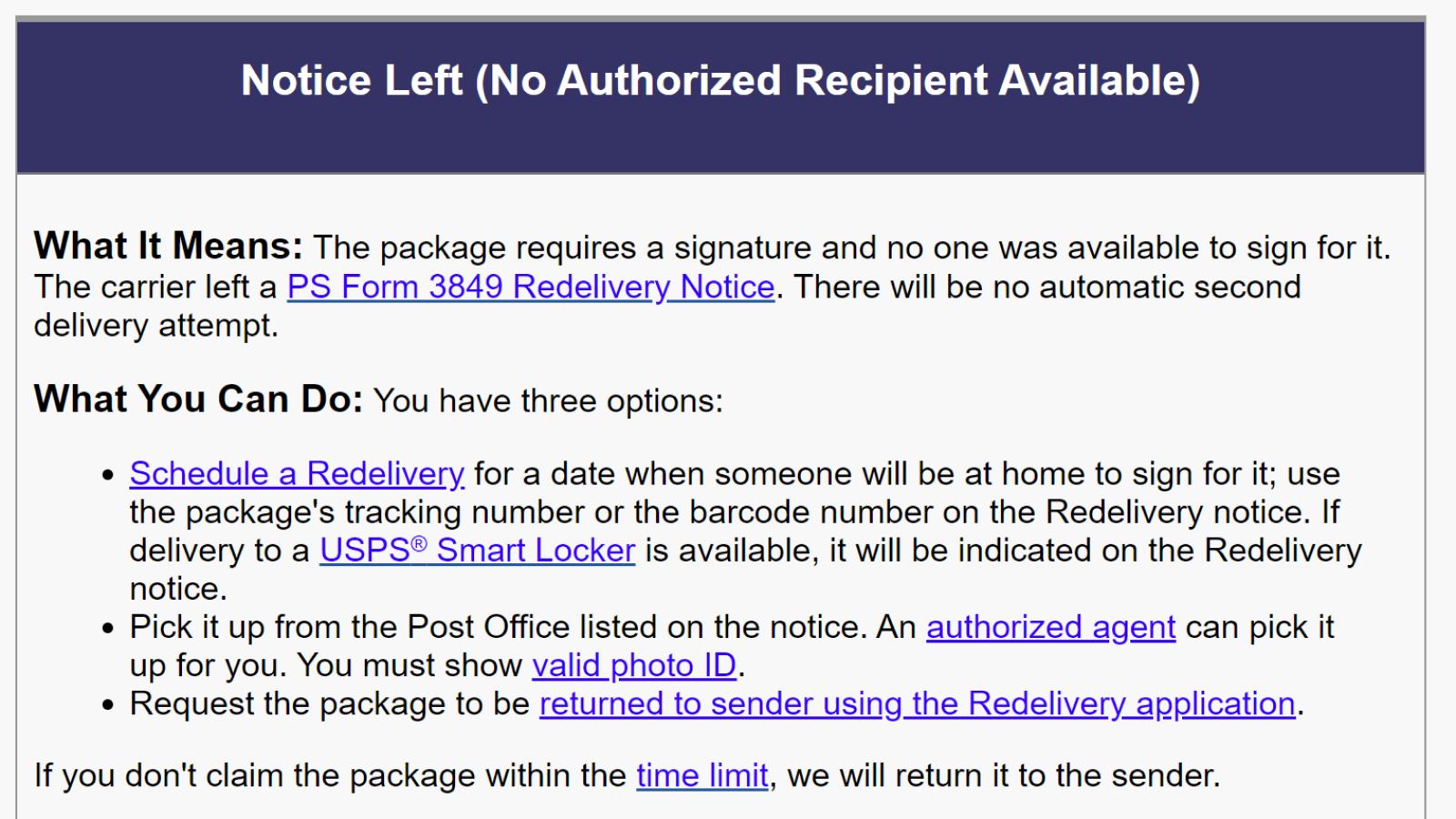
• Notice Left: Delivery was attempted, but no one was available to receive the package.
• Forwarded: Package is being sent to a different address due to a forwarding request.
• Insufficient Address: Package is being returned due to an incomplete or incorrect address.
• No Access to Delivery Location: Carrier couldn't reach the delivery point due to obstacles.

• Shipping Label Created: A label has been created, but USPS hasn't received the package yet.
• USPS in Possession of Item: USPS has received the package and started processing.
• Redelivery Scheduled: A new delivery attempt has been scheduled.
• Held at Post Office: Package is being held at the local Post Office per customer request.
• Shipment Received, Package Acceptance Pending: Package is in a bulk shipment awaiting processing.
These statuses cover the main stages of a package's journey through the USPS system, from initial shipping to final delivery, including potential issues or special circumstances.
What Does in “In Transit” Mean in FedEx?
“In transit” means your package is on its way to its final destination.
"In Transit" in FedEx tracking generally means:
- Package is actively moving: The package is on its way through the FedEx network, being transported between facilities or towards its final destination.
- Normal progress: The shipment is moving as expected without any current issues or delays.
- Between scan points: The package is traveling between FedEx facilities where it receives scans.
- Not necessarily in a vehicle: "In Transit" can mean the package is in a sorting facility, warehouse, or on a plane, not just in a delivery truck.
- No specific location details: The exact location isn't provided during this status.
- Automated updates: This status often updates automatically at set intervals, even if no new scans occur.
- Temporary status: It will change when the package reaches a new facility or moves to the next stage of delivery.
- No action required: Customers don't need to do anything; the package is progressing normally.
- Duration varies: The time a package spends "In Transit" depends on distance, shipping speed, and other factors.
- Common status: This is one of the most frequently seen statuses during a package's journey.
Remember, if a package stays "In Transit" for an unusually long time, it might be worth contacting FedEx for more information.
| Package status | Meaning |
|---|---|
| “Your package is in transit.” | “In transit” means your package is on its way to its final destination. It doesn’t necessarily mean your package is in a moving vehicle like an airplane or truck. It might be at one of our facilities. |
| “Your package is out for delivery.” | “Out for delivery” means your package was scanned by a package handler and placed on a pallet to be loaded on a vehicle for delivery. You can check the estimated delivery window online. |
| “There is no scheduled delivery date at this time.” | “No scheduled delivery date at this time” means we don’t have a delivery estimate, or we don’t have the package yet. You might see this status if your shipment is delayed or there’s a handling exception. (See below for exception examples.) |
| “Your scheduled delivery is now pending.” | “Scheduled delivery is now pending” means the delivery date has changed based on a delay of some kind. Know that we’re still doing everything we can to deliver your package as soon as possible. |
| “Delivery exception.” | “Delivery exception” means an unexpected event is preventing us from delivering your package. Some examples include customs delays, holiday closures, missing documentation, and security restrictions. |

What Does “In Transit” Mean in Shein?
When you see "In Transit" on your Shein order status, it generally means:
- Your package has left the Shein warehouse or distribution center.
- It is currently in the process of being transported to its destination.
- The package is moving through the shipping carrier's network, which may involve multiple stops or transfers between facilities.
- It has not yet reached its final destination or your local delivery center.
This status indicates that your order is actively on its way to you, but it hasn't reached the point where it's ready for final delivery. The "In Transit" phase can vary in duration depending on factors such as:
- Your location
- The shipping method you chose
- Any customs procedures (for international orders)
- Current shipping volumes and potential delays
During this time, you may or may not be able to track the package's specific location, depending on the shipping carrier and the level of tracking provided.
If your package remains "In Transit" for an unusually long time, it's best to contact Shein's customer service for more information about your order's status.
Troubleshooting and Next Steps if a Package is Stuck "In Transit"
When a package gets trapped in "In Transit", both parties involved might find it disturbing. A major cause of slowdowns is interruption of the shipment network that may result from rain or congestion, an increase in the shipment volume, especially during spectacular days such as holidays. Awareness of such frequent causes of delays will give knowledge of why a package might be stuck in transit.
If a package is completely stuck "In Transit" for an unusually long time giving no updates or movement on its location, then it is appropriate to touch base with the shipping carrier or the company. Generally, carriers offer a customer support service customers can pose questions and ask for other additional information about the status of their shipments. Sending the tracking number and some details that are relevant to the shipment may even speed up the problem resolution.
Monitoring Tracking Information
Another action to take place is to monitor the tracking information, especially for updates and changes. At times, the post may be held up for a while but later comes out as it continues to move through the network. Tracking information might allow us to gain information about the delivery status and to reveal any problems that should be fixed.
Verifying Address Information
Sometimes the package may be "In Transit" because the address or postal information is incorrect or incomplete. The carrier will not be able to deliver the package to its destination if there is a problem with the address and the package will remain in the process of shipment until the issue is cleared. To fix this issue, senders shall find out the exactness of the address provided and also make sure that all required information is included. Consignees can also notify carriers by themselves if the addresses are changed or updated.
Filing a Claim
If the shipment remains there "In Transit", and the matter has been addressed, then you may want to claim the carrier/shipping company. All providers have avenues to be contacted in case of lost or delayed consignments, and they might pay a sum or help in tracing the parcel. It is very vital to offer the necessary documentation and relevant details concerning the shipment when filing a complaint so that the claim can be handled in real time.
Addressing Customs Clearance Issues
Sometimes, a shipment could be stuck on "In Transit" also because of the customs processing, mostly in cross-border trade. Many reasons contribute to the delay in clearing customs. Some of the deactivating reasons include lack of or incomplete documentation, customs inspection, and import restrictions. Recipients might be required to give more resources or documents if the package fails to pass through customs, which would be a delaying factor. Close coordination with the carrier and customs authority may not only reduce the time necessary for customs clearance but also help to repair the package.
Finally, kicking some issues of the “In Transit” status necessitates patience, contacting the carrier or the shipping company ahead of time, and teamwork. As a sender or a receiver, knowing the reasons for delays and reaching out to the carrier, tracking listing, cross-checking the address details, contacting the supplier in case of claims, and tackling the customs clearance issues, a sender, as well as a receiver, can at least cope with the situation and ensure timely delivery of the shipments.
Leveraging Global Sources for Efficient Logistics Management
Integrating a variety of Global sources for a strategic approach to logistics management can be done by tapping into the international multichannel B2B marketplaces such as Global Sources (globalsources.com) to ensure hassles material transportation. World Sales being a global source serves as a complete website that unites buyers and suppliers all around the world under the platform of a very large variety of products of all the possible industries. The fact that Global Sources enables businesses access to a massive database of trustworthy vendors and enables such businesses to get the same products at competition-friendly prices and also streamline their supply and sales process is a great factor.
The use of Global Sources in logistics branching gives a perfect chance to use the wide range of suppliers and manufacturers from different areas of the world. This assists businesses to avail themselves of multiple sourcing choices, to contrast prices and standards as well as to select the most fitting suppliers accorded to their needs. On top of that, Global Sources features communication tools and training resources for the buyers and suppliers to help the parties communicate, negotiate, and collaborate effectively, introducing transparency and efficiency to the purchase system.
The Logistics Management Benefits of Global Sources come both with the flexibility to localize production and with the efficiency of vast scale. Through cutting off the middleman, businesses can go directly to factories or wholesalers and hence reduce the intermediary cost, pass this saving on to customers, and thus meet their price expectations. Furthermore, Global Sources provides tips and advice on worldwide trade rules, shipping assignments, and customs clearance requirements, thereby enabling commercial companies to tackle complicated logistics issues successfully and fulfill legal and regulated requirements.
Also, Global Sources gives an idea to companies on how to extend their supplier network and reduce the risk of supply chain failures. Through multi-sourcing - getting from the multiple suppliers from various regions, businesses will be able to reduce risks thanks to the fact that they can be protected from consequences such as geopolitical crises, natural disasters, or other unpredictable situations that may be the cause of production or supply disruptions. A business can benefit by having a strategic approach to supplier diversification because this enables its supply chain to be more resilient and flexible, for which it can respond to various changes in the market and an unbroken operation.
To summarize, gaining Global Sources for proficient logistics administration through platforms such as Global Sources provides extensive advantages to companies that want to enlarge their supply chain effectiveness. Through the power of being able to work with a multitude of suppliers, the simplification of procurement process, cost reduction, and risk mitigation; companies may therefore better compete, boost operational efficacy, and increase sustainable growth in the globally connected marketplace. Given the growing effects of globalization, the multinational enterprises and complex supply chain landscapes Samsung must utilize global sources in order to obtain success on the changing business surroundings.
FAQs: Deepening Shipping and Transit
Questions about transit times, delivery statuses, and international shipping frequently come to mind when something is shipped. Below, we attempt to answer the most commonly asked questions about these issues.
How long does a package stay in transit?
The duration of a package stays in transit depends on several factors such as the shipping method, distance between the source and destination, carrier efficiency, and any unforeseen issues like weather or transportation disruptions. Usually, local domestic parcels require from 1 up to 7 business days for transit, which can be reduced with the help of express delivery options. Transit times for international shipments could take a few days to weeks, based on clearance processes by the destination country's customs and shipping services selected.
Does "in transit" mean out for delivery?
"In transit" and "out for delivery" are two separate stages of the shipment process. When a package is marked "in transit", it means that the parcel is in action, and it moves through the shipping network--whether it is between two distribution centers, transportation hubs, or to a local delivery facility of the recipient. However, "out for delivery" is a notation that the package has arrived at its final destination such as at the post office or local carrier facility, and has been scheduled for delivery to the recipient's address. The phrase "in transit" refers to the shipment being inside the shipping network, while the phrase "out for delivery" means that the package is about to reach the end of its journey and the recipient.
How long does it take from "in transit" to delivered?
All these factors such as shipping method, the service of the carrier, and distance play a vital role in changing the length of time that something starts from "in transit" up to being delivered. Once the package changes its status from the state of "in transit" to "out for delivery", the package gets delivered to the recipient's specified address within a period of 1 or 2 working days for domestic packages. However, delivery times would depend on the racker's delivery schedule, things that can delay for example, and the shipper or receiver's special delivery instructions. For international shipments, the timespan of "in transit" to its delivery can indirectly increase because customs clearance procedures may take time and the additional distance needed for cross-border deliveries.
How long is SHEIN in transit?
SHEIN's transit times can vary significantly depending on several factors, including your location, the shipping method chosen, and any potential customs delays. Typically, SHEIN orders can be in transit anywhere from 7 to 20 business days. For standard shipping, it's common to see transit times of 10-15 days. However, if you've opted for express shipping, this could be reduced to 3-7 business days. It's important to note that these are general estimates, and actual transit times may differ. Factors such as holidays, weather conditions, or unforeseen logistical issues can impact shipping duration. SHEIN usually provides an estimated delivery date when you place your order, which takes into account the average transit time for your location. If your package has been in transit for longer than the estimated time, it's advisable to check the tracking information or contact SHEIN's customer service for more detailed information about your specific order.
Does "in transit" mean it will be delivered today?
The status "in transit" doesn't necessarily mean that your package will be delivered today. "In transit" is a general term used by shipping companies to indicate that a package is actively moving through their network towards its destination. This status can apply at various stages of the shipping process, from when the package leaves the origin facility to when it's on its way to the final delivery location. For a package to be delivered on the same day, it typically needs to have a more specific status like "Out for Delivery" or "On Vehicle for Delivery." If your package is showing as "in transit," it could still be several days away from final delivery, depending on the distance it needs to travel and the shipping method used. To get a more accurate estimate of delivery, check the estimated delivery date provided by the shipping company or look for more detailed tracking information that might indicate the package's current location.
Why is my SHEIN package still in transit?
There are several reasons why your SHEIN package might still be in transit:
- Distance: If you're far from the origin point, it naturally takes longer to reach you.
- Shipping method: Standard shipping takes longer than express options.
- Customs processing: International orders may be held for customs inspection.
- High volume: During peak seasons, shipping networks can be overwhelmed, causing delays.
- Weather conditions: Severe weather can slow down or halt transportation.
- Logistical issues: Problems with sorting facilities or transportation can cause delays.
- Incomplete address: If there's an issue with the delivery address, it may cause delays.
- Multiple stops: The package may be making several stops at different distribution centers.
- Tracking updates: Sometimes, tracking information isn't updated in real-time.
- COVID-19 impact: The pandemic has caused widespread shipping delays globally.
If your package has been in transit for an unusually long time, consider contacting SHEIN's customer service for more information. They may be able to provide additional details or investigate any potential issues with your shipment.
What does in transit mean with orders?
When an order is "in transit," it means that the package is actively moving through the shipping company's network towards its final destination. This status indicates that your order has left its origin point (such as a warehouse or distribution center) and is on its way to you. However, "in transit" is a broad term that can cover several stages of the shipping process:
- Transportation between facilities: The package may be moving between different sorting centers or distribution hubs.
- On a delivery vehicle: It could be on a truck, plane, or ship, depending on the shipping method.
- Customs processing: For international orders, "in transit" may include time spent in customs.
- Local delivery: The package might be en route from a local distribution center to your address.
It's important to note that "in transit" doesn't provide specific location details. The package could be in any of these stages. This status usually updates automatically at set intervals, even if no new scans have occurred. While "in transit" means your order is on the move, it doesn't necessarily indicate how close it is to final delivery. For more precise information, you'll need to check the estimated delivery date or wait for a more specific status update like "Out for Delivery."
How long does a package stay in transit?
The duration a package stays in transit can vary widely depending on several factors:
- Shipping method: Express services are faster than standard shipping.
- Distance: Longer distances naturally take more time.
- Domestic vs. International: International shipments typically take longer due to customs processing.
- Carrier: Different shipping companies have varying transit times.
- Origin and destination: Some routes are more direct than others.
- Time of year: Holiday seasons can cause delays due to high volume.
- Weather conditions: Severe weather can slow down transportation.
- Customs delays: International packages may be held for inspection.
For domestic shipments within the same country, transit times typically range from 1-5 business days for standard shipping. International shipments can take anywhere from 5-20 business days or more. Express or priority services can significantly reduce these times.
It's important to note that "in transit" is a general status that can apply throughout much of the shipping process. A package might show as "in transit" for most of its journey, with more specific statuses appearing only at key points like departure from origin, arrival at destination facility, and out for delivery.
If a package has been in transit for longer than expected, it's advisable to check with the shipping company for more detailed information.
What does in transit mean for delivery?
When a package is "in transit" for delivery, it means that the item is actively moving through the shipping company's network towards its final destination. This status indicates that your package has left its origin point and is on its way to you, but it doesn't necessarily mean it's close to final delivery. Here's what "in transit" typically implies:
- Active movement: The package is being transported, not sitting idle.
- Part of the journey: It could be at any point between the origin and destination.
- Normal progress: The shipment is moving as expected without current issues.
- Between scan points: The package is traveling between facilities where it receives scans.
- Not specific: It doesn't provide exact location details.
- Automated updates: This status often updates at set intervals, even without new scans.
- Temporary status: It will change when the package reaches a new stage of delivery.
- No action needed: Customers don't need to do anything at this point.
"In transit" is a broad term that can cover various stages of the shipping process, from long-distance transportation to local movement. For more precise delivery information, you'll need to wait for a status like "Out for Delivery" or check the estimated delivery date provided by the shipping company.
Does in transit mean it's coming soon?
While "in transit" indicates that your package is actively moving towards its destination, it doesn't necessarily mean that delivery is imminent. The term "coming soon" is relative and can mean different things depending on the context of the shipment. Here's what you should consider:
- Shipping method: Express services will arrive sooner than standard shipping.
- Distance: Packages traveling shorter distances may arrive quicker.
- Estimated delivery date: This is a more reliable indicator of when to expect your package.
- Current location: If available, check where the package was last scanned.
- Domestic vs. International: International shipments typically take longer.
- Customs processing: This can add significant time to international shipments.
- Local distribution: Once at a local facility, delivery is typically within a few days.
- Carrier practices: Some carriers use "in transit" throughout most of the shipping process.
"In transit" simply means the package is on its way, but it could still be days or even weeks from delivery, especially for international shipments. For a package to be truly "coming soon," you'd typically see a status like "Out for Delivery" or "Arrived at Local Facility." If you need a more precise estimate, it's best to refer to the estimated delivery date provided by the shipping company or contact their customer service for more detailed information.
How long does transit mean?
The duration of "transit" can vary significantly depending on several factors:
- Shipping method: Express services are faster than standard shipping.
- Distance: Longer distances naturally take more time.
- Domestic vs. International: International shipments typically take longer due to customs.
- Carrier: Different shipping companies have varying transit times.
- Origin and destination: Some routes are more direct than others.
- Time of year: Holiday seasons can cause delays due to high volume.
- Weather conditions: Severe weather can slow down transportation.
- Customs processing: Can add significant time to international shipments.
For domestic shipments, transit times typically range from 1-5 business days for standard shipping. International shipments can take anywhere from 5-20 business days or more. Express or priority services can significantly reduce these times.
It's important to note that "in transit" is a general status that can apply throughout much of the shipping process. A package might show as "in transit" for most of its journey, with more specific statuses appearing only at key points.
If a package has been in transit for longer than expected, it's advisable to check with the shipping company for more detailed information. Always refer to the estimated delivery date provided by the carrier for the most accurate timeframe.
How long does in transit take for USPS?
The duration of "in transit" for USPS packages can vary widely depending on several factors:
- Service type: Priority Mail Express (1-2 days), Priority Mail (1-3 days), First-Class Mail (1-5 days), USPS Retail Ground (2-8 days).
- Distance: Longer distances typically take more time.
- Destination type: Rural areas may take longer than urban centers.
- Time of year: Holiday seasons can cause delays due to high volume.
- Weather conditions: Severe weather can slow down transportation.
- Package size and weight: Larger or heavier items may take longer to process.
- Customs (for international): Can add significant time to the transit process.
Generally, domestic USPS packages remain "in transit" for 1-5 business days. However, this can extend to 7-10 days for some ground services or during peak seasons. International shipments can be in transit for 1-4 weeks or more, depending on the destination and customs processing.
It's important to note that "in transit" is a general status that can apply throughout much of the shipping process. For more accurate estimates, always refer to the specific service type you've chosen and the estimated delivery date provided by USPS. If a package has been in transit significantly longer than expected, contacting USPS customer service may provide more detailed information.
Will my package be delivered today if it says in transit?
If your package status shows "in transit," it doesn't necessarily mean it will be delivered today. Here's why:
- General status: "In transit" is a broad term indicating the package is moving through the shipping network.
- Multiple stages: It could be at any point between origin and destination.
- Not location-specific: It doesn't indicate proximity to final delivery.
- Automated updates: This status often updates at set intervals, even without new scans.
- Delivery day indicators: Look for statuses like "Out for Delivery" or "On Vehicle for Delivery" for same-day delivery.
- Estimated delivery date: This is a more reliable indicator of when to expect your package.
- Time of day: If it's late in the day and still "in transit," delivery is less likely today.
- Local facility arrival: Packages typically need to reach the local distribution center before delivery.
- Carrier schedules: Delivery times vary by carrier and service type.
- Unexpected delays: Weather, logistical issues, or high volume can affect delivery timing.
For the most accurate information, check the estimated delivery date provided by the shipping company. If that date is today and it's still early, delivery might be possible. However, without a more specific status update, it's best not to assume the package will arrive today based solely on an "in transit" status.
Is in transit the package is on its way?
Yes, when a package status shows "in transit," it generally means the package is on its way to its destination. Here's what "in transit" typically indicates:
- Active movement: The package is being transported, not sitting idle.
- Part of the journey: It's somewhere between the origin and destination.
- Normal progress: The shipment is moving as expected without current issues.
- In the shipping network: It's being processed through the carrier's system.
- Between scan points: The package is traveling between facilities where it receives scans.
- Not location-specific: It doesn't provide exact location details.
- Automated updates: This status often updates at set intervals, even without new scans.
- Various transportation methods: Could be on a truck, plane, or ship, depending on the route.
- Temporary status: It will change when the package reaches a new stage of delivery.
- No action needed: Customers don't need to do anything at this point.
While "in transit" does mean the package is on its way, it doesn't indicate how close it is to final delivery. The package could be in any stage of its journey, from just leaving the origin point to nearing the final destination. For more precise delivery information, you'll need to wait for a status like "Out for Delivery" or check the estimated delivery date provided by the shipping company.
The Bottom Line
In the end, a "in transit" indicates the process of a package being carried through the system while it is making its way from one place to another. Knowing this situation matters to both senders and recipients basing on it they should be able to set goals, follow the shipment's progress on its way and solve arising problems. A journey of a package in "in transit" condition involves logistics operations such as sorting, transportation, and delivery that has both, senders and recipients, as participants. USPS, FedEx, and Shein are a few of them, and they, respectively, may have diverse interpretations of what "in transit" means, but the main meaning remains the same. Utilizing world resources in, for example, Global Sources, helps carry out logistics management and simplify supply chain processes. Finally, plus answering the issues that are commonly FAQ regarding shipping timings, delivery position, and international shipping process, So creating a smoother shipping process for all people involved.

