A market ripe with opportunity with high expectations for growth this year and next.
- Story Highlights:
- Wearables were a US$1.4 billion market in 2013 according to Juniper Research, and is expected to be US$18-19 billion in 2018
- Still a nascent industry, with many opportunities for many players
- Price points run from US$10 to over US$1,500 depending on type and capabilities
Wearable electronics is currently one of the most dynamic mobile electronics sectors. Estimates of the market’s size range widely, though Juniper Research estimated that the global market was US$1.4 billion in 2013. The overall market nevertheless in its infancy, with annual CAGR estimates that range anywhere from 50 percent to 90 percent over the next 5 years. According to IDC and Juniper, the total market size will be around US$18-19 billion in 2018.
Key players and segmentation
At present, there are two fundamental types of wearable electronics – “smart” electronics like smart watches and glasses, and “basic” electronics such as fitness bands. Most smart wearables use the Android operating system or the Android Wear operating system, with the primary interface being the Google Now voice-command feature. Basic wearables typically do not have such an interface, and rely exclusively on a Bluetooth connection to a smartphone or tablet.
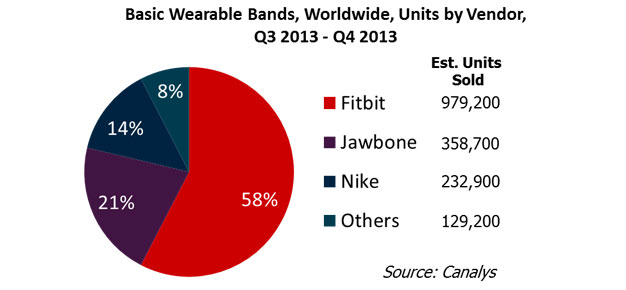
In 2013, basic fitness-focused wearables – notably Fitbit, Jawbone, and Nike’s Fuelband – dominated the market with price points in the US$100 range. Even more basic wearables, typically bands or jewelry that light up or vibrate when text messages come in on a connected device, can be less than US$20. Finally, Xiaomi has announced a potentially disruptive US$13 wearable band called the Mi Band that duplicates many of the functions of existing fitness bands.
At an estimated ASP of about US$180, this would mean that the smart band market would be around US$86 million for the quarter, or about US$345 million on an annualized basis. This relatively low number, however, does not account for the new push into smart watches by several participants during the course of 2014.
Sony led the development of smart watches with its Smart Watch line in 2012 and is on the verge of releasing its third iteration of the brand later this year or early next year. Late in 2013 Samsung entered the smart watch market with its Galaxy Gear line of Android-based smart watches, and has followed upwith a second generation (Galaxy Gear 2) of smart watches using the Android Wear and Samsung-made Tizen operating systems. LG has also entered the market with an Android Wear-based smart watch, the LG G, at a price point of US$230. Apple, Motorola, Asus, and others are expected to release smart watches in the near future. Samsung’s offerings are typically more versatile than the fitness-focused basic bands, but also come with a price tag starting at US$150 and go to about US$270 in the US.
Demand drivers
Many analysts have pointed to 2014 as the year that wearables will take off, though as yet the evidence is not in.
For all the press that Google Glass has gotten, it is clear that for the moment at least wrist-based wearables are the most popular and most common. Samsung alone is in its second generation of smart watches, and companies like Pebble, Fitbit and Jawbone have had significant success so far.
As for smart wearables, according to estimates released by Canalys, in Q1 2014, smart wearables accounted for less than 500,000 units shipped. Google’s offering has been offered only in limited quantities, and the overall sales have not been disclosed, though they are almost certainly below 50,000, and the product has not been released to the public.
At present, the vast majority of wearables either require or work best with a mobile computing device, typically a smartphone with Bluetooth connectivity. As this is a prerequisite, it is no surprise that in markets with high smartphone adoption rates – North America, Europe, South Korea and Japan – are also the markets with the highest short-term potential for wearables, and the largest current markets.
With the growing adoption of smartphones in developing markets, however, the potential for the wearables market to grow increases as well.
There are two features of particular interest that may help to drive the industry – battery life and fashion. While some smart watches tout “always-on” capabilities (notably the LG G and Pebble), both sacrifice something along the way to achieve it. LG claims its smart watch lasts around 36 hours, while Pebble’s battery lasts much longer, but sacrifices the color AMOLED display for a monochrome e-Ink display. Developing better battery life or new display technology may help adoption significantly.
Second, making the device more fashionable may be the final piece to the smart watch puzzle. Watches are typically fashion statements and pieces of prestige worn on a wrist. The maker that creates a smart watch with style may be able to sacrifice some functionality but still score a sales win.
Finally, Apple’s expected entry into the market may also drive the market as a whole. While competitors like Samsung have already made a significant push into the space, Apple’s famously loyal customer base may help to drive the category on its own, much as the release of the original iPhone drove smartphone adoption. Apple’s offering is expected to be released in either 4Q 2014 or (more likely) 1Q 2015.






