
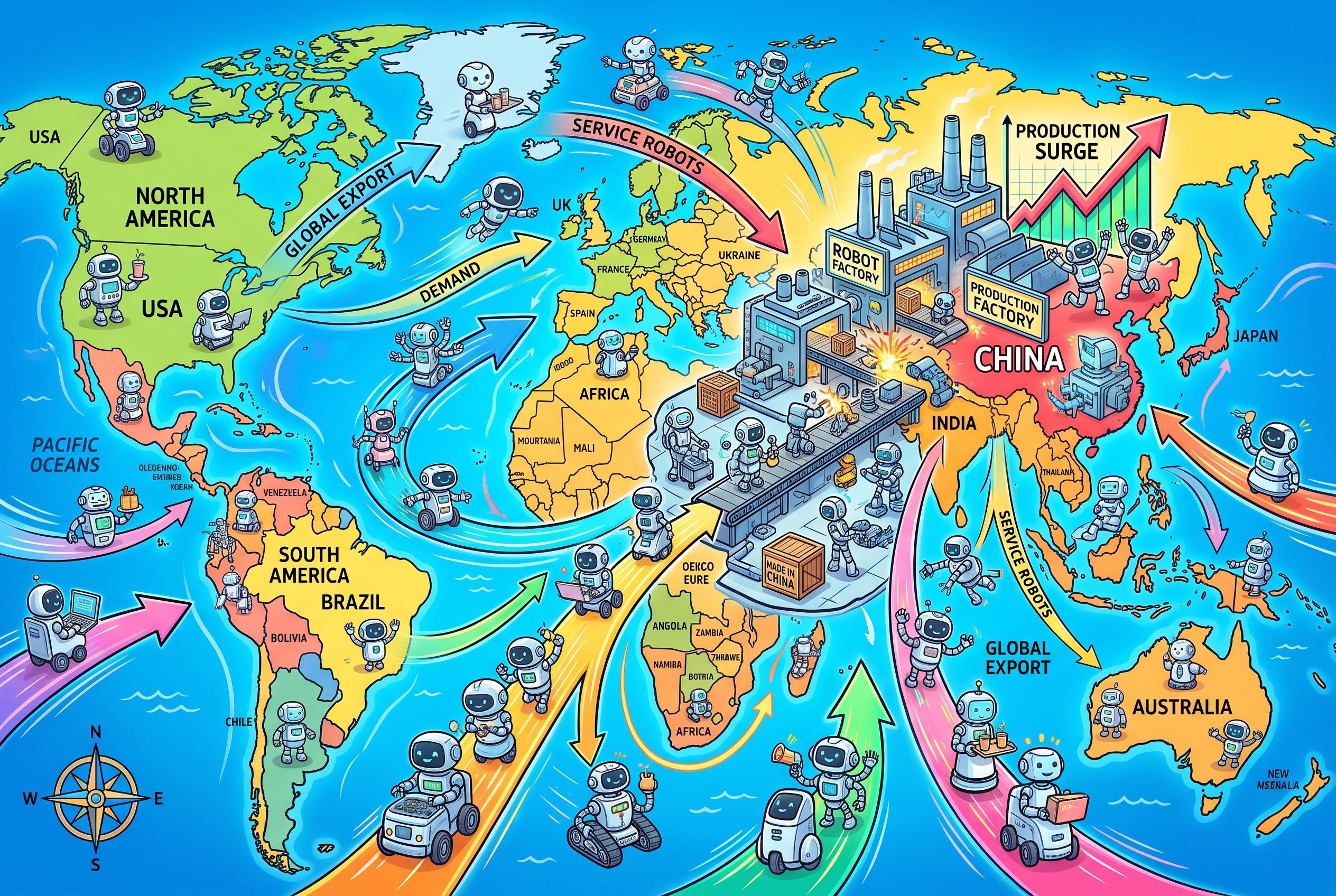
- Service robot production surged 170% in Beijing during the first nine months of 2026.
- Industrial robots, servers, electronics and semiconductor output also posted strong gains.
- Growth in digital services and exports contrasted with weaker retail sales of consumer goods.
Beijing’s service robot production surged during the first nine months of 2026, highlighting the city’s expanding role in advanced manufacturing and China’s broader shift toward a high-tech economy. Data released Wednesday by the Beijing Municipal Bureau of Statistics and the Beijing survey office of the National Bureau of Statistics showed service robot output rising 170% year over year, far ahead of most other industrial categories.
The figures also showed broad strength across Beijing’s manufacturing sector. Industrial robot output climbed 47.6%, servers increased 36.8%, and integrated circuits rose 20.5%. Overall industrial output among large enterprises grew 5.4% year over year at comparable prices, with growth picking up by 2 percentage points from the first half of the year.
Technology-intensive industries provided the biggest push. Official data showed that manufacturing of computers, communications equipment and other electronics expanded 40.9%. Within that group, integrated circuit production jumped 130%, while consumer electronics grew 12.5%. High-tech manufacturing and strategic emerging industries also recorded solid gains, rising 22.1% and 16.2%, respectively.
Beijing’s industrial export deliveries stayed positive too. Shipments by large industrial enterprises totaled 167.77 billion yuan, or roughly $24.85 billion, up 5.4% from a year earlier. Export deliveries from pharmaceutical companies and automakers increased 24.3% and 10.8%, respectively, suggesting demand held up in several upstream and finished-goods areas.
On the services side, value added increased 5.6% year over year at constant prices, supported by demand for computing power and storage. The information transmission, software and information technology services sector generated 998.11 billion yuan in value added, an increase of 8.4%. Integrated circuit design, information processing and storage services, along with internet data services, also grew quickly, reinforcing Beijing’s position as a major hub for digital infrastructure and data activity.
Consumer activity was less even. Total market consumption rose 2.3%, while services consumption increased 4.3%. Retail sales of consumer goods, however, declined 0.7% to 973.87 billion yuan, though the drop narrowed by 1.5 percentage points compared with the first half. For manufacturers, especially those supplying automation, electronics and cloud infrastructure, the results suggest Beijing remains an important production center and market as the city continues moving toward higher-value industrial output.
What the figures show about Beijing’s industrial direction
The strongest growth came from sectors connected with automation, electronics and digital infrastructure. Service robot output rose 170% year over year, while industrial robot production increased 47.6%. Together, these figures show that robotics is becoming an increasingly important part of Beijing’s manufacturing profile.
The expansion also extended across the electronics supply chain. Server output increased 36.8%, integrated circuit production rose 20.5% overall, and integrated circuit production within the computer, communications equipment and other electronics category jumped 130%. These gains point to expanding activity in hardware production, semiconductor-related manufacturing and the infrastructure supporting computing services.
The 40.9% growth recorded by computer, communications equipment and other electronics manufacturing was one of the clearest indicators of the city’s high-tech momentum. Consumer electronics grew 12.5%, showing that the sector’s performance included both infrastructure-related products and goods connected with consumer demand.
High-tech manufacturing increased 22.1%, while strategic emerging industries rose 16.2%. These results reinforce the wider pattern: Beijing’s industrial growth was not driven only by traditional production, but increasingly by sectors associated with advanced technology and higher-value output.
Robotics and automation gain prominence
The rise in service robot production was the most dramatic figure in the data. A 170% year-over-year increase places service robots well ahead of industrial robots, servers and integrated circuits in terms of growth rate during the period.
Industrial robot output also expanded substantially, rising 47.6%. The simultaneous growth of service and industrial robots suggests broad activity across automation-related production. For companies involved in sourcing components, electronics manufacturing and logistics equipment, the increase may be relevant because automation products depend on connected hardware, computing systems and integrated circuits.
The figures do not indicate that every part of the industrial economy expanded at the same pace. Instead, they show a concentration of momentum in technology-intensive areas. Robotics, servers, electronics and semiconductors all recorded significant gains, while overall industrial output among large enterprises rose 5.4%.
That difference between overall growth and sector-specific growth is important. It shows how technology-intensive industries contributed disproportionately to Beijing’s industrial performance. The city’s manufacturing expansion was therefore associated with a shift toward products and services linked to automation and digital systems.
Electronics and computing infrastructure support services
The services data further illustrate the importance of digital infrastructure. Value added in the services sector increased 5.6% year over year at constant prices. Within services, the information transmission, software and information technology services sector generated 998.11 billion yuan in value added, rising 8.4%.
Demand for computing power and storage supported this expansion. Integrated circuit design, information processing and storage services, and internet data services also grew quickly. These areas connect closely with the manufacturing gains reported in servers, integrated circuits and electronics.
The relationship between manufacturing and services is visible in the data. Hardware production supports computing and communications systems, while software, storage and data services create demand for that hardware. Beijing’s growth therefore involved both physical products and the services required to operate digital infrastructure.
This combination may also influence sourcing decisions. Manufacturers and technology companies seeking access to electronics, computing resources or data-related services may view the city as an important production and operating center. The available figures show growth in both industrial output and information technology services, rather than growth in only one side of the technology economy.
Export deliveries remain positive
Beijing’s industrial export deliveries totaled 167.77 billion yuan, or roughly $24.85 billion, during the first nine months of 2026. The figure represented a 5.4% increase from a year earlier.
Growth was recorded in pharmaceuticals and automobiles, with export deliveries increasing 24.3% and 10.8%, respectively. These gains indicate that demand remained firm in several upstream and finished-goods segments.
The export data add another dimension to the manufacturing figures. Beijing’s industrial growth was supported not only by domestic production and services activity, but also by shipments connected with international demand. Pharmaceutical products and automobiles were among the areas showing particularly strong export delivery growth.
For logistics and supply chain planning, continued positive export deliveries provide an indication that goods movement remained active across these industries. The data do not describe individual trade routes or shipping volumes, but they show that large industrial enterprises maintained growth in the value of export deliveries.
Consumer demand remains mixed
The consumption figures were more uneven than the industrial and technology data. Total market consumption rose 2.3%, and services consumption increased 4.3%. Retail sales of consumer goods declined 0.7% to 973.87 billion yuan.
The decline in retail sales narrowed by 1.5 percentage points compared with the first half of the year. This suggests that the consumer-goods market showed some improvement in direction, even though it remained below the level recorded a year earlier.
The contrast between services consumption and retail sales of consumer goods is notable. Services consumption increased faster than total market consumption, while retail sales of goods fell. This indicates that the recovery in consumer activity was not evenly distributed across products and services.
For electronics manufacturers and suppliers, the mixed consumer data may make market conditions more complex. Consumer electronics grew 12.5% as a manufacturing category, but overall retail sales of consumer goods declined. The figures therefore show stronger production in selected electronics areas without indicating uniformly strong retail demand across all consumer goods.
Implications for manufacturers and suppliers
For manufacturers, the results point to a growing role for advanced production, automation and digital infrastructure in Beijing’s industrial economy. Service robots, industrial robots, servers and integrated circuits all recorded growth, while high-tech manufacturing and strategic emerging industries expanded at double-digit rates.
For companies involved in sourcing, the data highlight several areas of activity: robotics, electronics, semiconductors, servers and information technology services. The figures also show that Beijing’s technology economy extends beyond factories. Computing power, storage, integrated circuit design and internet data services all contributed to services growth.
For logistics providers, positive industrial export deliveries and increased output in pharmaceuticals, automobiles and electronics indicate continued activity across multiple supply chains. For businesses focused on lifestyle and mobile technology, the growth of consumer electronics and digital services provides evidence of continued production and service activity, although retail demand was mixed.
The overall picture is one of structural change. Industrial output among large enterprises rose 5.4%, but technology-intensive categories grew much faster. This suggests that Beijing’s economic momentum increasingly depends on sectors with connections to advanced manufacturing, automation and digital infrastructure.
Q&A
What grew fastest in Beijing during the first nine months of 2026?
Service robot output grew fastest, rising 170% year over year.
Which other manufacturing categories recorded strong growth?
Industrial robots increased 47.6%, servers rose 36.8%, and integrated circuits increased 20.5%.
How did electronics manufacturing perform?
Manufacturing of computers, communications equipment and other electronics expanded 40.9%. Integrated circuit production within that group jumped 130%, while consumer electronics grew 12.5%.
Did Beijing’s exports increase?
Yes. Industrial export deliveries totaled 167.77 billion yuan, up 5.4% from a year earlier.
How did services perform?
Services value added increased 5.6%. The information transmission, software and information technology services sector rose 8.4%.
Was consumer demand equally strong across categories?
No. Total market consumption rose 2.3% and services consumption increased 4.3%, but retail sales of consumer goods declined 0.7%.
Disclaimer: This article may have been created with AI assistance and reviewed by our editorial team. It is provided for general informational purposes only. Readers should verify information independently before relying on this content.
Source Reference Map
Inspired by headline at: [1]
Sources by paragraph: - Paragraph 1: [1] - Paragraph 2: [1] - Paragraph 3: [1] - Paragraph 4: [1] - Paragraph 5: [1] - Paragraph 6: [1]
