
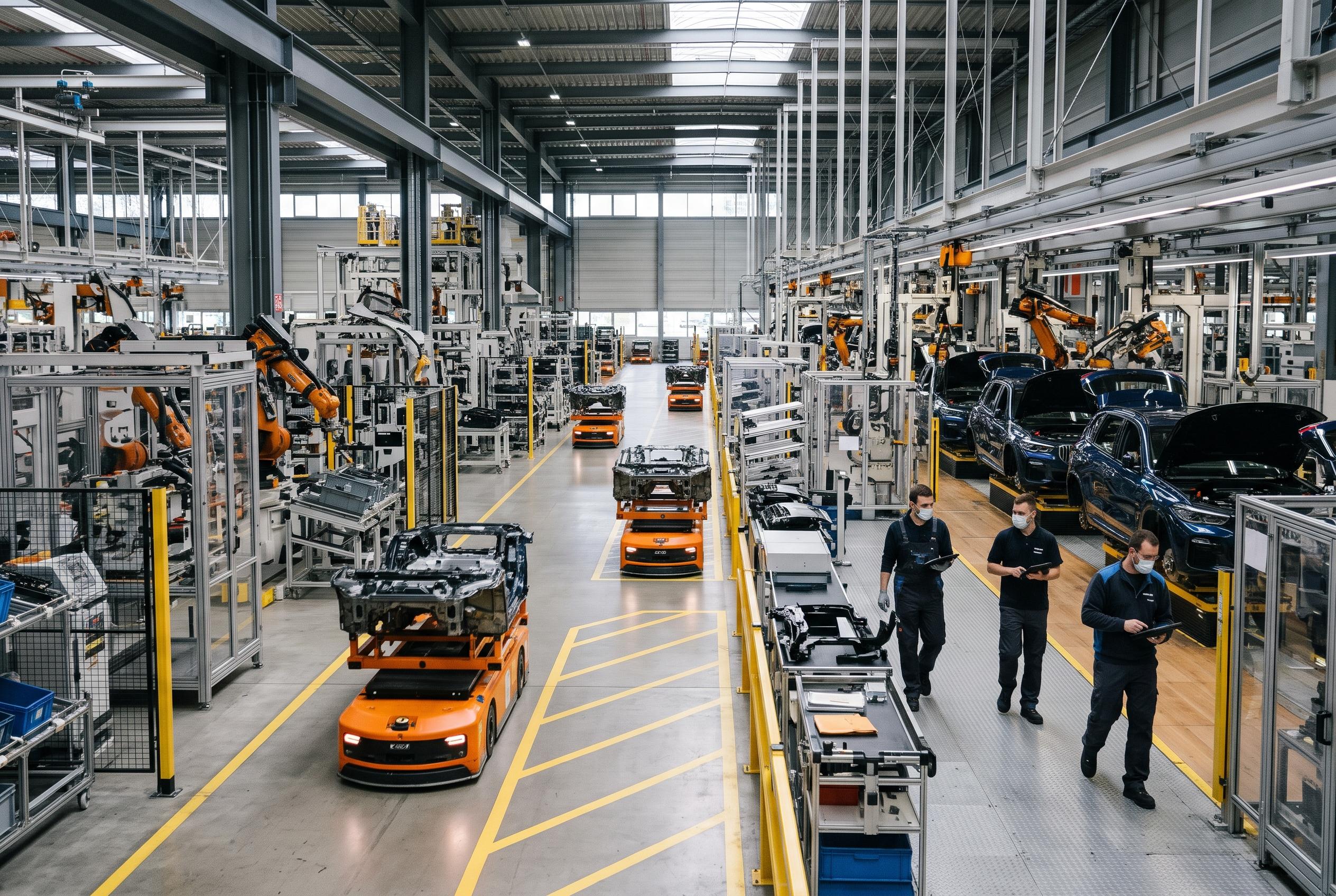
BMW Group has hit one million driverless vehicle movements inside its factories, a milestone that shows how automated driving is moving beyond public roads and into everyday manufacturing. The system now operates across four sites, including MINI Plant Oxford, helping newly built cars travel between production and logistics areas with less human intervention.
BMW’s driverless factory cars are quietly changing production
A freshly built car usually looks ready for the road, but inside a factory it still has plenty of travelling to do. BMW’s Automated Driving In-Plant system handles some of those journeys without a driver, guiding vehicles through defined production and logistics routes while sensors watch for people, machinery, and unexpected obstacles.
According to BMW Group, the network has now completed one million automated movements. That figure is less flashy than a driverless taxi demonstration, perhaps, but it represents something more practical: autonomous vehicle technology working repeatedly in a controlled environment, day and night.
The system currently performs around 3,500 movements per day across participating facilities, according to company information reported by Motor1. MINI Plant Oxford alone recorded more than 53,000 transfers over the past year, giving the technology a particularly visible role at the British site.
Why factories are an ideal proving ground for autonomy
Public roads are messy by nature. Factory routes are more predictable, with mapped lanes, fixed operating areas, and known destinations. That makes them a sensible place to test and scale automated driving, especially when the job involves moving completed vehicles between clearly defined stages.
BMW’s system uses LiDAR sensors installed around the plant rather than relying on hardware fitted to every vehicle. The sensors create a live picture of the route, while cloud-based software and motion-planning tools decide how each car should move.
That approach also gives the system flexibility. Different models, vehicle sizes, and production equipment can use the same infrastructure, rather than requiring a separate autonomous-driving package for every car. It’s a tidy solution, and your average factory planner would probably prefer tidy over theatrical.
Oxford links vehicle movements with factory equipment
MINI Plant Oxford has taken the system a step further by connecting automated vehicle movements with existing factory control systems. The setup allows cars to be positioned alongside lifting equipment used for specific manufacturing operations.
BMW says a cloud-based solution coordinates the vehicles and equipment, which matters because timing is everything on a production line. A car that arrives too early, too late, or slightly out of position can disrupt a much larger sequence of tasks.
The Oxford plant is the fourth BMW Group site to adopt the system, following facilities in Dingolfing, Leipzig, and Regensburg. BMW has also described the Dingolfing installation as Europe’s largest LiDAR infrastructure for this type of factory application, according to StreetInsider.
What the LiDAR system actually watches
The automated system isn’t simply following a digital line on the floor. It monitors people, conventional vehicles, driverless transport equipment, logistics traffic, and temporary obstructions along its routes.
BMW says the technology is CE-certified for its production environment and can be adapted to different factory layouts and manufacturing processes. Embotech, the Swiss technology company working with BMW, contributes software for perception, prediction, and planning, alongside a separately certified safety architecture developed with TÜV SÜD.
According to Embotech, system availability across the four facilities exceeds 99.5 percent. That kind of reliability is crucial in manufacturing, where an automated feature needs to be dependable rather than merely impressive during a demonstration.
Spartanburg is next, with more sites likely to follow
BMW has tested the technology at Dingolfing since 2022 and is now preparing to introduce it at Plant Spartanburg in the United States. Series operation there is scheduled to begin in 2027, extending the system to one of BMW’s most important global production locations.
The company’s partnership with Embotech has also deepened. BMW i Ventures acquired a financial interest in the Swiss firm in December 2024, while the two companies have continued developing tools for deployment, monitoring, diagnosis, and recovery.
Embotech says BMW completed the first 500,000 automated movements in 15 months, then reached the next 500,000 in just seven months, as reported by Drivers Section. That acceleration suggests the project is shifting from a carefully watched pilot into repeatable industrial infrastructure.
The bigger story isn’t that cars can move without someone behind the wheel. It’s that factories are finding useful, unglamorous jobs where autonomy can save time, improve consistency, and reduce repetitive work. For BMW, the next million may arrive much faster.
Disclaimer: This article may have been created with AI assistance and reviewed by our editorial team. It is provided for general informational purposes only. Readers should verify information independently before relying on this content.
