
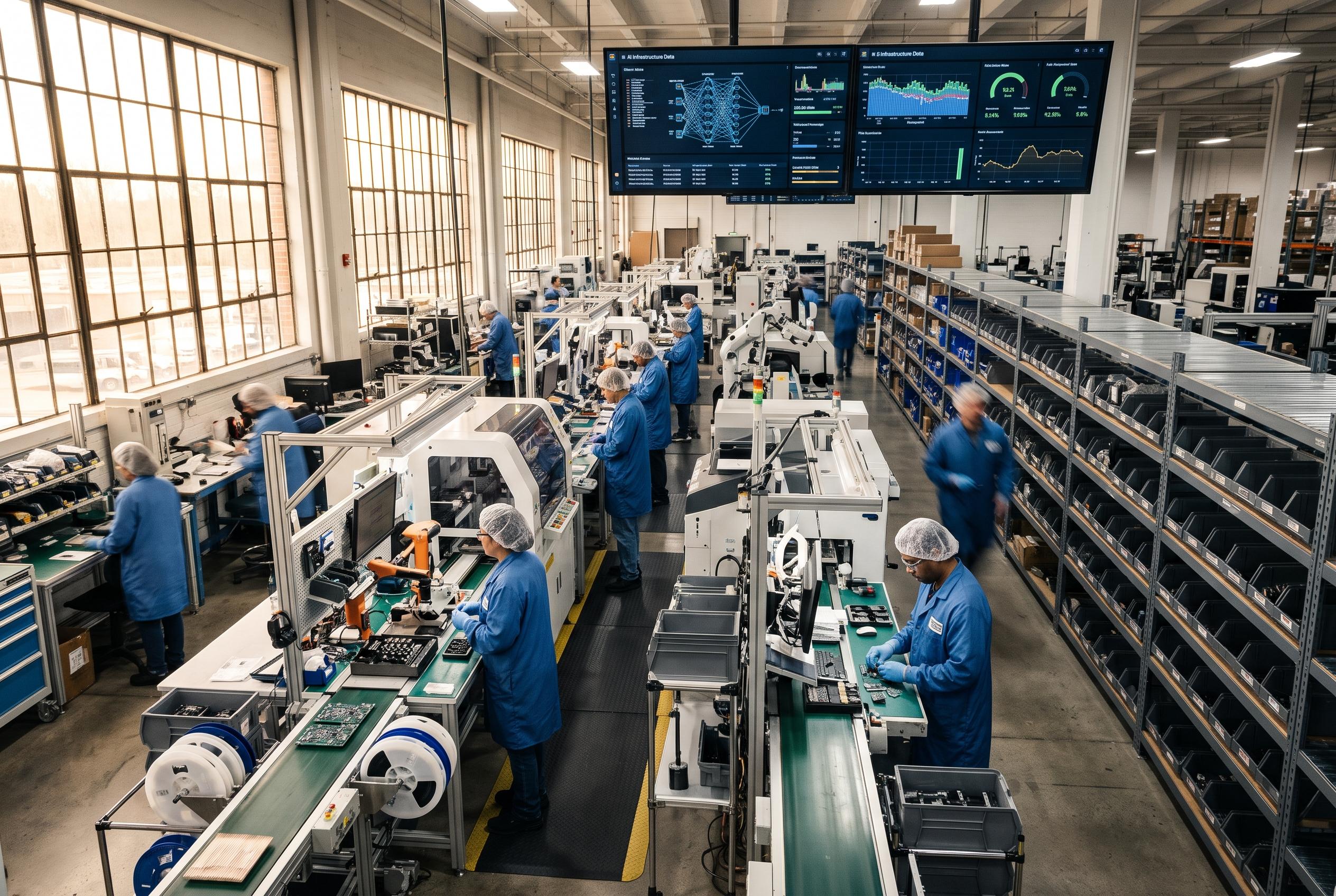
Manufacturers and buyers are feeling the squeeze as AI data centers absorb more interconnects, passive components, and electromechanical hardware. Strong orders, lean inventories, and shifting factory capacity are creating longer lead times across the market, while raw-material costs could push prices higher through 2027.
AI orders are arriving faster than components
The clearest signal from the latest IP&E market outlook is that demand isn't merely strong on paper. Orders are increasingly turning into real sell-through, leaving distributors with less breathing room and customers with fewer easy substitutions. Industry figures cited by S&P Global Market Intelligence also point to supply-side constraints behind the AI electronics boom, rather than demand alone.
Book-to-bill ratios across interconnect, passive, and electromechanical components are running above one, meaning orders continue to outpace shipments. AI and data centers are leading the charge, with military, aerospace, and industrial applications adding further support. Automotive demand is steadier, but it isn't driving the same kind of urgency.
That imbalance could make the fourth quarter of 2026 and the opening months of 2027 particularly busy. For buyers, the uncomfortable twist is that a component doesn't need to be an obvious AI part to become harder to find.
Factory capacity is moving where the money is
Suppliers are reportedly shifting manufacturing capacity away from some automotive and industrial work and toward AI and data-center programmes. That's a commercial decision, but it can create surprisingly wide ripples across the supply chain.
Accurist Technologies has similarly warned that data-center expansion is increasing pressure on electronic component availability, especially as systems demand more power delivery, cooling, and high-speed connectivity. In other words, the bottleneck may sit several steps away from the finished AI server.
This matters for passive-component buyers because the pressure isn't evenly distributed. Capacitors, resistors, and inductors won't all face identical shortages, and the available evidence doesn't provide a universal forecast for every technology. Still, lean stock and precautionary purchasing can make the broader market feel tight very quickly.
Why copper remains central to AI racks
Optical networking gets much of the attention, but copper hasn't quietly left the building. Complex AI systems still need backplanes, flyover cables, and intra-rack links, particularly where short-distance connections favour familiar electrical designs.
The market outlook estimates roughly $73,570 in data and signal connector and cable content for an Nvidia VR200 NVL72 system, compared with about $66,610 for a GB200 or GB300 NVL72 system. It also suggests that denser backplane designs could lift VR300 content by 60 to 70 percent compared with VR200. Those are architecture-based estimates, not supplier quotes, but they show why connectivity remains such a valuable part of the rack.
Meanwhile, the transition to higher-speed optical and electrical links is proving uneven. TechRadar has highlighted the wider infrastructure challenges around AI inference, including the difficulty of adapting existing systems to rapidly changing workloads. For component makers, that uncertainty can encourage customers to extend proven copper designs before committing to a new architecture.
Pricing pressure is building for 2027
Higher demand would be enough to keep suppliers busy, but raw-material inflation and transport costs are adding another layer. Channel feedback points to further supplier increases in early 2027, although the size and timing of those moves will vary by product and customer.
The outlook specifically raises the possibility of another double-digit channel increase from TE Connectivity. That remains a market expectation rather than a confirmed, universal price schedule, so buyers shouldn't treat it as a guaranteed number. Automotive pricing appears less aggressive, with low-single-digit increases expected in a market already dealing with financial pressure among vehicle manufacturers and Tier 1 suppliers.
That difference is worth watching. Component demand can be healthy even when customers are pushing back hard on price, which means negotiations may become more complicated rather than simply more expensive.
What buyers should do before lead times stretch further
A little planning could matter more than a last-minute hunt for stock. Buyers should review the full bill of materials, identify parts with limited second sources, and ask distributors about actual sell-through rather than relying only on catalogue availability.
Precautionary inventory can help, but it isn't free insurance. Holding too much stock ties up cash and risks obsolescence, particularly in fast-moving AI hardware. A better approach is to rank components by substitution difficulty, qualification time, and the damage a delay would cause to production.
Power infrastructure, thermal management, and interconnects deserve particular attention. TrendForce has pointed to the expanding hardware demands created by AI data centers, while broader industry reporting continues to flag power and connectivity as constraints on deployment. The most prepared buyers won't necessarily buy everything early; they'll know which parts can't be replaced easily when the market turns tight.
AI infrastructure still has plenty of momentum, but the next phase won't be frictionless. As one industry analysis puts it, growth is increasingly limited by the physical systems needed to support it, not just by demand for computing. For manufacturers and procurement teams, that makes availability, architecture choices, and pricing discipline just as important as the headline AI opportunity.
It's a constructive market, but buyers should expect less slack and more careful planning through 2027.
Disclaimer: This article may have been created with AI assistance and reviewed by our editorial team. It is provided for general informational purposes only. Readers should verify information independently before relying on this content.
