
Korean chip designer BOS Semiconductors is working with LG Electronics and Hana Micron on chiplet-based automotive semiconductors, a partnership designed to support vehicle AI, autonomous driving and more flexible chip development. The collaboration covers design, packaging, testing and commercialisation, giving the emerging technology a practical route from lab bench to road.
Vehicle AI needs more than one powerful chip
The partnership comes as vehicles take on increasingly demanding computing jobs, from processing camera feeds to managing driver-assistance features. A conventional single system-on-chip can handle a lot, but developing one large processor for every vehicle programme can be expensive, slow and unnecessarily rigid.
Chiplets offer a more modular alternative. Instead of putting every function onto one oversized piece of silicon, manufacturers can build separate chiplets and connect them through a high-speed interconnect. Think of it as a carefully engineered team rather than one chip trying to do every job.
That modular approach could help automakers tailor computing platforms to different models and levels of automation. It also creates a slightly less glamorous but crucial benefit: a design developed for one programme may be adapted for another, rather than starting from scratch each time.
BOS brings the AI processing muscle
BOS Semiconductors will develop and supply neural processing unit chiplets aimed at autonomous driving and vehicle-based AI. The company will also work on checking whether chiplets communicate properly, optimising their operation and supporting future commercial applications.
Its broader roadmap includes the Eagle-A system-on-chip for vehicle control and processing, alongside the Eagle-N accelerator for high-performance AI workloads. The company is building a chiplet-based computing platform around those technologies, according to industry coverage of its automotive semiconductor programme.
That division of labour is important. AI processing inside a car has to be fast, but it also needs predictable behaviour, low power consumption and dependable operation in a demanding environment. A chip that looks impressive in a demonstration still has a long road ahead before it can support real-world driving functions.
LG Electronics supplies the vehicle control foundation
LG Electronics will contribute a foundational chiplet responsible for key automotive control functions. That gives the project a bridge between specialised AI acceleration and the broader electronic architecture found inside modern vehicles.
As LG explains in its mobility technology coverage, semiconductors increasingly help vehicles see, hear and think by processing information from sensors and coordinating intelligent features. The challenge is making those functions work together smoothly, without creating a tangle of separate systems.
A modular chiplet platform could make that integration easier to manage. It may also give vehicle manufacturers more room to adjust computing performance by model, rather than relying on one fixed architecture for every car.
Hana Micron tackles the packaging challenge
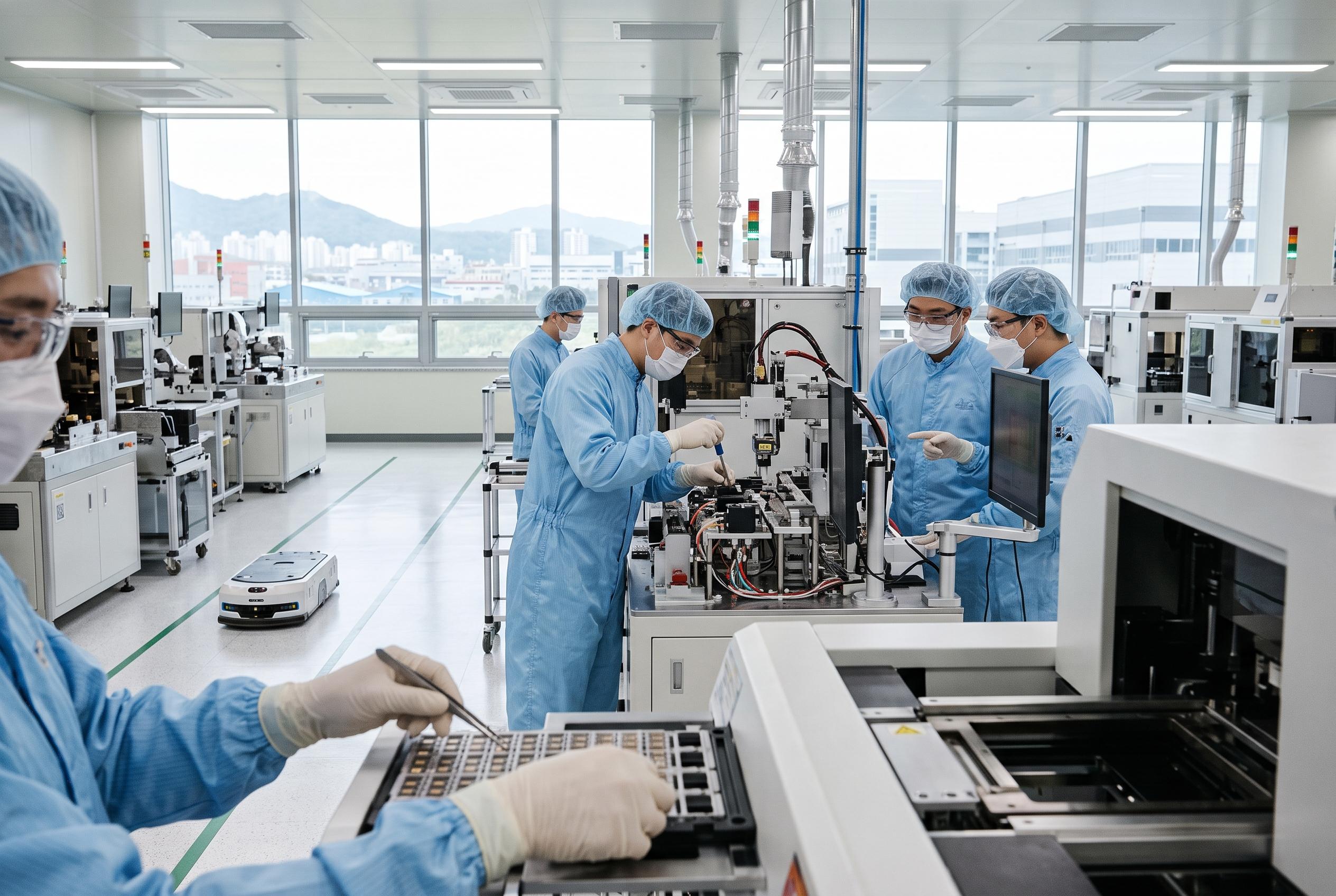
Hana Micron will develop the multi-chiplet packaging solution, combining several chiplets into a single package and supporting performance testing and technical verification. This may sound like back-end engineering, but it is one of the places where the entire concept succeeds or fails.
Connecting separate chips requires more than simply placing them side by side. The package must support high-speed communication, manage heat and power, and maintain reliability over years of vibration, temperature changes and daily use. In a vehicle, there is little patience for a clever design that becomes fragile outside the lab.
That is why the partnership covers the full development cycle, including integration, packaging, testing, validation and commercialisation. The arrangement is intended to build a domestic supply chain rather than leave each stage to disconnected specialists.
Open standards could make chiplets more useful
BOS is participating in the Universal Chiplet Interconnect Express ecosystem, known as UCIe. The open standard is designed to let chiplets from different sources communicate through a common high-speed connection, which could help prevent automotive platforms from becoming locked to one supplier.
The company is also involved with the Open Chiplet Atlas ecosystem, which focuses on chiplet interoperability. Those efforts address one of the technology's biggest practical questions: can components from different designers work together reliably enough for commercial systems?
For automakers and suppliers, that flexibility could eventually mean more choice, faster upgrades and easier reuse. It won't remove the hard work of certification and validation, but it could make future vehicle computers less monolithic and more adaptable.
The road to production will still be demanding
The collaboration is part of South Korea's wider Manufacturing AI Transformation Alliance initiative, known as the M.AX Alliance. Its goal is to encourage cooperation around industrial AI, with this project applying that idea to next-generation automotive semiconductors.
The immediate appeal is clear: vehicles need more computing power, while chip designers need more efficient ways to deliver it. Chiplets offer a promising middle ground, combining specialised functions without forcing every capability into one enormous processor.
Still, the most important milestone won't be the announcement. It will be whether the partners can prove interoperability, thermal performance, reliability and cost effectiveness at automotive standards. If they can, chiplet-based vehicle computers may shift from an intriguing architecture to a practical foundation for the next generation of connected cars.
It's a small-package idea with potentially big consequences for vehicle intelligence.
Disclaimer: This article may have been created with AI assistance and reviewed by our editorial team. It is provided for general informational purposes only. Readers should verify information independently before relying on this content.
