
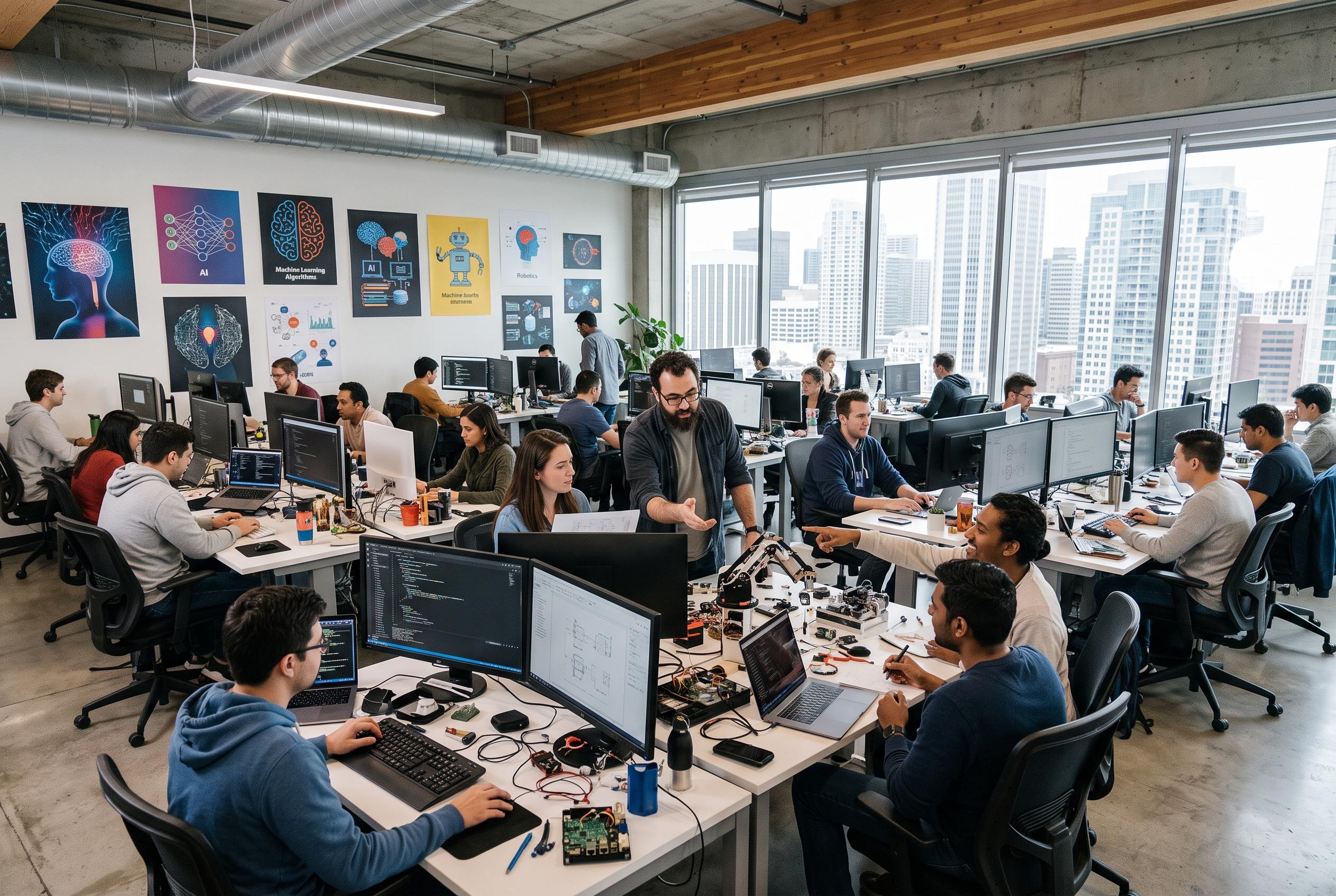
Elorian has launched Glimpse, a visual reasoning model designed to inspect images, revisit details, and analyze video at a lower cost than larger rivals. The research preview is already attracting attention from developers and robotics companies, but its bigger test will be whether impressive benchmark results translate into dependable performance in messy, real-world settings.
Glimpse wants AI to look twice
The most interesting thing about Glimpse isn't simply that it can recognize an image. It's that Elorian says the model can return to the picture, zoom in, inspect a video frame, and use code before settling on an answer.
That approach gives the system something resembling a visual workbench. Instead of translating an image into text and reasoning mostly from that description, Glimpse can keep checking the evidence. According to TechCrunch, Elorian describes this capability as a "visual scratch space."
It's a useful distinction. A person assembling flat-pack furniture can follow a diagram without reading a paragraph of instructions, while an AI system may still stumble over symbols, orientation, or small visual differences. Elorian chief executive Andrew Dai used a board-game example to explain the gap, telling TechCrunch that a model struggled to identify the winner because it couldn't interpret the game's symbols.
The model is cheap, but the claims need testing
Elorian is positioning Glimpse as a budget-friendly option for developers. The company lists pricing at $0.60 per million input tokens and $3 per million output tokens, a structure that could make frequent image and video analysis more affordable for startups and research teams.
The company has also reported that Glimpse performs ahead of GPT-6 Astra on selected tests, including CharXiv-R, short video captioning, open-vocabulary counting, and manipulation-event understanding. The reported CharXiv-R scores are 92.90 for Glimpse and 92.10 for Astra, while both systems delivered the same result on an embodied spatial-reasoning test. Elorian's own launch material presents the model as a compact alternative to much larger systems.
But this isn't a clean sweep. Glimpse reportedly falls behind Astra on dense video captioning, detailed temporal reasoning, and product-image counting. Its score on Elorian's HSS scene-understanding benchmark was 46.36, compared with Astra's 53.6 and a human baseline of 93.1%. The comparison has not yet been independently verified, so buyers should treat the figures as an early signal rather than a final verdict.
Why visual reasoning still breaks in the real world
A polished benchmark image is a long way from a factory floor, warehouse aisle, or busy workshop. Real scenes contain reflections, shadows, blocked views, unusual angles, and sensors that don't always behave nicely.
Research from Berkeley, Princeton, and Google DeepMind found that its strongest model answered 56.5% of 474 robot-focused questions correctly in the RoboVista evaluation. Another inspection dataset, InspecSafe-V1, included 5,013 examples from 41 robots operating across 2,239 sites, highlighting how glare, occlusion, and sensor noise can undermine visual understanding. Industry coverage of these studies points to fine-grained perception as one of the field's stubborn weak spots.
That matters because a model can sound confident while missing the tiny detail that changes the answer. For a photo caption, that's frustrating. For a robot checking equipment or navigating around people, it's a safety concern.
Robotics gives Glimpse a bigger commercial stage
The potential market is substantial. The International Federation of Robotics reported roughly five million industrial robots operating worldwide in 2025, with more than 600,000 new units installed during the year. As machines become more capable, they need better ways to interpret their surroundings, not just follow fixed instructions.
That demand is also pushing companies to build larger training pipelines. LG, for example, is working with Nvidia tools to gather 100,000 hours of robot-training data by the end of 2026, ahead of a planned humanoid demonstration in early 2027. The project isn't connected to Elorian, but it shows why visual intelligence has become such a hot investment area.
Elorian says it eventually wants to move from visual reasoning toward direct robot control. Glimpse doesn't offer that today, though, and the difference is important. Understanding a scene is one challenge. Making a safe physical decision based on that understanding is another.
Should businesses try the model now?
For developers, Glimpse's API preview could be worth exploring when the task is narrow and easy to evaluate. Product-image analysis, document inspection, visual counting, and selected video workflows are sensible starting points, especially when a company can compare results against human-labelled examples.
The smart move is to run a private pilot before replacing an existing model. Test difficult images, poor lighting, unusual layouts, fast motion, and cases where the correct answer depends on a tiny object or subtle change. Track not only accuracy but also response time, integration effort, error severity, and the cost of checking mistakes.
Elorian has raised $55 million and reportedly reached a $300 million valuation, with backing that includes Nvidia and Google's chief scientist Jeff Dean. That gives Glimpse credibility, but funding doesn't remove the need for independent testing. In visual AI, the cheapest answer is only a bargain if it gets the important details right.
Glimpse is an intriguing step toward AI that can inspect its evidence instead of glancing once and guessing. The next chapter will be less about flashy scores and more about whether the model stays reliable when the picture gets cluttered, dim, or unexpectedly human.
A lower-cost visual model could be valuable, but real-world accuracy should lead the buying decision.
Disclaimer: This article may have been created with AI assistance and reviewed by our editorial team. It is provided for general informational purposes only. Readers should verify information independently before relying on this content.
