
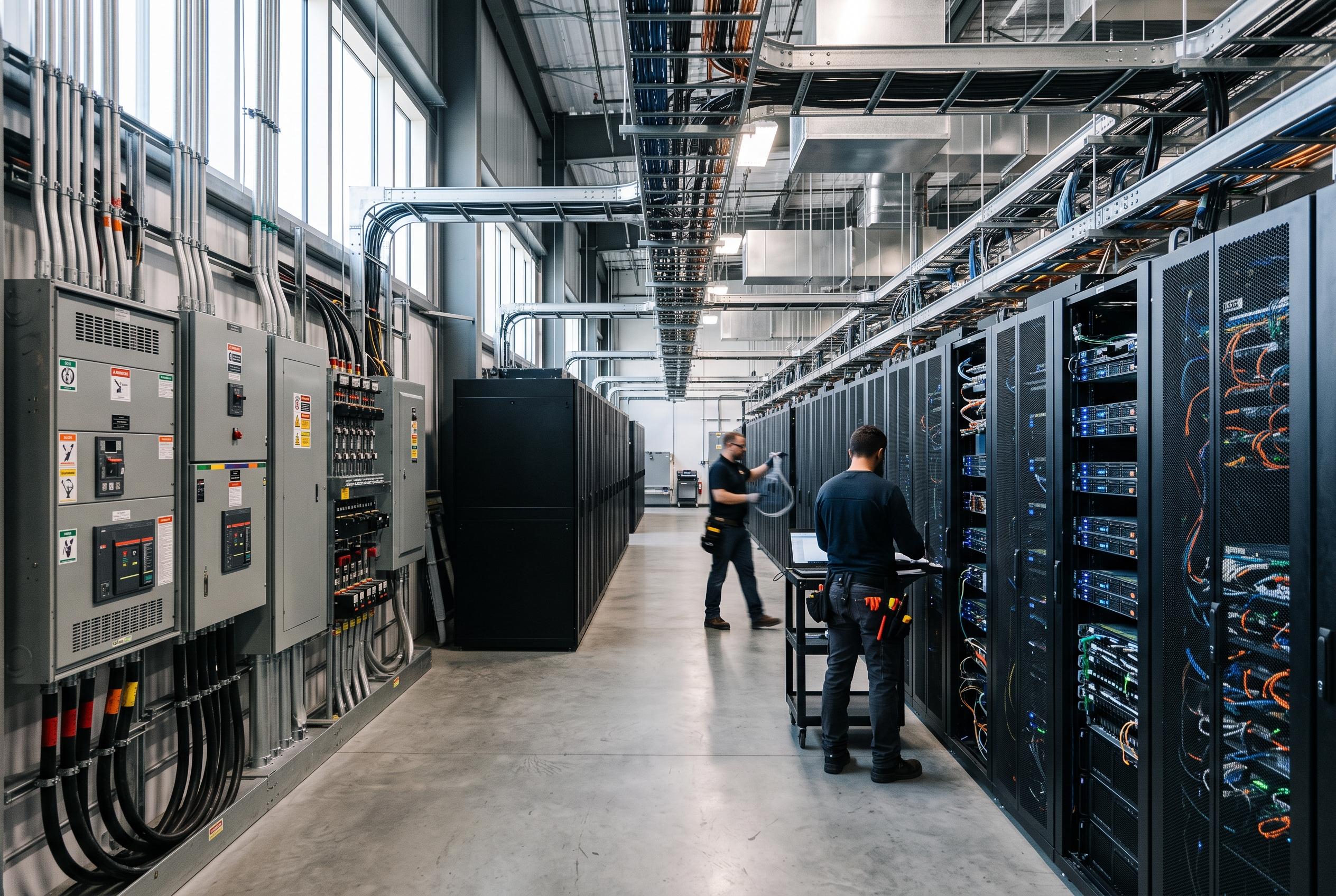
AI data centers are moving toward 800 VDC power systems, and a new Power Integrations and Ideal Power collaboration aims to make that shift safer. Their prototype combines 1700 V GaN power conversion with bidirectional solid-state switching, helping isolate faults quickly without relying on a separate auxiliary supply.
Why 800 VDC changes the protection challenge
The push toward 800 VDC is being driven by AI racks that demand far more power than conventional computing equipment. Higher voltage can move that energy more efficiently, but it also raises the stakes when something goes wrong.
Mechanical circuit breakers remain familiar, but they don't react quickly enough for sensitive, high-density AI hardware. Conventional electronic protection is faster, yet its power losses can become costly at data-center scale. That leaves operators looking for protection that's both rapid and efficient.
A self-powered breaker for high-density AI racks
The proposed solid-state circuit breaker, or SSCB, pairs Power Integrations' InnoMux-2 IC with Ideal Power's B-TRAN bidirectional semiconductor switch. According to the companies, a working prototype has already been demonstrated, with a reference design in development.
The architecture draws operating power directly from the 800 VDC bus. InnoMux-2 converts that high-voltage input into isolated outputs for gate drive, sensing, control and auxiliary functions, so the breaker doesn't need an external low-voltage supply. That's a tidy approach in a system where every extra component adds space, wiring and another possible failure point.
What the 1700 V GaN technology brings
Power Integrations' InnoMux-2 uses 1700 V PowiGaN technology, giving it substantial voltage headroom when operating on an 800 VDC bus. The company describes the IC as providing several independently regulated outputs, rather than depending on one isolated supply followed by multiple converters.
That integration matters inside tightly packed power shelves. The InnoMux product family is designed around consolidated power conversion, while earlier company announcements positioned its 1700 V GaN switcher technology as a way to improve efficiency and reduce component count, according to Power Integrations' investor materials.
Why B-TRAN could make fault isolation faster
Ideal Power's B-TRAN device is designed for bidirectional switching, which suits power paths that may need to manage current in more than one direction. In this collaboration, the switch acts on the 800 V feed to the AI load while the InnoMux-2 circuit supplies the intelligence needed to sense conditions and control the interruption.
The key promise is speed without the heavy efficiency penalty associated with some semiconductor protection systems. That balance is important: a breaker that reacts instantly but wastes significant energy isn't especially attractive in a facility already consuming enormous amounts of electricity.
What data-center operators should watch next
The prototype is encouraging, but real-world adoption will depend on more than a clever circuit. Operators and equipment makers will need evidence on interruption performance, thermal behaviour, reliability, electromagnetic compatibility and integration with rack-level power systems.
Packaging will matter, too. AI infrastructure is becoming a contest in compactness as much as raw computing power, so a protection module must fit within strict mechanical limits while remaining serviceable. The companies' planned reference design should offer a clearer look at how the architecture could move from demonstration hardware into deployable equipment.
The broader trend is clear: as AI workloads push rack power higher, protection is becoming a system-design issue rather than an afterthought. A faster, self-powered breaker could help make 800 VDC practical, but the industry will be watching closely for production timelines and independent performance data.
Disclaimer: This article may have been created with AI assistance and reviewed by our editorial team. It is provided for general informational purposes only. Readers should verify information independently before relying on this content.
