
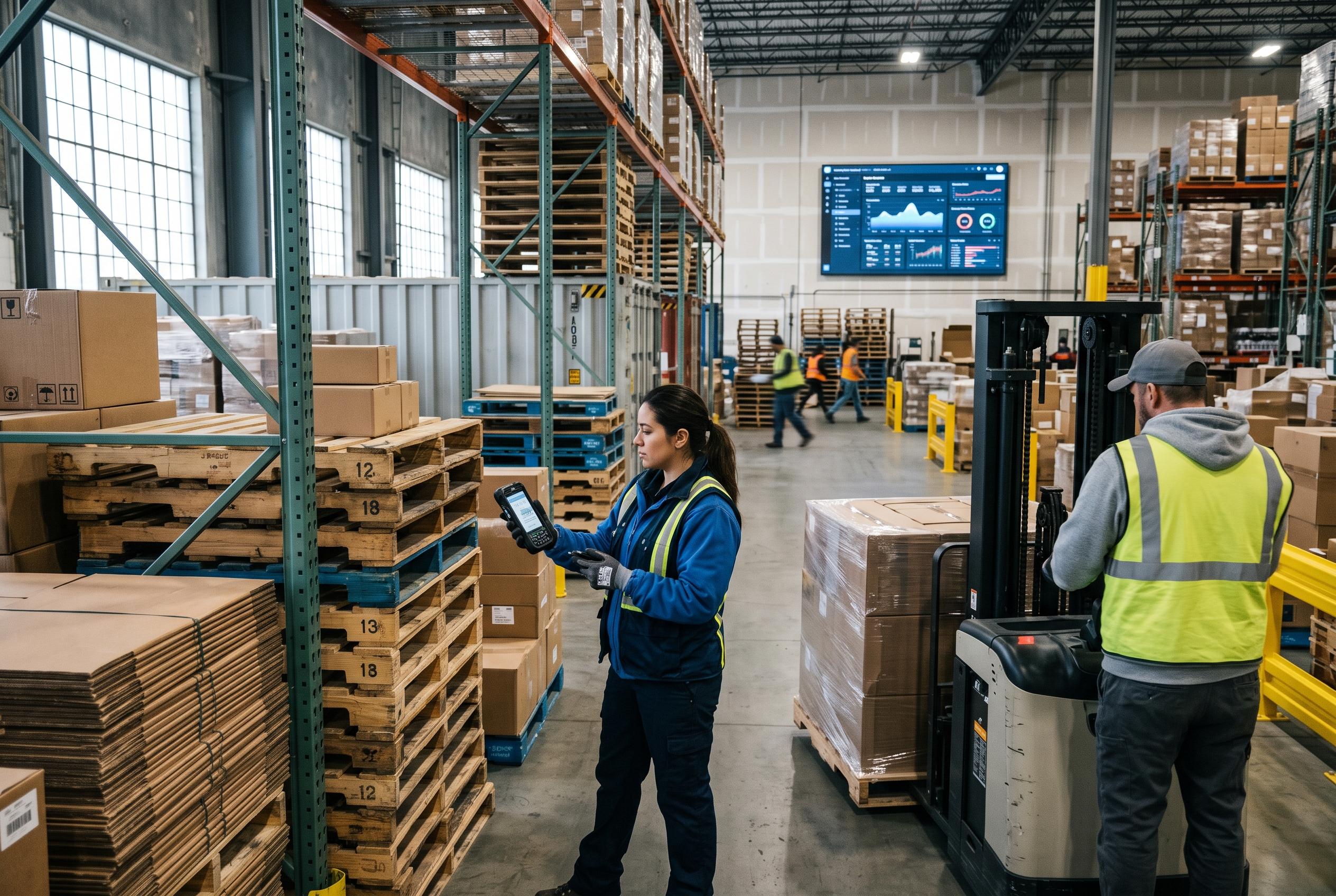
Businesses are embracing AI across forecasting, inventory, transport, and warehousing, but the biggest gains may come from a less glamorous first step: fixing the operation. In warehouses and supply chains worldwide, leaders are moving from eye-catching experiments toward practical tools that improve decisions, manage exceptions, and support workers without handing over control too quickly.
AI won't rescue a confused supply chain
The most important supply chain AI lesson is also the easiest to overlook: more technology doesn't automatically create a better operation.
Businesses are exploring AI for demand forecasting, inventory management, labor planning, transportation, and warehouse execution. Yet Gartner's supply chain technology research points toward a more practical direction, with companies looking for tools that solve defined problems rather than simply adding another layer of software.
That distinction matters because a glossy dashboard can make an operation look informed while leaving the underlying process untouched. If inventory records are unreliable, workflows are inconsistent, or nobody agrees on the decision being improved, AI may simply produce faster answers to the wrong question.
Why warehouse AI is becoming more practical
Warehouses are a natural testing ground for AI because conditions shift constantly. Orders change, labor availability moves around, equipment encounters delays, and one late process can quickly affect an entire shift.
Gartner has identified four warehouse AI trends: traditional AI focused on optimization, generative AI designed around operations, suggestive or semi-autonomous agents, and physical AI agents. Together, they show the market moving from analysis and recommendations toward systems that can help execute decisions in real time.
That could mean assigning work, adjusting priorities, identifying bottlenecks, or redirecting tasks when a zone starts to fall behind. The appeal is obvious, especially in busy fulfillment environments where a problem can become expensive before a manager has time to investigate it.
Still, the best systems won't treat autonomy as a switch that is simply flipped on. They should let companies decide whether AI offers a recommendation, requires approval, or acts automatically within carefully defined boundaries.
Context is the missing ingredient
Many supply chain teams already have plenty of data. The harder challenge is understanding how separate events connect.
A delayed order might be caused by a labor gap, a replenishment issue, a congested aisle, a faulty piece of equipment, or a rule that no longer suits the current workload. AI becomes more useful when it can see those relationships instead of examining one data stream in isolation.
This is where warehouse execution platforms are gaining attention. IFS Softeon's AI Layer, known as SAIL, is built into its warehouse management and execution environment, with functions covering implementation support, in-application assistance, optimization, and broader operational reach.
In practice, that kind of embedded approach can help a system suggest changes to task rules, reroute work, or reassign lanes when delays appear. Whether a person approves the adjustment or the platform makes it depends on the site's chosen level of control. That flexibility is reassuring, particularly for operators who want faster decisions without feeling as though the warehouse has become a black box.
What to check before investing in supply chain AI
Before choosing an AI platform, leaders should ask a few plain questions.
What problem needs solving? Which decision is too slow, too inconsistent, or too expensive today? Is the process itself sound, and can the necessary data be accessed and trusted? Those questions may sound basic, but they can prevent a costly technology project from becoming an elaborate workaround.
Integration deserves equal attention. A tool that can't connect cleanly with warehouse management, planning, inventory, labor, or automation systems may create yet another information silo. Gartner's research on supply chain technology and autonomous planning also emphasizes that progress toward greater autonomy will depend on data, technology, organizational readiness, and human oversight.
For fast-moving operations, size and risk matter too. A recommendation that works for a high-volume distribution center may be excessive for a smaller facility. Companies should begin with a measurable use case, set clear boundaries, and compare results against practical metrics such as order accuracy, throughput, labor hours, stock availability, and response time.
The future is assisted, not entirely automatic
The supply chain industry is clearly investing in AI. Gartner forecasts strong growth in worldwide AI spending, while separate research suggests that warehouses will become increasingly automated and, in some developed markets, may require far fewer people on the floor by 2030.
But those predictions don't mean humans are disappearing from every warehouse. They point instead to a gradual shift in what people do, with workers and managers spending less time chasing information and more time supervising exceptions, improving processes, and handling decisions that require judgment.
That balance may be the most sensible path forward. The strongest supply chain AI won't be the system with the flashiest claims. It'll be the one that quietly helps a team spot a problem sooner, make a better call, and keep the operation moving. Better outcomes, not more AI, should remain the real target.
Disclaimer: This article may have been created with AI assistance and reviewed by our editorial team. It is provided for general informational purposes only. Readers should verify information independently before relying on this content.
