
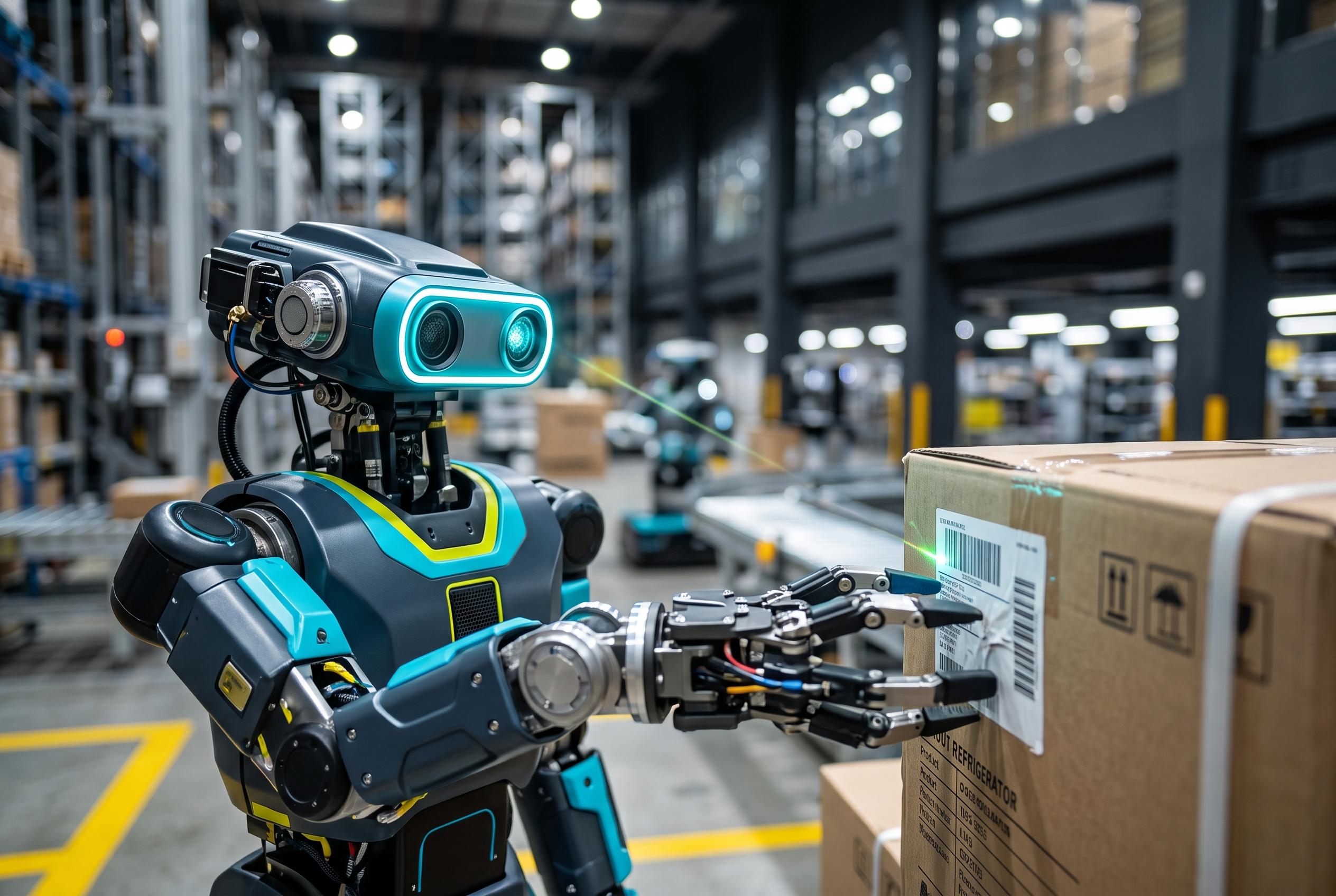
Lotte Hi-Mart is moving toward a 2028 warehouse trial for humanoid robots that could identify appliances, pick orders, scan barcodes, and pack products. The South Korean retailer says the project is designed to reduce picking errors, ease worker fatigue, and build homegrown AI-powered logistics technology for increasingly complex appliance deliveries.
Appliance warehouses are becoming a serious robotics test
A warehouse full of boxed appliances may sound straightforward, but it can be a visual maze. Washing machines, refrigerators, televisions, and smaller devices often come in near-identical packaging, with crucial differences hidden in model numbers, capacity, colour, or configuration. That makes a wrong selection more than a minor inconvenience. It can mean a delayed delivery, a costly return, and a very unhappy customer.
Lotte Hi-Mart's humanoid robot project is aimed at that awkward middle ground between repetitive warehouse work and tasks that still require judgment. The machines are expected to read orders, recognise products and options, scan barcodes, and handle picking and packing. Industry coverage from Robots.com describes the programme as a move toward specialised humanoid robots for logistics rather than general-purpose machines built for broad public use.
The appeal is easy to understand. A robot that can identify the right box and move it through several connected steps could help smooth the handoff from online order to delivery truck. It isn't flashy in the way a robot dancing on stage is, but dependable warehouse accuracy may be the more useful breakthrough.
Lotte Hi-Mart is building a longer runway for testing
The initiative was selected for South Korea's 2026 Robot Industry Technology Development Programme, overseen by the Korea Evaluation Institute of Industrial Technology under the Ministry of Trade, Industry and Energy. The work is scheduled to continue from 2026 through 2031, giving the partners time to test hardware, software, safety procedures, and real warehouse conditions.
Eugene Robotics is leading the project, with C-SO and the Korea Electronics Technology Institute involved as research partners. Lotte Hi-Mart and Lotte Global Logistics are participating as companies that understand the practical demands of appliance distribution. The Korea Herald reported that the collaboration reflects a wider effort to develop domestic robotics capabilities and reduce reliance on overseas robot platforms and AI systems.
That timetable matters. Robots often look impressive in demonstrations, where lighting, object placement, and workflow are tightly controlled. A working distribution centre is much less polite. Boxes shift, labels wrinkle, orders change, and people move through the same space. The early years of this project will focus on analysing processes in simulated environments and establishing performance standards before the warehouse trial begins.
What will the humanoid robots actually do?
The planned workflow starts with order confirmation and product identification. From there, robots are expected to recognise appliance models and options, read barcodes, select items, and pack them. The larger ambition is a continuous autonomous process in which one system can perform several linked jobs rather than handling a single isolated motion.
That is a tougher target than simply moving a box from one shelf to another. The robot must connect visual recognition with physical action, while accounting for different packaging dimensions and product variations. Technology Review's reporting on the project highlights the importance of collecting success and failure data so the system can improve as it encounters real-world exceptions.
For shoppers, the benefit would be fairly unglamorous but welcome: fewer wrong products and fewer delivery surprises. If you've ever opened a box expecting one finish or capacity and found another, you already know how much a small warehouse error can disrupt a day.
The project also puts workers in the picture
Automation conversations can quickly become all about machines, but Lotte Hi-Mart is presenting this effort partly as a way to reduce the physical burden on warehouse employees. Handling bulky appliances repeatedly can be tiring, especially when workers must combine lifting with constant checking and fast order turnaround.
The company is also involved in a separate government-backed AI commercialisation project using a strength-enhancing exoskeleton suit at its Daegu Logistics Center in Chilgok County. That work, involving FR Robotics, is focused on applying wearable assistance to the warehouse and improving AI control for appliance logistics. Robots Daily reported that the two projects show how automation may develop through a mix of mobile machines, wearable equipment, and software rather than one single replacement technology.
The sensible version of this future is less about removing people from every process and more about giving them better tools for the heaviest, most repetitive, or most error-prone steps. A quieter shift and fewer strained backs would be a meaningful result, even before full autonomy arrives.
Why domestic AI matters for the next phase
Lotte Hi-Mart says it wants to build a foundation for logistics AI in South Korea while lowering dependence on foreign robots and AI models. That ambition gives the project a strategic role beyond one retailer's warehouse. A locally developed system could be adapted to regional packaging standards, warehouse layouts, language requirements, and the particular quirks of appliance distribution.
Still, the real test will be reliability. A robot may correctly recognise a product in a controlled trial but struggle when two boxes look almost identical, a barcode is partially blocked, or an item is positioned awkwardly. The project plans to use operational data to identify those weak points and improve the system over time, according to the project's reported partners and industry coverage.
The 2028 deployment should therefore be viewed as a meaningful field test, not the finish line. If the machines can move from demonstration to dependable daily work, they could offer a practical template for other retailers managing large, varied products.
A more accurate warehouse may be the most useful kind of robot revolution.
Explore how intelligent automation could make appliance fulfilment safer, faster, and less frustrating.
Disclaimer: This article may have been created with AI assistance and reviewed by our editorial team. It is provided for general informational purposes only. Readers should verify information independently before relying on this content.
