
- Advances in materials like ULTEM enhance sensor housing and connector performance
- Scenario-based validation and synthetic data improve safety assurance
- Integration of lightweight electronics and scalable mapping fuels full autonomous driving readiness
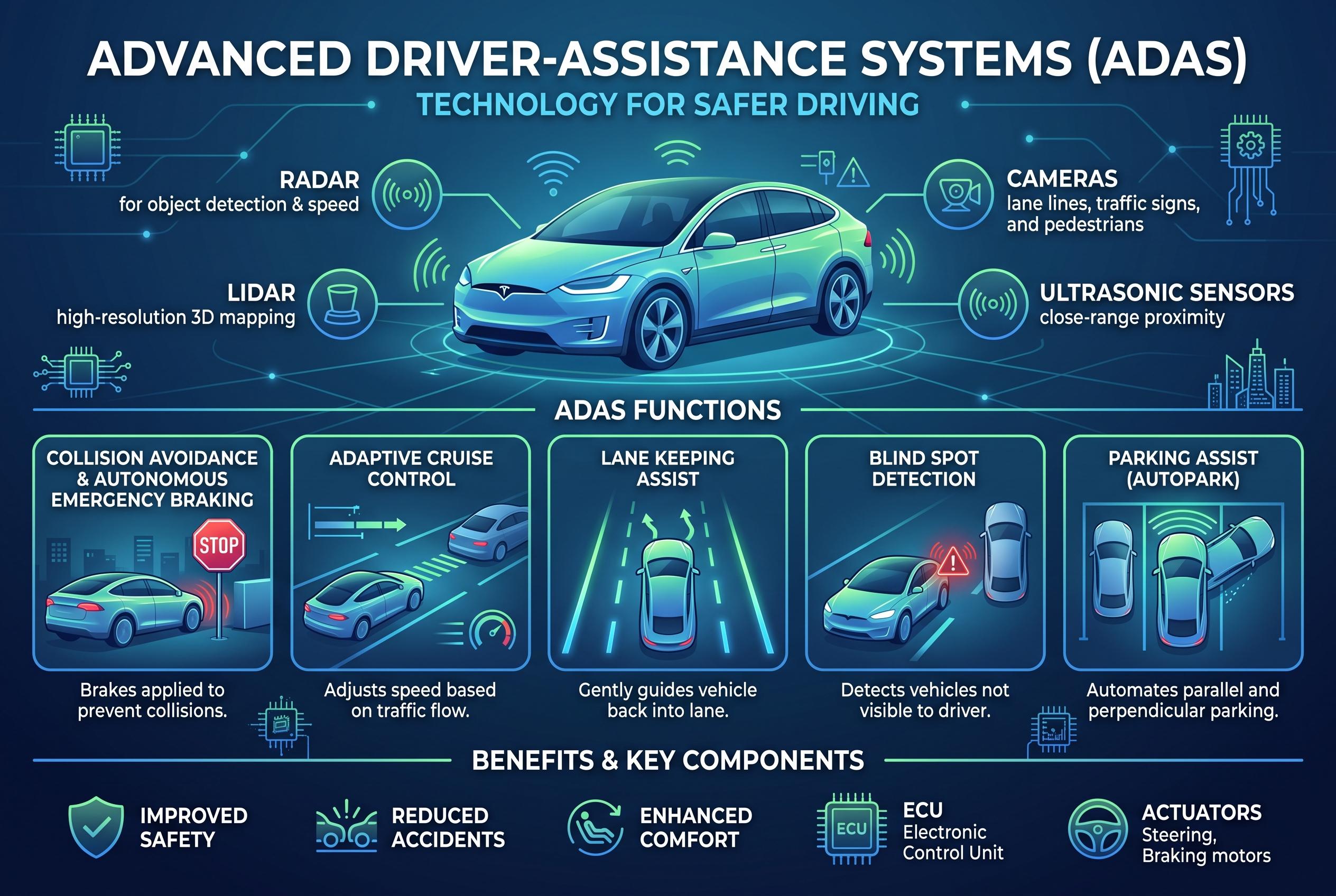
Automakers and their suppliers are now stepping into a more challenging phase of developing advanced driver-assistance systems (ADAS) and automated driving technology. In this stage, materials science, wiring frameworks and validation techniques are all being pushed to keep up with increasing sensor counts and more intricate software. The special report set to come out in August 2026, focusing on connected and automated vehicles, makes it clear that progress hinges not just on getting better sensors but also on improving the systems surrounding them: think lighter housings, cleaner signal pathways and more trustworthy ways to demonstrate safety before vehicles hit the road.
SABIC’s specialty resins are part of this broader shift. The company claims that their ULTEM thermoplastic polyetherimide combines high heat resistance, stable dimensions and chemical durability. Automotive-specific variants are targeted at sensor housings, internal layers and connectors. Interestingly enough, SABIC also emphasizes that some grades of ULTEM offer infrared transparency, which can be handy for LiDAR and camera applications, plus, it allows for glass replacement that cuts weight. Related resin lines like NORYL and NORYL GTX are being positioned to tackle EMI shielding and other under-the-hood ADAS needs.
On the hardware front, the report highlights the rising importance of metallized injection-molded waveguide antennas used in millimeter-wave radar, along with the broader move toward fiber optic connections to reduce congestion in high-bandwidth vehicle networks. Power over Coax (PoC) is another practical solution gaining traction, allowing power and data transmission over a single cable, which helps to cut weight, simplifies installation and lowers costs in sensor and camera assemblies. Coilcraft’s pre-engineered PoC filter options are presented as a way to sustain signal integrity, even while supporting high current loads.
Now, validation gets a lot trickier. HORIBA MIRA’s CERTUS tool reflects a wider industry trend away from just accumulating miles through brute-force testing, toward scenario-based methods. This approach focuses on edge cases, those tricky situations most likely to reveal safety gaps. The company explains that CERTUS combines simulation with physical testing, then evaluates the results using algorithmic oracles, giving an estimate of residual risk in accordance with ISO 21448. Basically, this helps teams figure out when they have gathered enough evidence to move forward. It is a way of reducing redundant testing and hopefully shortening development cycles, all without sacrificing confidence.
Synthetic data is also becoming part of the validation toolkit. When used properly, it can produce realistic sensor inputs and generate rare scenarios that would be costly or impossible to gather in the real world. But, the report notes, concerns around fidelity and bias still linger. The most credible workflows now seem to be the hybrid types, combining real-world data, simulations and synthetic inputs, to support perception systems that need to perform reliably across a much wider operational envelope than earlier driver-assist systems.
Mapping, too, is evolving. Instead of relying solely on LiDAR-rich high-definition maps, the report points to more scalable solutions: precise GNSS-anchored, standard-definition maps that can be continuously updated across fleets at a lower cost. For suppliers and car makers alike, the message is clear: the race to fully automated driving is being won by a mix of engineering discipline and sensor performance. And all these components, materials, wiring, data, validation, are under increasing pressure to become lighter, cheaper and more dependable.
What stands out across all of these developments is how much the conversation has shifted from isolated product performance to system-level readiness. In electronics sourcing, for example, a radar module or camera assembly is no longer judged only by what it can detect. It is also evaluated by how its housing behaves under heat, how the connectors perform after vibration, how the cable routing affects signal los, and how easily those parts can be assembled at scale. That means procurement teams, design engineers and logistics planners are all part of the same ADAS equation.
The supply chain side matters more than ever. A sensor platform may look advanced on paper, but if the materials sourcing is unstable, the electronics content is difficult to qualify, or the logistics network cannot support global production timing, the program slows down fast. This is especially true for mobile and connected vehicle platforms, where automakers need consistency across multiple plants and regions. Lightweight resin choices, fiber-based data links and standardized PoC components can all help reduce complexity, but only if they fit into a sourcing strategy that supports volume, traceability and long-term reliability.
There is also a lifestyle angle that is easy to overlook. Drivers may never see a waveguide antenna, a PoC filter or a scenario-validation platform, yet these technologies influence the everyday experience of safer commutes, smoother parking assistance, better driver monitoring and more responsive automated features. In that sense, the evolution of ADAS is not only an engineering story; it is also a consumer story about trust, convenience and the gradual normalization of intelligent vehicle functions.
For suppliers, the strategic takeaway is that innovation increasingly comes from integration. A material that enables an infrared-transparent sensor window is useful, but it becomes far more valuable when paired with a manufacturable enclosure, robust electronics packaging and a validation approach that can prove the design in realistic use cases. Likewise, a cleaner vehicle network architecture is most effective when it reduces wiring weight, improves logistics efficiency and supports the future move toward more software-defined mobility platforms.
The next phase of automated driving will likely reward companies that can connect these dots. Better sensing still matters, but so does the invisible infrastructure around it: sourcing decisions, electronics architecture, validation methods and manufacturing readiness. In other words, the winners may not just be the teams with the smartest sensors, but the ones that can build a complete and scalable system around them.
Takeaways / FAQ
- - What is changing most in ADAS development? The focus is shifting from sensors alone to the full system: materials, wiring, validation and scalable production.
- - Why do materials like ULTEM matter? They can help reduce weight, improve heat resistance and support sensor and connector applications.
- - Why is scenario-based validation important? It targets rare edge cases and can reduce the need for brute-force road testing.
- - What role does PoC play? It simplifies sensor and camera cabling by carrying power and data over one line.
- - What is the big picture? Automated driving progress depends on lighter, cleaner and more dependable vehicle systems.
Disclaimer: This article may have been created with AI assistance and reviewed by our editorial team. It is provided for general informational purposes only. Readers should verify information independently before relying on this content.
Sources:
- - Paragraph 1: [[1](https://www.techbriefs.com/component/content/article/55744-doc-9981?catid=1397&Itemid=690)
- - Paragraph 2: [[2](https://www.sabic.com/en/products/specialties/ultem-resin), [[3](https://www.sabic.com/en/industries/automotive/specialties/materials/ultem-resin), [[4](https://www.sabic.com/en/industries/automotive/specialties/applications/underthehood), [[7](https://www.chemistrythatmatters.org/en/industries/automotive/specialties/applications/adas)
- - Paragraph 3: [[1](https://www.techbriefs.com/component/content/article/55744-doc-9981?catid=1397&Itemid=690), [[4](https://www.sabic.com/en/industries/automotive/specialties/applications/underthehood)
- - Paragraph 4: [[5](https://www.horiba.com/jpn/mobility/applications/connected-and-autonomous-vehicles/), [[6](https://www.mobilityengineeringtech.com/component/content/article/55577-sharper-validation-without-brute-force)
- - Paragraph 5: [[1](https://www.techbriefs.com/component/content/article/55744-doc-9981?catid=1397&Itemid=690)
- - Paragraph 6: [[1](https://www.techbriefs.com/component/content/article/55744-doc-9981?catid=1397&Itemid=690), [[5](https://www.horiba.com/jpn/mobility/applications/connected-and-autonomous-vehicles/)
