
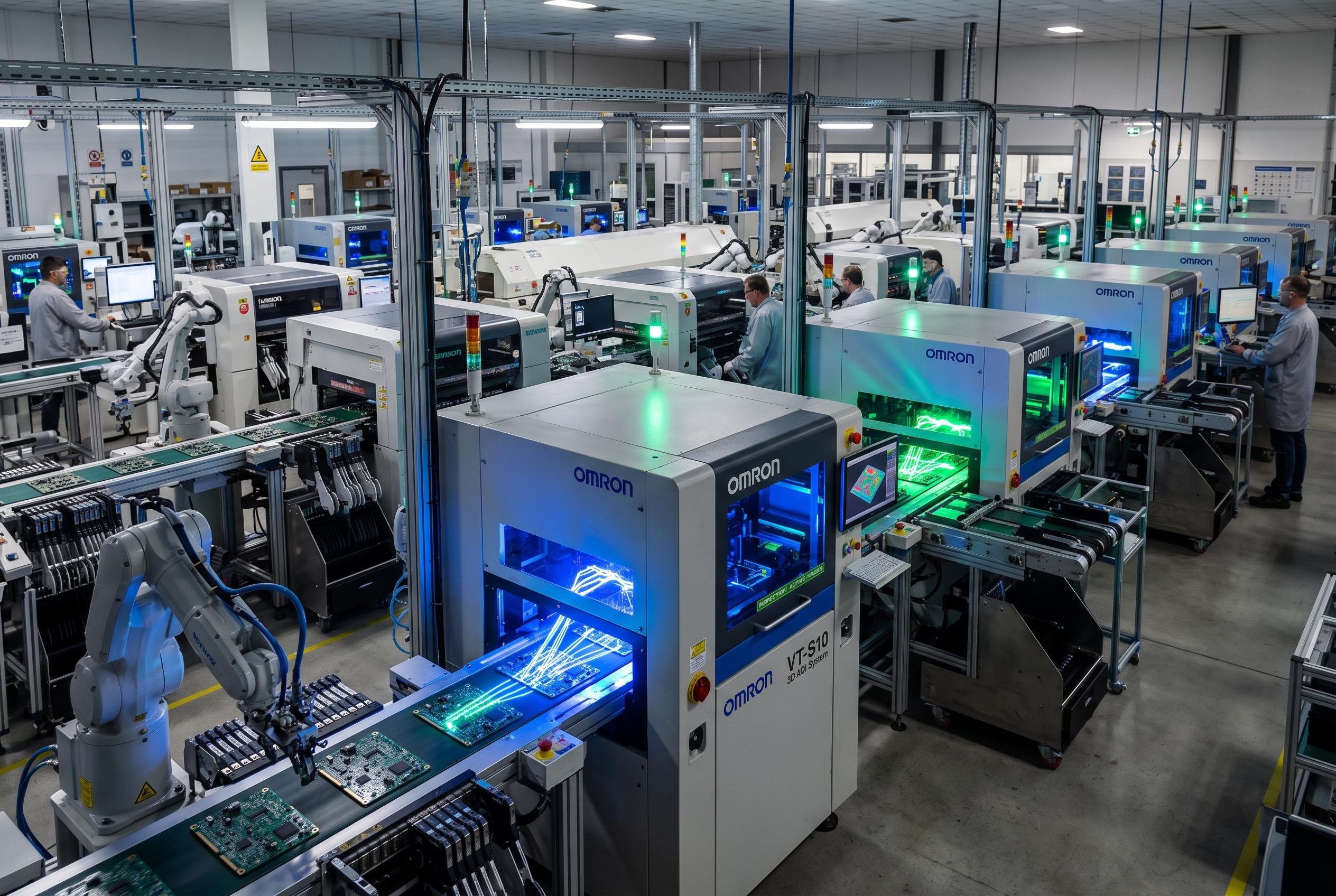
OMRON is set to showcase its latest electronics inspection systems, integrating AI, 3D imaging, and predictive maintenance, at SMTA Guadalajara 2026, emphasizing a comprehensive approach to quality control in complex assembly processes.
OMRON to Showcase Inspection Strategy at SMTA Guadalajara 2026
OMRON will use SMTA Guadalajara 2026 as an opportunity to present its electronics inspection strategy to manufacturers managing tighter quality requirements and increasingly complex assemblies. The event is scheduled for October 7-8 at Expo Guadalajara. OMRON will exhibit at booth 234, where it plans to demonstrate inspection systems designed to support quality control across several stages of electronics production.
The company’s presence will focus on how inspection technologies can help manufacturers identify defects, improve consistency, and gain better visibility into processes that can otherwise be difficult to evaluate. For electronics manufacturers, inspection is not limited to checking completed products. It can also involve monitoring solder paste, examining solder joints that cannot be seen from the outside, and applying automated optical inspection to assembled circuit boards.
At SMTA Guadalajara 2026, OMRON will place three systems at the center of its display: the VT-S10 automated optical inspection platform, the VT-X750 3D CT X-ray system, and the VP9000 solder paste inspection solution. Each system addresses a different inspection requirement, giving visitors an opportunity to consider how optical inspection, X-ray imaging, and solder paste monitoring can work across a broader electronics manufacturing process.
Three inspection systems at booth 234
The VT-S10 automated optical inspection platform will be presented as a system for identifying defects and delivering more consistent inspection results. Automated optical inspection, commonly known as AOI, is used to examine assemblies through imaging rather than relying only on manual checks. In OMRON’s positioning, the VT-S10 supports a more consistent approach to finding problems during production.
For manufacturers, consistency is important because inspection results can influence decisions at several points in the line. A system that detects defects can help operators identify issues during production rather than allowing them to move unnoticed into later stages. OMRON says the VT-S10 is designed to spot defects and contribute to more consistent inspection, placing it within the company’s wider effort to combine imaging, software, and predictive maintenance.
The second featured system, the VT-X750 3D CT X-ray system, is intended to reveal hidden solder joints through high-resolution cross-sectional imaging. Unlike defects that can be identified from an exterior view, some solder-related conditions are located inside an assembly or beneath components. The VT-X750 is designed to provide visibility into those concealed areas through 3D computed tomography, or CT, X-ray inspection.
That capability is particularly relevant to electronics assemblies in which the most important connection points may not be directly visible. OMRON describes the VT-X750 as a tool for examining hidden solder joints through high-resolution cross-sectional images. The emphasis is therefore on access to information that cannot be obtained through surface-level inspection alone.
The third system, the VP9000 solder paste inspection solution, is intended to identify variation in solder paste early in the process. Solder paste is applied before components are placed and soldered. When paste application varies, the resulting issue may affect later stages of assembly. OMRON says the VP9000 is designed to catch that variation before defects move deeper into production.
Together, the three systems represent different points of inspection within an electronics manufacturing environment. The VP9000 focuses on solder paste variation at an early stage. The VT-S10 addresses defects through automated optical inspection. The VT-X750 provides imaging of hidden solder joints through 3D CT X-ray technology. OMRON’s presentation will place these systems within one inspection strategy rather than treating them as unrelated equipment.
Preview of the VT-S1080 V3
OMRON will also introduce visitors to the VT-S1080 V3, the company’s newest AOI platform. The machine itself will not be on the show floor, but the system will still form part of OMRON’s presentation at the event.
According to OMRON, the VT-S1080 V3 uses AI-assisted programming to create inspection routines in a few clicks. The stated purpose is to reduce setup time and make operation easier. In a production environment, setup can be an important consideration when manufacturers need to adjust inspection for different assemblies or production requirements. OMRON’s description positions AI-assisted programming as a way to simplify that part of the process.
The company’s regional product materials also state that the VT-S1080 uses multi-direction, multi-color illumination and advanced 3D imaging. These features are intended to improve inspection of difficult solder geometries and reduce false calls.
Difficult solder geometries can create challenges for inspection because visual conditions may vary depending on the shape, angle, and surface characteristics of the solder connection. OMRON’s stated combination of illumination and 3D imaging is designed to provide more inspection information in those situations. The company also links the approach to reducing false calls, or instances in which an inspection system identifies a potential issue that does not represent an actual defect.
Because the VT-S1080 V3 will not be physically displayed at the booth, visitors will be introduced to the system through OMRON’s presentation rather than through a live machine demonstration. Its inclusion nevertheless expands the scope of the company’s message beyond the three systems on the show floor. It gives OMRON an opportunity to discuss a newer AOI platform and its approach to programming, imaging, and inspection analysis.
A broader focus on electronics quality control
OMRON’s presentation reflects a wider shift in electronics manufacturing toward faster setup, fewer manual interventions, and improved detection of hidden defects. These priorities are connected. Faster setup can help manufacturers move more efficiently between inspection requirements. Fewer manual interventions can support a more automated line. Better detection of hidden defects can provide information that surface inspection cannot deliver by itself.
The company says the VT-S1080 is intended to support higher first-pass yield and more automated line operation. First-pass yield refers to the proportion of products that meet requirements without needing rework or additional corrective action. OMRON’s positioning links the VT-S1080’s inspection capabilities with the objective of improving the number of assemblies that pass through production successfully the first time.
The VT-S10 series remains part of OMRON’s broader effort to integrate imaging, software, and predictive maintenance into its inspection portfolio. This means the company’s strategy is not centered only on individual inspection machines. It also involves the relationship between imaging systems, software functions, and maintenance-related capabilities.
That integrated approach is relevant as electronics assemblies become more complex and quality demands become tighter. Inspection needs can differ according to the stage of production and the type of issue being evaluated. Solder paste variation may need to be identified before components move further through the line. Optical inspection may be used to detect visible defects. X-ray inspection may be required to examine solder joints hidden inside an assembly.
OMRON’s product lineup at SMTA Guadalajara 2026 is structured around these different requirements. The VP9000 addresses early solder paste inspection. The VT-S10 supports automated optical inspection. The VT-X750 is focused on hidden solder joints and cross-sectional imaging. The VT-S1080 V3 adds a newer AOI platform with AI-assisted programming, multi-direction, multi-color illumination, and advanced 3D imaging.
What manufacturers can expect at the event
Visitors to booth 234 will see OMRON present inspection as part of a connected electronics manufacturing workflow. The company’s emphasis is on quality control across multiple stages rather than on a single inspection point.
The systems also illustrate different ways manufacturers can approach inspection. One priority may be the early identification of solder paste variation. Another may be consistent optical inspection for defects. A different requirement may involve examining solder joints that cannot be evaluated through a standard external view. OMRON’s display will bring those capabilities together in one location.
The VT-S10, VT-X750, and VP9000 will be the main systems on display. The VT-S1080 V3 will be introduced separately, without the physical machine present on the show floor. This distinction is important because it clarifies what visitors will directly encounter at the booth and what will be presented through product information.
Overall, OMRON’s participation in SMTA Guadalajara 2026 will focus on the changing demands of electronics manufacturing and the role of inspection technology in responding to them. The company will highlight automation, imaging, software, setup efficiency, and the detection of both visible and hidden issues. Its message is that inspection can support quality control throughout production, from solder paste application to final assembly evaluation.
As electronics manufacturers continue to manage complex assemblies, OMRON’s presentation will place particular attention on tools intended to make inspection more consistent, more automated, and better suited to difficult inspection conditions. The company’s systems will be positioned as components of a broader strategy that combines inspection hardware with software and predictive maintenance capabilities.
Takeaways
- - OMRON will exhibit at booth 234 during SMTA Guadalajara 2026 on October 7-8.
- - The VT-S10, VT-X750, and VP9000 will be displayed at the event.
- - The VT-S1080 V3 will be presented but not physically exhibited.
- - The systems address automated optical inspection, 3D CT X-ray inspection, and solder paste inspection.
- - The presentation connects electronics quality control with automation, imaging, software, and predictive maintenance.
Disclaimer: This article may have been created with AI assistance and reviewed by our editorial team. It is provided for general informational purposes only. Readers should verify information independently before relying on this content.
Sources:
