
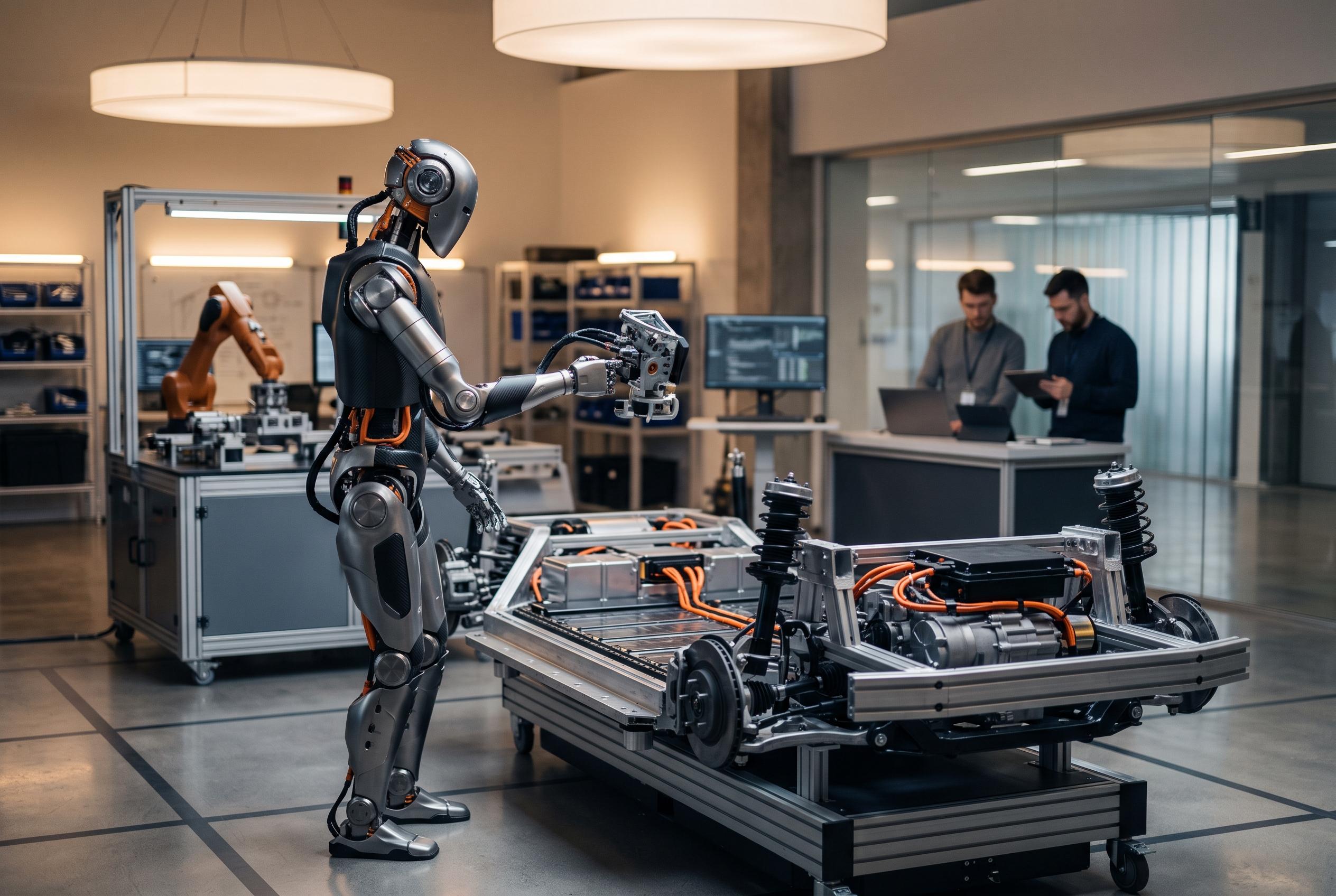
Korean conglomerates are building a new kind of competitive edge, investing heavily in GPUs, AI data centers, semiconductors, robots, and proprietary models. The shift matters well beyond technology: companies that own the computing power behind AI may gain faster, cheaper production, while smaller businesses risk being left paying for access from the outside.
AI Infrastructure Is Becoming the New Factory Floor
The most important change in Korean industry isn't simply that companies are using AI. It's that they're trying to own the machinery that makes AI possible.
That machinery is physical and expensive: high-performance GPUs, advanced memory, dedicated data centers, cooling systems, reliable electricity, and the data needed to train and operate models. Samsung's semiconductor and AI plans reflect this broader shift, with investment spanning chip production, high-bandwidth memory, data centers, and robotics. Samsung describes AI hardware as a foundation for next-generation computing, rather than a narrow technology upgrade.
In other words, the factory of the future may still contain metal, glass, and moving parts, but it will also hum quietly with racks of servers. That's a very different kind of industrial muscle.
Samsung and SK Bet on Chips, Memory, and Massive Scale
Samsung's approach combines the components that sit closest to the AI engine. Its roadmap includes semiconductor clusters, HBM facilities, AI data centers, and production lines aimed at physical AI and humanoid robots. That gives the group a chance to capture value across both the computing layer and the machinery that uses it.
SK is taking a similarly infrastructure-heavy route, with major commitments to AI data centers and AI memory production. SK hynix's technology overview highlights the importance of high-bandwidth memory in AI systems, where rapid movement of data can be just as critical as raw processing power.
The logic is straightforward, even if the numbers are startling. AI workloads are growing quickly, and companies that control scarce memory, chips, and computing capacity may have more predictable costs than those buying access whenever demand spikes.
Hyundai Wants AI to Move Beyond the Screen
Hyundai Motor Group's strategy puts AI into vehicles, factories, and robots. The group plans to direct a substantial share of its future investment towards AI, software-defined vehicles, autonomous manufacturing, electrification, robotics, and hydrogen technologies. Its innovation programme also links AI with automated driving and intelligent production.
That physical emphasis matters. An AI model that writes a report is useful, but an AI system that helps coordinate a factory, operate a vehicle, or guide a robot can change how work is organised from the ground up.
Humanoid robots make the idea especially vivid. They promise flexibility in environments designed for people, although the practical test will be reliability, safety, and cost. A robot may look impressive in a demonstration, but factory managers will care more about whether it can repeat a task all day without turning into an expensive headache.
LG Focuses on Data Centers and the Details That Keep Them Running
LG's AI push is centred on data-center capacity, proprietary AI capabilities, and the infrastructure that keeps demanding systems stable. Its technology work includes AI-related solutions and data-center equipment, including cooling systems that help manage the heat produced by dense computing environments.
That cooling detail may sound less glamorous than a new AI model, but it's crucial. More GPUs mean more power consumption and more heat, so efficiency, thermal management, and uptime can directly affect operating costs.
LG's planned AI facilities include large-scale data-center capacity as well as compact AI boxes designed to hold substantial GPU resources. The broader message is clear: the AI race won't be decided only by who has the cleverest software. It will also depend on who can keep the servers powered, cool, and available.
What This Means for Smaller Businesses
The biggest concern is not whether AI will spread. It almost certainly will. The question is whether access to useful AI will be affordable and dependable for companies that can't build their own data centers or reserve large pools of computing power.
Large groups can spend heavily upfront, then spread infrastructure costs across many products and divisions. Smaller manufacturers, retailers, and service businesses may instead pay cloud or software fees every time they increase usage. If AI improves productivity, that extra productivity could generate more money for the next round of investment, creating a cycle that favours companies with deeper pockets.
For smaller firms, the practical response isn't necessarily to buy hardware. It may be smarter to identify the workloads that create the clearest return, negotiate predictable cloud pricing, protect proprietary data, and choose systems that can work with existing software. The winning strategy may be selective rather than spectacular.
The Next Competitive Measure Is Computing Capacity
Korean industry is moving towards a world where factory size and sales remain important, but they no longer tell the whole story. The companies with dependable access to chips, memory, data, models, robots, and electricity may be able to experiment faster and run AI at lower marginal cost.
There is still plenty of uncertainty. Building infrastructure doesn't guarantee that every project will pay off, and AI hardware can become obsolete quickly. Even so, the direction is hard to miss: AI is becoming less like an optional business tool and more like a core industrial capability.
It's a small wonder the new factory floor sounds more like servers than steel.
Disclaimer: This article may have been created with AI assistance and reviewed by our editorial team. It is provided for general informational purposes only. Readers should verify information independently before relying on this content.
