
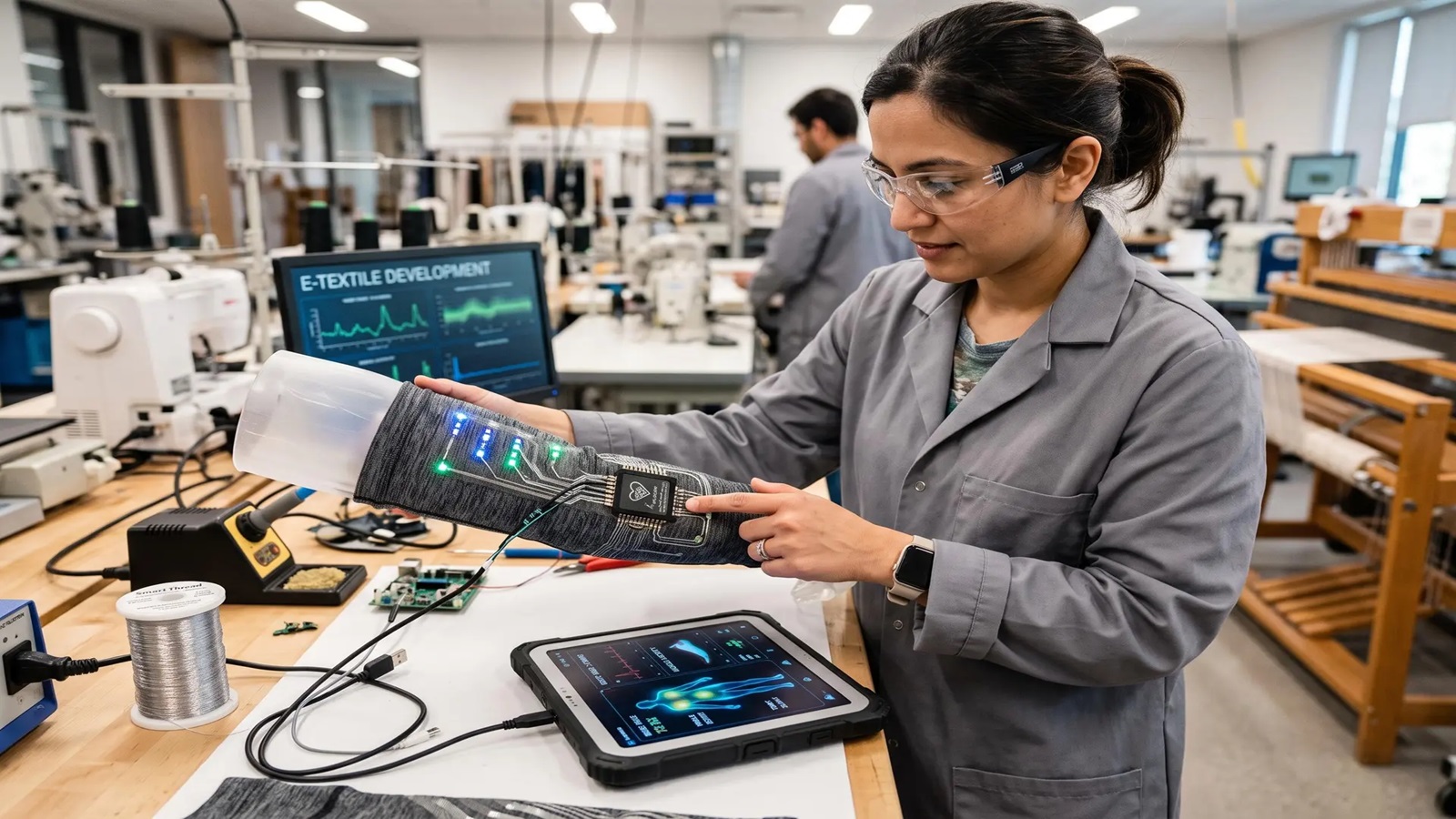
Smart fabrics are progressively transitioning from niche innovations into much broader industrial opportunities, as textiles today are starting to take on sensing, monitoring and energy-related roles, functions that used to be mostly confined to electronics. In real-world terms, this shift is altering the way manufacturers, buyers and sourcing teams think about materials: fabric is no longer just a passive component but increasingly becoming a functional platform. According to Persistence Market Research, the global market for these smart fabrics is expected to grow from $7.2 billion in 2026 to a whopping $24.9 billion by 2033. That’s quite a jump, and it really reflects the rising interest from various sectors, including healthcare, defense, sports, fashion and transportation.
A huge part of that growth is being driven by wearable technology. You see, smart textiles can embed sensors and conductive materials directly into the fabric, allowing clothing to monitor movement, temperature, and other biometric data, without sacrificing comfort or flexibility. Grand View Research points to wearable tech as a main driver of this expansion, while Market.us reports that in 2025, wearable smart textiles made up a significant share of the market. This indicates how rapidly the category is becoming commercially relevant, and really gaining momentum.
Healthcare remains one of the most promising areas here, with a lot of potential. Industry reports from IMARC Group and Verified Market Research highlight the strong demand for textile-based monitoring solutions in medical and clinical wearables. These include products capable of continuously observing heart rate, respiration, and activity levels. The appeal is quite straightforward, really, smart fabrics provide a less intrusive alternative to traditional devices. That could make a big difference in remote patient care, rehab programs, and managing chronic illnesses.
The defense and military sectors are also shaping how these textiles develop. Both Grand View Research and Emergen Research identify the military and protection markets as major target areas, with applications that range from physiological monitoring to adaptive camouflage and environmental sensing. For procurement teams, the main draw is gear that can offer protection, communication and situational awareness, all while remaining lightweight and easy to carry.
But beyond those core industries, the market is expanding into areas like energy harvesting, glow-in-the-dark textiles and smart interiors for vehicles and buildings. Persistence Market Research notes that “very smart fabrics,” the ones with the most advanced embedded features, are emerging as the fastest-growing segment. This growth is being supported by advances in embedded electronics, artificial intelligence and connectivity. Still, manufacturers face familiar challenges, things like cost, washability, durability and recycling, that will influence how quickly these products move from small pilot projects into wider-scale production.
For sourcing teams, the implication is clear: smart fabrics are no longer only a research topic or a futuristic product concept. They are becoming a supply-chain category that requires careful evaluation across materials engineering, component integration, and end-use performance. Buyers need to look beyond the textile itself and assess the full system around it, including conductive yarns, sensors, power sources, data transmission modules, and the logistics needed to keep those components aligned with production schedules. In many cases, the sourcing process now looks more like a hybrid of electronics procurement and traditional textile buying, which means new capabilities are required across quality control, vendor management and compliance.
That shift also creates a different set of priorities for manufacturers. Traditional textile production is built around softness, stretch, color and durability, but smart fabric production has to balance those characteristics with electrical performance, signal stability and long-term reliability. A fabric that performs well in a lab may still fail in real-life use if it cannot survive repeated washing, flexing, abrasion or exposure to sweat and heat. As a result, industrial buyers are increasingly asking whether a supplier can demonstrate not just product innovation, but also practical lifecycle performance. This is especially important in healthcare and defense, where failure is not just inconvenient, it can affect safety and outcomes.
The role of electronics in this category cannot be overstated. Smart fabrics are one of the clearest examples of how electronics and textiles are converging into a single product platform. That convergence has implications for design, production, and distribution. For example, a garment with embedded sensing features may require specialized assembly lines, testing protocols and packaging methods that differ from ordinary apparel. It may also call for coordination between textile mills, component suppliers and system integrators across multiple regions. In global sourcing, that means supply chain visibility becomes a major competitive advantage, especially as companies work to reduce lead times and avoid bottlenecks in critical components.
Another reason the category is attracting attention is lifestyle demand. Consumers are increasingly comfortable with wearable devices, connected accessories, and mobile-first health tools, which makes smart fabrics a natural extension of everyday technology use. In lifestyle and sports applications, the value proposition is especially strong: garments can track performance, provide feedback during training or support comfort in changing environments. For example, apparel that monitors body temperature or muscle activity can help athletes optimize routines, while adaptive textiles can support outdoor users who need more responsiveness from clothing than standard materials can provide. This is where the market begins to move from being purely technical into something more familiar and consumer-facing.
Mobile connectivity is another key enabler. As smart fabric applications become more linked to phones, apps, and cloud systems, the value of the textile is no longer just in the garment itself but in the data and insights it can produce. That creates opportunities for subscription services, remote monitoring platforms and integrated health ecosystems. It also means that future success may depend on how well fabric-based products connect with mobile experiences that are easy to use, secure and useful over time. In practical terms, the smartest fabric is not necessarily the one with the most sensors, but the one that delivers actionable information in a way that fits into a user’s daily routine.
From a logistics perspective, smart fabrics may also reshape how companies think about warehousing, fulfillment, and repair. Unlike conventional textiles, these products may need more controlled handling, more detailed traceability and more careful storage conditions for integrated components. The reverse logistics challenge is also significant. If a product contains both textile and electronic elements, recycling and disposal become more complicated, and sourcing teams will need to consider end-of-life planning much earlier in the product cycle. This is where sustainability becomes more than a marketing theme; it becomes a design requirement. Companies that can solve for reusability, modularity and recyclability may gain an advantage as regulations and customer expectations evolve.
The industrial opportunity is also tied to the broader pace of innovation in materials science. As conductive fibers, flexible circuits and energy-harvesting materials improve, the gap between experimental smart textiles and mass-market products continues to narrow. That said, scale will depend on whether suppliers can deliver consistent performance at acceptable price points. For many businesses, the key question is not whether the technology works, but whether it can be sourced reliably and manufactured with enough consistency for commercial use. This is why partnerships across electronics, textiles and manufacturing are becoming increasingly important.
In the long run, the most successful smart fabric companies are likely to be those that combine technical credibility with strong supply chain execution. They will need to speak the language of electronics, understand the expectations of apparel and industrial buyers, and build sourcing strategies that can support both innovation and scale. As demand rises across healthcare, defense, transportation, sports and lifestyle segments, smart fabrics are likely to become a defining example of how everyday materials can evolve into connected, data-driven products.
