
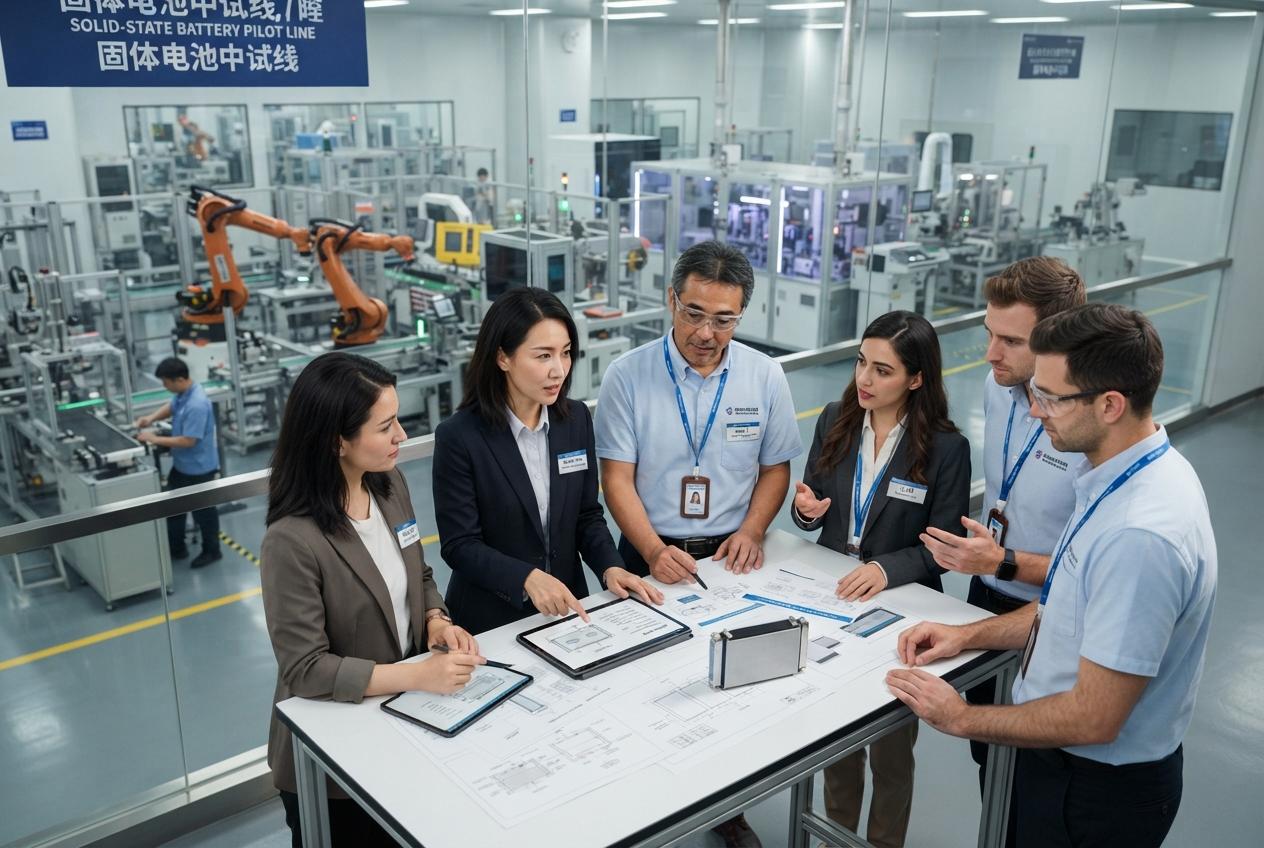
- Industry transitions from early research to pilot manufacturing and validation
- Japan and South Korea spearhead real-world testing and small-scale production
- Diversification into drones, robotics, and electronics begins to drive early demand
Fully solid-state batteries are starting to move beyond just early-stage research and into a more active phase of real-world testing, pilot manufacturing, and supply chain setup. According to TrendForce, in 2026, the industry has shifted from initial concept development towards more rigorous engineering validation, particularly with Japanese and South Korean firms like Toyota, Honda, Nissan, and Samsung SDI taking the lead on small-scale production and vehicle-level demonstrations.
This shift definitely signals a notable step in maturation. You used to mostly see many ASSB programs confined to early technology-readiness stages, but now some are actually hitting the point where they're fine-tuning manufacturing processes, improving yields, and testing for durability on pilot lines. TrendForce suggests that at this stage, the main focus isn’t just proving the concept anymore. Instead, it's about ensuring the technology can meet automotive standards consistently.
The most significant advances seem to be coming from Japan and South Korea, where companies are actively testing cells under real-world operating conditions. For instance, Nissan has reportedly tested a 23-layer automotive cell that maintained capacity better than traditional lithium-ion batteries with liquid electrolyte. Meanwhile, in China, companies like CATL, BYD, and FAW are setting up tiny pilot lines, creeping toward the same developmental milestone. Even if commercialization isn’t uniform around the world yet, this indicates a more global race is clearly underway.
And the market itself is broadening beyond just passenger electric vehicles. TrendForce highlights that brands like Samsung SDI, Maxell, Ilika, ProLogium, and Factorial are developing batteries for a variety of other applications, drones, eVTOL aircraft, microelectronics, construction machinery, and robots, where factors like size, energy density, and safety matter just as much as cost. Interestingly enough, some of these projects are already producing tangible results, with concrete orders and prototypes, which could help create initial demand before mass EV adoption really kicks in.
Another aspect that's evolving is the upstream supply chain. Sulfide-based electrolytes have become the most promising route, leading to growing demand for lithium sulfide, or Li2S. By mid-2026, TrendForce reports that global output of Li2S exceeded 600 tons, and it could push into several thousand tons per year come 2027. Prices have already dropped sharply as supply has increased, but overall demand remains relatively low because production of fully solid-state batteries is still in its early stages.
Government policies are also giving a push to this technology. Japan, for example, is quite proactive here. TrendForce notes that the Japanese Ministry of Economy, Trade and Industry has backed next-generation batteries through its Battery Stable Supply Assurance Plan. As of early 2026, five ASSB-related projects had received government support, with total subsidies reaching around $660 million. That kind of public funding, along with ongoing pilot production and vehicle testing, really suggests the industry is shifting from simply discovering new ideas toward scaling up production, at this point, it’s less about invention and more about making sure everything’s pretty handy for commercial use.
What makes this moment especially important is that fully solid-state batteries are no longer being discussed only as a future promise. They are becoming an engineering, sourcing, and logistics challenge. The transition from laboratory samples to pilot lines requires more than chemistry; it also depends on equipment readiness, quality-control systems, and a stable materials pipeline. In other words, the industry is now trying to align technology development with manufacturability, and that is often the hardest step in any advanced electronics or battery platform.
This is also why supply chain planning matters so much right now. When a battery program enters the validation phase, companies must think carefully about sourcing the right precursors, securing consistent electrolyte materials, and ensuring that the production ecosystem can support repeatable output. Even if current volumes are still small, early supply decisions can shape future cost structures and commercial timelines. For developers, that means the race is not only about electrochemistry, but also about logistics, procurement, and industrial scale-up.
The broader application landscape is another reason ASSBs are drawing attention. In mobile devices, robotics, and compact electronics, a battery that can provide higher energy density and improved safety could unlock new product designs. In aviation-adjacent use cases like drones and eVTOL platforms, reducing risk and improving performance are especially valuable. These segments may not absorb the same volumes as passenger EVs, but they can serve as meaningful proving grounds, helping manufacturers refine production and build a track record before larger-scale automotive rollout.
That diversification also matters for lifestyle-oriented consumers. As electronics become more powerful and more mobile, battery technology increasingly shapes the kinds of devices people can use every day. Whether the end product is a consumer gadget, a robot, or an electric vehicle, the underlying expectation is the same: better runtime, better safety, and more reliable performance. ASSBs are attractive because they potentially address all three, but the industry still has to demonstrate that promise at scale.
From a market perspective, this is a classic inflection point. Early research validates the idea; pilot manufacturing validates the process; and supply chain development validates the business model. TrendForce’s assessment suggests the ASSB sector is now working through the second of those stages, while beginning to build the third. That means investors, manufacturers, and downstream customers are likely to pay close attention not just to headline breakthroughs, but to less flashy indicators like yield rates, consistency, and materials availability.
It is also worth noting that the path to commercialization may not look identical across regions. Japan and South Korea are currently leading on visible validation and pilot production, while China appears to be rapidly building capability through pilot lines and ecosystem development. Elsewhere, companies are targeting niche applications that can support early revenue and practical learning. This uneven progress is normal for a technology of this complexity, but it also means that competition is likely to intensify as more firms move from research to manufacturing.
For the battery industry more broadly, the implication is clear: the next phase will be about execution. Companies that can manage materials sourcing, production stability, and logistics efficiently may gain an early advantage, even if their initial output is modest. In advanced electronics, small improvements in process control can determine whether a new chemistry remains experimental or becomes commercially relevant. That makes the current period especially important for firms trying to turn technical potential into real industrial momentum.
Takeaways
- - Fully solid-state batteries are moving from research toward pilot manufacturing and validation.
- - Japan and South Korea are currently leading the most visible progress.
- - The supply chain, especially Li2S sourcing, is becoming a key focus.
- - Early demand may come from drones, eVTOLs, robots, and other electronics before mass EV adoption.
- - Government support is helping reduce risk and accelerate development.
FAQ
What is the biggest change in 2026 for ASSBs? The focus has shifted from proving the concept to validating manufacturing and performance at pilot scale.
Why is Li2S important? It is a key material for sulfide-based electrolytes, which are seen as a promising route for ASSBs.
Will passenger EVs be the first major market? Not necessarily. Smaller applications like mobile electronics, drones, and robotics may adopt earlier.
Why does supply chain planning matter now? Because scaling ASSBs will depend on reliable sourcing, quality control, and logistics, not just battery chemistry.
Source references link to details and updates supporting these insights.
