
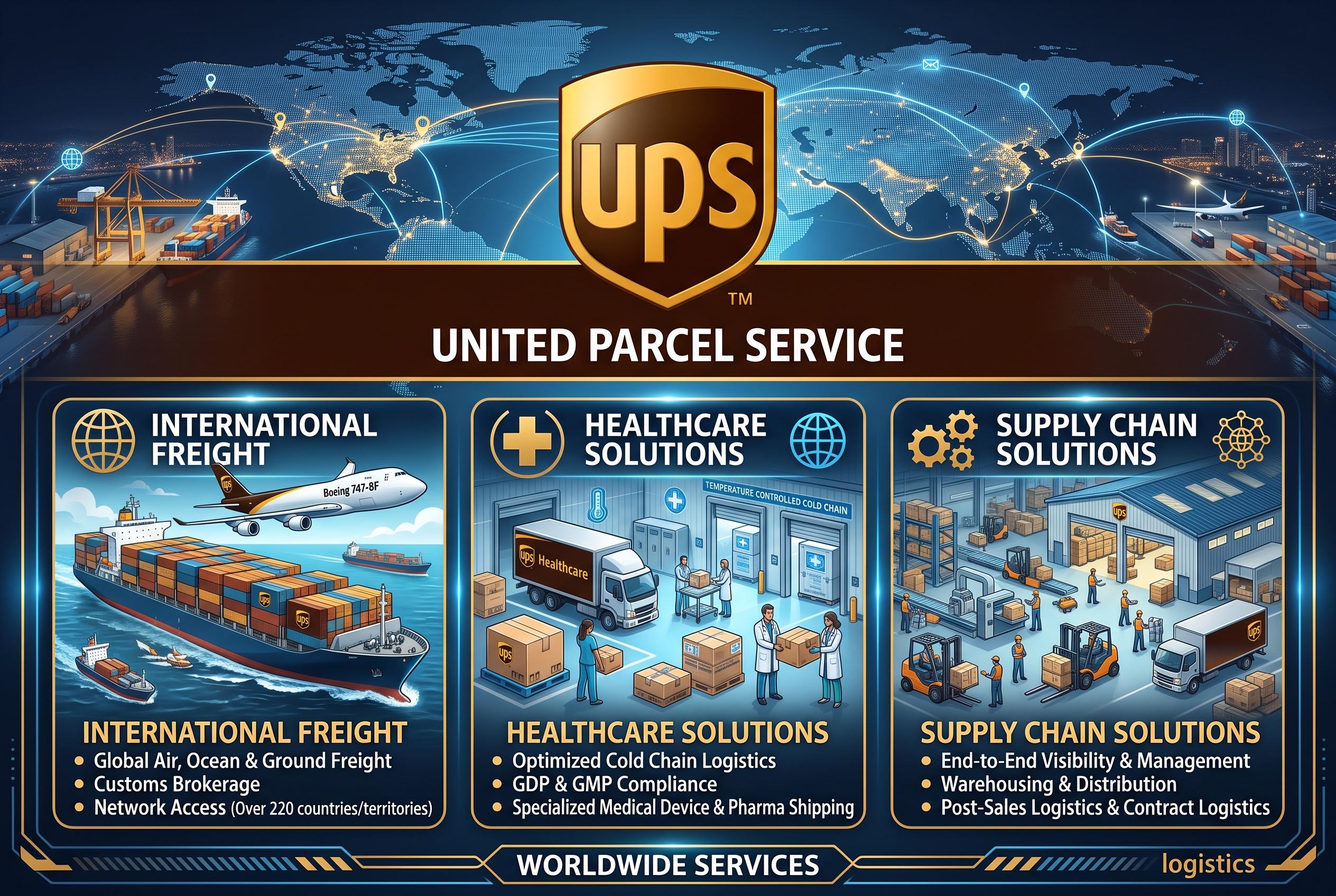
- UPS announces over $2 billion investment to expand its high-value services through 2028
- Focus on healthcare logistics, international freight and supply chain integration across key regions
- Strategy aims to boost margins and resilience by shifting toward specialized, complex logistics solutions
United Parcel Service is planning to invest over $2 billion to expand its International, Healthcare and Supply Chain Solutions divisions, a multiyear effort aimed at repositioning the logistics giant toward more specialized and higher-value services. The program started in 2024 and is expected to continue through 2028, with projects planned across regions like Europe, Asia-Pacific and the Americas.
The plan includes a new hub at Clark Airport in the Philippines, expected to open in late 2026, a new facility in Barrie, Ontario, in 2027, and a new air hub at Hong Kong International Airport in 2028. UPS is also adding temperature-controlled healthcare capacity and automated facilities in markets such as Taiwan and South Korea.
This strategy underscores a broader push to focus on sectors where customers care about reliability, visibility and specialized handling just as much, if not more, than price. Kate Gutmann, UPS’s EVP and President of International, Healthcare and Supply Chain Solutions, mentioned that the company is working to unify air, ground, brokerage and distribution services into a single, more streamlined model with fewer handoffs and less complexity. Especially in healthcare, that makes sense since shipping often relies heavily on strict temperature controls and tightly timed deliveries.
UPS already has a solid presence in that space. The company operates 27 temperature-controlled freight cross-dock facilities, and it also has a supply chain hub in Amsterdam that combines freight, brokerage and cold-chain services. UPS has been strengthening its network across Asia-Pacific, including investments linked to shifts in trade lanes and cross-border flows as manufacturers diversify their supply chains.
Now, the big question for investors is whether all this spending will actually lead to better profit margins and more stable growth. In 2025, UPS pulled in about $88.7 billion in revenue and employs roughly 460,000 people, so it does have the scale to fund these expansions internally. Still, the real payoff probably won’t come until later in the decade. For now, the company seems to be betting that increasing capacity in healthcare, international freight and other specialized B2B channels will help compensate for pressures in its lower-margin parcel business.
From a strategic perspective, this move reflects a familiar pattern in global logistics: the most valuable growth often comes from services that are harder to replicate, not simply from adding more volume. A standard parcel network can be efficient and profitable at scale, but it is also exposed to intense competition and pricing pressure. By contrast, healthcare logistics, cross-border distribution and integrated supply chain solutions tend to reward expertise, compliance, visibility and operational consistency. That means customers in these segments are often willing to pay more for a provider that can reduce risk and simplify the chain.
For UPS, the emphasis on healthcare is especially notable. Healthcare logistics is not just another vertical; it is a highly specialized ecosystem where failure can be costly in both financial and human terms. Temperature-sensitive medicines, biologics, diagnostic materials and medical devices require carefully managed routing and storage. In that kind of environment, every added handoff can create risk. A more unified network with fewer transitions can improve reliability, reduce delays and create a better customer experience. This is also where automation and temperature-controlled infrastructure become meaningful differentiators rather than just operational upgrades.
The planned expansion in Asia-Pacific also deserves attention because it fits broader sourcing and manufacturing trends. As companies diversify production and build more resilient supply chains, logistics providers with strong regional coverage are likely to benefit. Countries and trade lanes can change quickly, and businesses increasingly want options that support flexibility in sourcing, fulfillment, and last-mile delivery. In that context, a stronger presence in places like the Philippines, Taiwan, South Korea and Hong Kong can help UPS serve customers that need both international reach and local execution.
The same logic applies to the Americas and Europe. Businesses in these regions are still dealing with persistent supply chain reconfiguration, whether driven by trade policy, risk management or customer expectations around speed and transparency. A logistics network that combines international freight, brokerage, warehousing and distribution can help shippers move goods more smoothly across borders. That integrated approach may be especially appealing to companies that do not want to coordinate multiple vendors for one shipment or one supply chain lane.
There is also a broader shift underway in customer expectations. In the past, many shippers focused primarily on cost and transit time. Now, many organizations, especially in electronics, healthcare and other high-value sectors, care just as much about visibility, compliance, security and condition monitoring. For example, electronics shipments can be sensitive to damage, theft and timing, while healthcare products may require strict chain-of-custody controls. That is one reason specialized logistics solutions continue to gain importance in global commerce.
UPS’ push may also be viewed through the lens of long-term resilience. A business that depends too heavily on one segment, especially a commoditized one, can find itself vulnerable when demand weakens or pricing softens. By broadening the mix toward higher-value services, the company may be aiming to create a more balanced revenue profile. In practical terms, that could mean less dependence on parcel volume alone and more exposure to enterprise clients that need recurring, contract-based logistics support.
Of course, execution will matter. Large infrastructure projects can take years to generate returns, and the benefits often arrive gradually. The success of this investment will likely depend on whether the company can convert capacity into sticky customer relationships, maintain service quality as networks expand, and manage labor, technology and capital costs effectively. In logistics, scale helps, but scale without efficiency can be expensive. The challenge for UPS will be to ensure that new facilities and capabilities actually improve the economics of the network rather than simply enlarging it.
Another important factor is technology. Modern logistics increasingly relies on data, automation and integrated systems to coordinate shipments across air, ground, warehousing and brokerage operations. That is especially true for specialized sectors where timing and tracking are critical. If UPS can continue improving visibility and reducing complexity through better digital tools, it may strengthen its position in both healthcare and international supply chain services. In many cases, the customer experience is no longer defined only by physical delivery; it is defined by how well the provider manages information, exceptions and decision-making along the way.
For investors, the key question is less about whether the strategy is sensible and more about how quickly the results will become visible. A multi-year capital program typically requires confidence in the market opportunity and discipline in deployment. UPS appears to be making a long-term bet that global trade patterns, specialized healthcare demand and complex B2B logistics will continue to grow in importance. If that proves correct, the company could emerge with a more durable mix of business and improved pricing power in selected segments.
At the same time, the market will likely watch for signs of balance. Investors usually want to see that investments in higher-value services do not come at the expense of overall efficiency. They will also be looking at whether UPS can preserve service levels while expanding in multiple geographies at once. That is a logistics challenge, a capital allocation challenge and a customer retention challenge all at the same time.
Overall, this is less a short-term earnings story than a long-horizon transformation story. UPS is signaling that its future may be built less on generic parcel movement and more on specialized logistics, healthcare delivery and integrated international supply chain support. In a world where companies increasingly care about sourcing flexibility, delivery reliability, and end-to-end visibility, that is a logical direction. Whether it becomes a major growth engine will depend on execution, but the strategic intent is clear.
Takeaways
- - UPS is shifting toward higher-value logistics services, especially international freight, healthcare and supply chain solutions.
- - Healthcare logistics remains a strong area because it depends on temperature control, compliance and reliability.
- - The company’s investments in Asia-Pacific, Europe and the Americas suggest a broader response to changing sourcing and trade flows.
- - Success will depend on whether UPS can turn new capacity into higher margins and steadier growth.
- - Investors may need patience, since the full financial impact may not appear until later in the decade.
Frequently Asked Questions
Why is UPS investing in specialized logistics now? Because customers in sectors like healthcare and international trade often value reliability, visibility and compliance more than price alone.
What regions are included in the expansion plan? The program spans Europe, Asia-Pacific and the Americas.
Why is healthcare logistics important for UPS? It tends to be higher value and requires specialized handling such as temperature-controlled shipping and tightly managed delivery timing.
Will this immediately improve UPS profits? Not necessarily. The benefits may take several years to show up, since the program runs through 2028.
What is the main risk? The main risk is that large capital spending may take time to produce returns, especially if market conditions shift or execution falls short.
Disclaimer: This article may have been created with AI assistance and reviewed by our editorial team. It is provided for general informational purposes only. Readers should verify information independently before relying on this content.
