
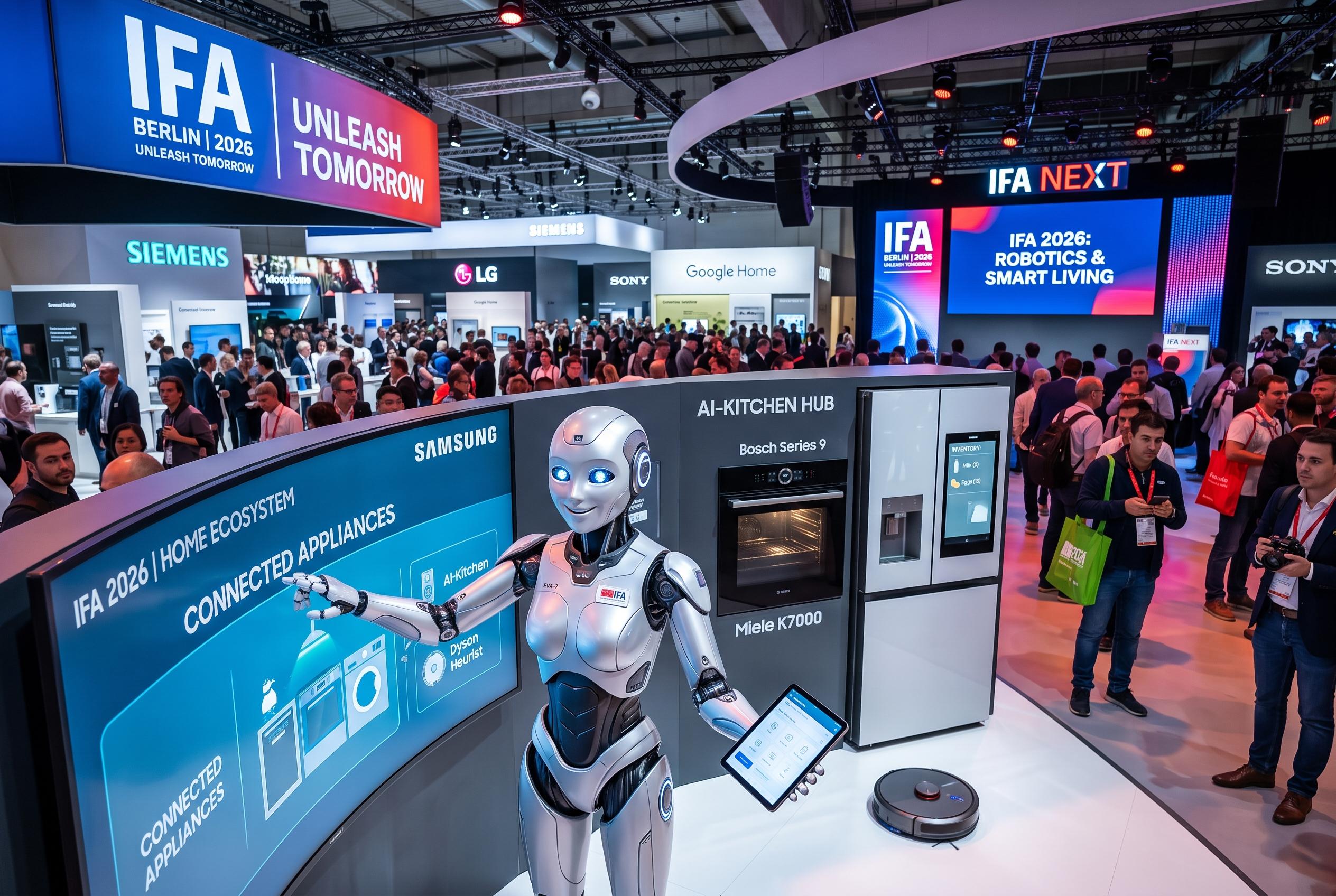
- IFA 2026 shifts focus from product launches to testing consumer-centric smart home strategies
- Samsung and LG adopt contrasting approaches: targeted electronics vs integrated AI ecosystems
- Chinese firms accelerate push into humanoid robots, intensifying global robotics competition
IFA 2026 seems to be shaping up more as a kind of referendum on what the future of the smart home might look like, rather than just your typical tech conference. From what reports are saying from Seoul and Berlin, the event in September, taking place in Germany’s capital, will bring together over 1,900 brands hailing from 49 countries. But the biggest contest might not be about who has the coolest new gadgets, but rather between companies pushing connected appliances versus those betting on humanoid robots.
Samsung Electronics, for example, is planning a more focused campaign rather than a broad, all-encompassing showcase. They are moving away from Messe Berlin and setting up shop at a separate venue right in central Berlin, aiming mainly at retailers, business clients and the press. Industry folks are predicting Samsung will highlight energy-efficient products tailored for Europe, like high-efficiency washing machines, heat pump systems and sleek displays such as micro RGB TVs.
Meanwhile, LG Electronics is sticking with Messe Berlin and using this event to showcase an expanded version of its AI home strategy. In a statement on its global newsroom, LG said their presentation will revolve around “Innovation in Tune With You,” and they will be highlighting an AI-powered connected ecosystem, their latest AI-powered TVs, and that AI Appliances Orchestra idea they introduced last year. The goal seems to be tying together products and services that match European living styles.
But the biggest shake-up might come from Chinese companies. Industry coverage suggests that more Chinese firms are planning to go beyond just robot vacuums and are shifting into humanoids and other physical AI systems. The innovation hall, called IFA Next, is expected to have around 300 exhibitors, including startups, research groups and even some national pavilions. Plus, there’s a segment called “Robot on the Runway,” which will feature walking humanoids strutting their stuff on stage.
Names like Unitree, AgiBot, Deep Robotics and EngineAI are expected to turn some heads, underlining how quickly Chinese firms are advancing. They are moving fast to turn AI into machines that can see, decide and act in real-world environments. An industry source quoted in Korea mentioned that this year’s Chinese robotics and AI showcase will probably be noticeably larger, with more focus on practical services and applications inside homes and everyday spaces, rather than just specs on paper.
That said, don’t expect humanoid robots to become household staples overnight. The main takeaway is that IFA is now a testing ground for two competing visions of the AI home: one focused on interconnected appliances, the other on robots that physically move around inside houses. During a briefing in Seoul back in June, IFA CEO Leif Lindner said that a lot of today’s innovation is coming from China. But he also pointed out that giants like Samsung and LG are still at the forefront when it comes to innovation speed, and that consumers are now looking for clearer reasons to buy into these new tech concepts.
What makes this moment especially important is that the smart home is no longer being defined by one device category. For years, the conversation centered on individual electronics: a smarter TV, a connected refrigerator, a vacuum that could map a floorplan or a speaker that responded to voice commands. Now the focus is shifting toward an ecosystem model, where sourcing, software, logistics and aftersales service matter as much as the product itself. In other words, the value is moving away from a single gadget and toward how well a brand can connect multiple devices into a lifestyle that feels useful, stable and easy to maintain.
That is where the European market becomes such an interesting proving ground. Consumers there often care deeply about energy efficiency, durability and practical design, so companies cannot rely only on flashy demos. They need to show how their electronics fit into daily routines without adding complexity. A smart washing machine is only compelling if it saves time or power in a way that feels obvious. An AI-driven home hub is only persuasive if it actually simplifies decisions rather than creating another app to manage. And a humanoid robot becomes more than a headline only if it can handle real home tasks safely, reliably and affordably.
This also explains why IFA 2026 feels different from older trade shows that were mainly about product launches. The event is increasingly a place where strategy gets tested in public. Samsung’s more focused approach suggests a careful reading of the market: deliver targeted products with clear value, speak directly to retail and business buyers, and emphasize what can already be shipped and supported. LG’s broader AI home message indicates a longer-term bet on connected living, where appliances, displays and services operate as part of one synchronized experience. Both approaches are valid, but they reflect different answers to the same question: what do people actually want from the next generation of home technology?
The robotics angle adds another layer. Humanoid systems and physical AI are exciting because they suggest a future beyond passive connectivity. Instead of just receiving commands, machines could move, observe, adapt and assist in real spaces. That opens the door to applications in households, healthcare, hospitality and other service environments. But it also raises the bar. Hardware must be safe, battery life must be practical, navigation must be dependable, and the overall user experience must be far less intimidating than a lab demonstration. For many consumers, the leap from a smart speaker to a robot that walks through a living room is still a very large one.
Still, the attention around Chinese exhibitors shows how fast the competitive landscape is changing. In electronics, speed of iteration matters. In logistics, supply chain resilience matters. In smart home and mobile categories, the brands that win tend to be the ones that can translate technical progress into a lifestyle benefit people immediately understand. That is why the conversation at IFA is not just about who has the best prototype. It is also about who can package innovation into something that feels trustworthy, relevant and ready for everyday use.
From a broader market perspective, IFA 2026 may end up revealing a split in how companies think about the future. One camp sees the smart home as a network of efficient devices working behind the scenes. The other sees it as an active environment where robots become part of the household workflow. Both visions depend on AI, both depend on strong industrial design, and both depend on consumer confidence. But they differ in how visible the technology is supposed to be. One hides intelligence inside appliances. The other puts intelligence on wheels and legs.
For readers following the event, the real question is not whether humanoids or connected appliances will “win” immediately. It is which vision makes everyday life feel noticeably better. In the near term, the answer will probably lean toward practical electronics with clear benefits: lower energy use, better integration, simpler control and more responsive services. Over time, though, the robotics side could become more influential if costs fall and the machines prove genuinely helpful. That is why IFA matters: it is not only a launchpad, but also a snapshot of where consumer expectations are heading.
Takeaways
- - IFA 2026 looks less like a normal trade show and more like a live test of the future smart home.
- - Samsung and LG are showing two different strategies: focused, energy-efficient electronics versus a broader AI-powered connected ecosystem.
- - Chinese companies are pushing harder into humanoids and physical AI, adding pressure to the global robotics race.
- - For consumers, the biggest issue is not novelty, it is whether these technologies fit real lifestyle needs.
- - The winners in electronics and mobile may be the brands that make advanced tech feel simple, useful and ready for everyday life.
Disclaimer: This article may have been created with AI assistance and reviewed by our editorial team. It is provided for general informational purposes only. Readers should verify information independently before relying on this content.
