
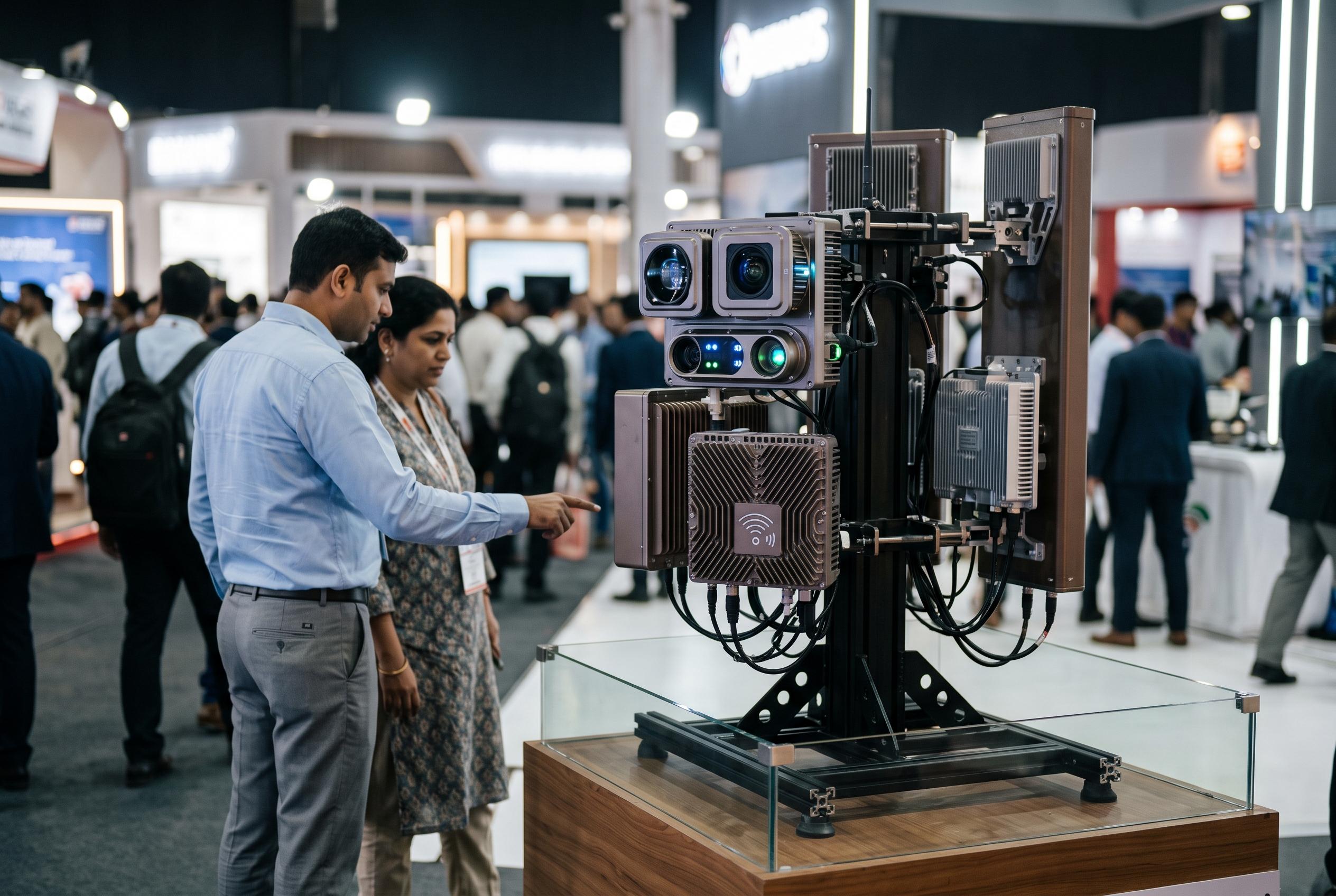
Tejas Networks and Qualcomm have demonstrated 6G Integrated Sensing and Communication technology at India Mobile Congress 2026, showing how existing 5G infrastructure could detect vehicles, drones, and other moving objects. The idea matters because future networks may do more than connect devices. They could also help cities and critical sites understand what is happening around them.
5G infrastructure gets a new job
The most striking part of the demonstration is its simplicity: the same wireless signals used to connect devices could also help identify movement nearby. According to TelecomTalk, Tejas Networks and Qualcomm presented the system at India Mobile Congress 2026 as a practical example of Integrated Sensing and Communication, or ISAC.
Instead of treating a base station as a quiet piece of connectivity equipment, ISAC turns it into something closer to a distributed radar node. That doesn't mean every tower suddenly becomes an airport control system, but it does suggest a more observant network, capable of noticing motion and changes in its surroundings.
Why ISAC matters for cities and security
The joint demonstration showed how communication signals could detect and track moving vehicles on urban roads and drones in sensitive areas. Reuters-style industry coverage from Telecom Gazette described the project as part of the wider push to make future wireless networks more intelligent and useful beyond traditional data transmission.
That could open the door to traffic monitoring, perimeter awareness, drone detection, and critical-infrastructure oversight. The appeal is practical: operators may be able to add sensing capabilities without building an entirely separate network of radar devices, cameras, and sensors.
Tejas and Qualcomm combine network hardware
The setup brought together Tejas Networks' 5G base station with Qualcomm Technologies' Radio Unit and Distributed Unit chipsets. A release carried by PR Newswire said the demonstration also used low-power computing and AI inference to support the sensing process.
That combination is important because sensing is only useful when a system can process what it detects. A network that spots an object but takes too long to interpret its movement won't be much help in a busy city or a security-sensitive location. Local processing could make the system faster, while also reducing the need to send every piece of raw data elsewhere.
What this means for 6G development
ISAC is being discussed as one of the technologies that could help define 6G. Reports from MarketScreener and Stockwatch.live noted that the Tejas and Qualcomm work demonstrates how connectivity, sensing, and artificial intelligence could share a common network foundation.
The approach also fits a broader shift in telecom. Networks are increasingly expected to support automation, analytics, and real-time decision-making, not just faster downloads. In that sense, ISAC feels less like a flashy add-on and more like an early look at networks becoming aware of context.
The useful questions still need answers
A demonstration is an encouraging step, but it doesn't settle questions about accuracy, privacy, cost, and regulation. Sensing a vehicle or drone is one thing; reliably identifying its location, direction, and relevance in crowded conditions is much harder.
There are also practical deployment issues. Operators will need to understand how much existing equipment can be upgraded, how sensing data should be protected, and who is allowed to use it. Still, the collaboration offers a compelling glimpse of a future in which telecom infrastructure quietly helps cities see more clearly.
It's a small but significant step toward networks that connect, sense, and respond.
Disclaimer: This article may have been created with AI assistance and reviewed by our editorial team. It is provided for general informational purposes only. Readers should verify information independently before relying on this content.
