
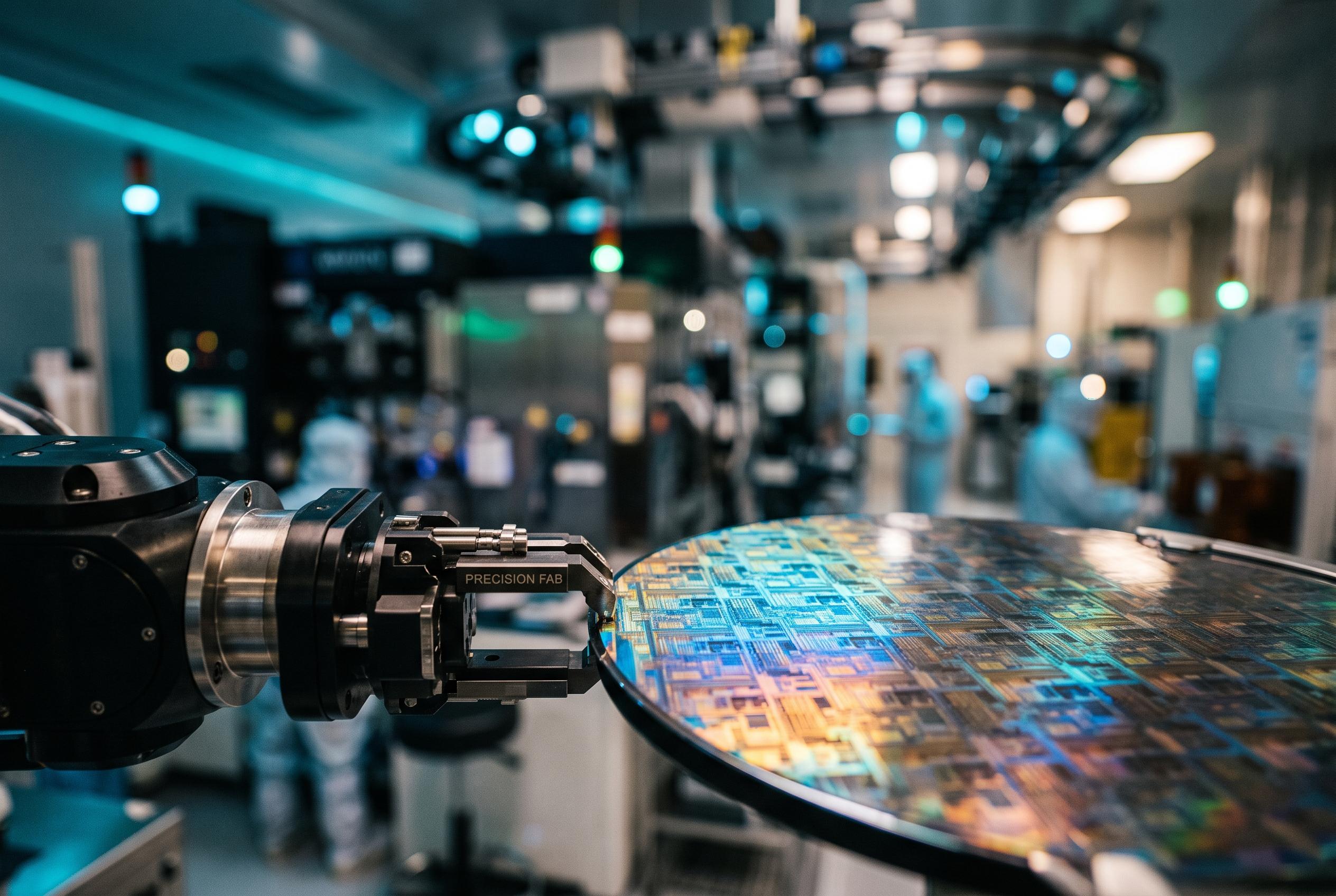
Elon Musk’s Terafab project is reportedly exploring a TSMC collaboration in Texas, a move that could bring world-class manufacturing expertise to one of the semiconductor industry’s most ambitious new factories. The potential partnership matters because Terafab is designed to supply AI chips for Tesla, SpaceX, and xAI while reducing reliance on overseas production.
The TSMC Terafab talks are still taking shape
TSMC and Elon Musk’s companies are discussing a possible Terafab collaboration, but no formal agreement has been signed. Tom’s Hardware reported that TSMC is assessing whether it could become a customer-facing manufacturing partner and potentially help operate the Texas facility.
That distinction matters. Terafab isn’t an ordinary chip plant waiting for a supplier; it’s an attempt to combine chip design, wafer production, memory, advanced packaging, and testing on one enormous campus. Bringing in TSMC could add the manufacturing experience needed to turn that bold blueprint into a functioning operation.
Intel is the only other publicly identified chipmaking partner linked to Terafab so far, according to Tom’s Hardware and The Motley Fool. For investors and technology watchers, TSMC’s involvement would signal that Musk’s project is being taken seriously beyond his own corporate network.
Why Texas is central to the plan
Terafab is planned for Grimes County, Texas, where Tesla and SpaceX have committed an initial $16.8 billion investment, according to TechCrunch. The companies are expected to hire at least 3,000 workers, giving the project a meaningful local economic footprint as well as national technology ambitions.
Texas has also offered substantial support. The state announced incentives and expansion assistance for SpaceX, while local officials approved tax benefits for the development, according to the Texas governor’s office and the Grimes County site-selection information.
The scale is almost comically large on paper. Planned floor space is estimated at roughly 100 million square feet, and the campus could stretch for more than three miles. That makes Terafab less like a conventional factory and more like a purpose-built industrial city, complete with the complicated logistics that come with it.
What Terafab wants to manufacture
The project’s technology goals are as ambitious as its footprint. Terafab is expected to target advanced processes, including a 2-nanometer class node, while producing chips for autonomous vehicles, humanoid robots, artificial intelligence systems, and space-based computing.
That range reflects Musk’s wider strategy. Tesla needs specialized processors for vehicles and robots, SpaceX needs chips that can cope with demanding space environments, and xAI needs large volumes of hardware for AI workloads. One integrated production campus could, in theory, give the companies tighter control over design, supply, packaging, and testing.
But chipmaking is notoriously unforgiving. A facility can be physically impressive and still struggle to achieve strong yields, consistent quality, and competitive costs. TSMC’s possible role is therefore especially important: its value would come not just from equipment or capacity, but from decades of practical manufacturing knowledge.
The supply-chain argument is driving Musk’s decision
Musk has linked Terafab to concerns about the reliability of future chip shipments from Taiwan. The thinking is straightforward, if politically charged: Tesla and SpaceX want more control over a component supply chain that could be disrupted by geopolitical tension, transport restrictions, or surging global demand.
The broader industry is already moving in that direction. Chipmakers are adding production in the United States, while governments are offering grants, tax breaks, and other incentives to encourage domestic semiconductor capacity. Terafab fits neatly into that push, although its proposed size and company-specific mission set it apart.
There’s also a practical reason for the urgency. AI computing is consuming chips at extraordinary speed, and demand is spreading beyond data centers into cars, robots, satellites, and industrial systems. As Chip Dispatch reported, Musk has suggested that existing global fabrication capacity may not be enough for the next stage of AI growth.
Can Terafab meet its huge deadline?
Construction began in August, with limited operations targeted for the end of 2027, according to the project’s public plans. That timeline is aggressive for any advanced semiconductor facility, particularly one aiming to integrate so many steps under one roof.
The project’s total investment could eventually reach about $119 billion across future construction phases, based on reporting tied to SpaceX’s filings. That figure shows both the opportunity and the risk. Building a fab is expensive; building one at unprecedented scale while developing new chips and manufacturing systems at the same time is an even bigger test.
A TSMC partnership could make the path less daunting, but it wouldn’t remove the hard parts. Terafab still needs equipment, engineers, reliable suppliers, strong yields, and a steady stream of viable chip designs. For now, the project remains a fascinating promise rather than a proven production engine.
What a TSMC partnership could mean for chip buyers
If talks become a formal agreement, Terafab could gain credibility with customers, suppliers, and government agencies. TSMC could also help Tesla, SpaceX, and xAI understand what it takes to scale advanced chip production without sacrificing reliability.
For consumers, the effects would be indirect at first. Better supply security could eventually support more capable vehicles, robots, satellites, and AI services, but those benefits depend on Terafab delivering working chips at commercial volumes.
The most telling development may be the partnership model itself. Musk’s companies appear to want control over strategic hardware, while TSMC brings the expertise needed to make advanced manufacturing repeatable. That combination could become one of the semiconductor sector’s most closely watched experiments.
Terafab is still a daring bet, but a TSMC collaboration could give the Texas project a much steadier foundation.
Disclaimer: This article may have been created with AI assistance and reviewed by our editorial team. It is provided for general informational purposes only. Readers should verify information independently before relying on this content.
