Download App
Better Online and Trade Show Sourcing Experiences.Scan the QR code to download.
Learn More
Hot Topics
The Octobot is modeled after an octopus and uses a chemical reaction and microfluidic logic circuit for movement.
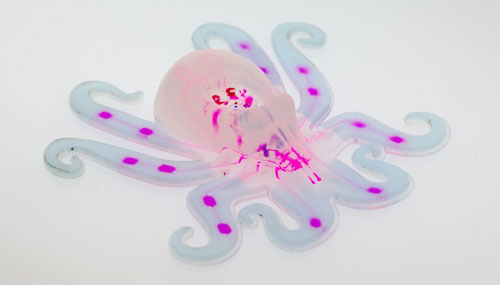
The Octobot was created using 3D printing, molding and soft lithography,
and moves via gas from a chemical reaction (Source: Lori Sanders/Harvard University)
Harvard researchers have created the world's first autonomous soft robot. Experts have long been looking for a way to create robots without rigid parts because it opens up a whole new way for the machines to move about. The trouble has been that robots typically require at least some electronic components, which would mean using rigid parts for power and circuitry. To get around this, the Harvard team uses gas through a chemical reaction and a microfluidic logic circuit that directs the reaction.
Modeled after an octopus, the robot is being called the Octobot. To create it without rigid parts, the robot was put together using 3D printing, molding and soft lithography. This means producing Octobot copies is quick and cheap relative to other means of manufacturing.
For now, the Octobot is just a proof of concept. Soft robots are not yet capable enough to be useful. The research is important, however, because it demonstrates how such robots could be made in the future. The researchers are hopeful that the Octobot can inspire roboticists to build on the concept, potentially paving the way for much more capable soft robots in the future.
As the concept exists now, it does not appear there will be much communication involved with the soft robots the way there is with modern interactive robots. That would require rigid components. Still, it is possible that at some point, roboticists will create a way for soft robots to work well with some small rigid components for the purpose of remote control.
More Sourcing News
Read Also

关注 “环球资源外贸” 官方微信,获取实时外贸资讯
iOS & Android
iOS & Android(Mainland China)
Copyright © 2026 Publishers Representatives Limited. All rights reserved.