Download App
Better Online and Trade Show Sourcing Experiences.Scan the QR code to download.
Learn More
Hot Topics
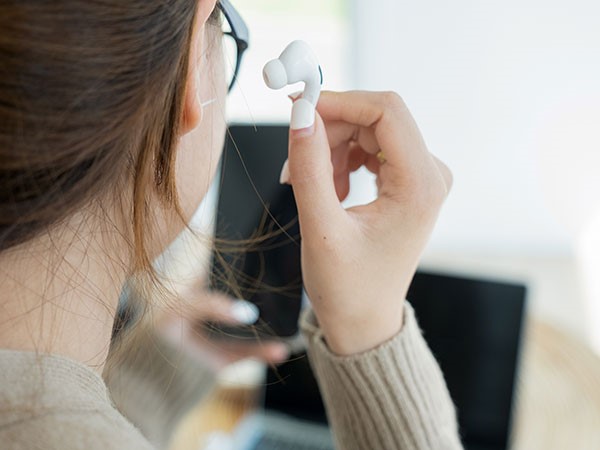 Image source: Getty
The first recorded patent application for earphones was submitted by a French engineer, Ernest Mercadier, in 1891. Back then, the in-ear device closely resembled a medical stethoscope and was primarily designed for telephone operators so that they could transfer calls through switchboards hands-free. Mercadier even called his invention a “bi-telephone.” Earphones have come a long way since their 19th-century debut.
Today’s earphones are sometimes grouped with headphones and the terms used interchangeably. However, to be precise, earphones are an audio device or speaker that is inserted in the ear and transmits sound directly into the ear canal. Some use the term “ear headphones,” which emphasize the device’s in-ear location.
There are only two types of earphones based on where they are inside the ears – earbuds and in-ear monitors, or IEMs.
Earbuds sit in the outer ear, so they may provide low isolation from outside noise. IEMs, on the other hand, have tips – sometimes called nubs or bits – that form a seal with the ear canal and thus provide better noise isolation. Striking a balance between sound quality and a comfortable fit essentially boils down to user preference if price is not a consideration.
Industry analysts categorize the sector into classic, wired, wireless and true wireless earbuds or earphones.
Classic earbuds are those that sit in front of the ear canal and rest on the earlobes. A common example would be Apple AirPods. Since they don’t completely block the ears, this type allows more ambient noise in, which is ideal for users who want to be aware of their environment. There is no in-ear pressure and they are lightweight, so they are comfortable to wear.
Downsides of this type are that the lack of isolation reduces sound quality, particularly bass performance, and that they may fall off when the user moves, especially during sports activities.
Wired earphones are those that connect to a device to receive audio signals. This type is more popular with the audiophile niche market who prefer more detailed sound and better noise isolation. End users value this type’s reliable audio transmission because they have zero latency or audio delay.
The downside of this type is that a growing number of devices no longer support earphone jacks. Another minus point is the cable noise that arises when the earphones’ wire rubs on a user’s clothes. Yet another disadvantage to wired units is that they can be easily unplugged from a device.
Wireless earbuds or earphones are those that receive audio signals from a device wirelessly via Bluetooth technology but have a wire connecting the left and right earpieces. Having a wire connecting the buds allows them to connect with each other and also provides space for a microphone, control buttons and batteries.
There are three main designs for wireless earphones:
One is where the wire falls behind the back of the head and a user can adjust the fit by means of a cable tightener.
Another design is one that uses a longer cable such that the wire rests along the back of the neck.
The third design is the neckband style, which uses a solid band resembling a collar to hold the wire in place. The collar-style support band allows a user to simply let the earphones dangle from the neckband when not in use. Neckband-style earphones can provide good call quality because the microphone is close to the user’s mouth.
True wireless earphones, meanwhile, are Bluetooth-based units whose earpieces not only connect to a device but also to each other without the use of any wires. An example is Apple’s Beats Fit Pro. They are highly portable, with a carrying case that doubles as the charging unit. Because all the essential tech – driver, amplifier, microphone, battery, etc. – must fit in the earbuds of true wireless units, there are some disadvantages.
Firstly, the earpieces are larger than usual wireless earbuds, so fit may be a problem and the pieces could easily fall out.
There is less space for everything, so batteries are smaller, affording less usage time.
Sound quality is also affected because the drivers are packed with everything else that needs to make speakers work in a small space.
The microphone is also farther away from the user’s mouth, which affects call quality.
In terms of connectivity, wireless earphones are segmented into those that use Bluetooth (BT), Wi-Fi and Near Field Communication (NFC).
Bluetooth is expected to be the major segment for the foreseeable future, according to Fortune Business Insights (BI), because the codec technology of BT earphones provides good sound quality. “Users are least likely to suffer from latency when listening to sound from mobile devices through BT earphones,” according to Fortune BI.
Bluetooth-based wireless earphones have different operating ranges based on their Bluetooth class. Most wireless earphones are Class-2 devices and can operate up to a range of 10m or about 33ft. Wireless earphones that are Class-1 have a range of 100m or about 300ft. Earphones within this class and range of connection are able to provide excellent sound.
One of the major technology developments for earphones is in the area of noise reduction.
Earphones with active noise-canceling (ANC) functions have tiny microphones and speakers built-in to capture background noise and then, by means of an audio processor, play the frequencies of these sounds in reverse polarity such that the noise is minimized or effectively blocked for the user.
In some models, the ANC function is complemented with ambient sound technology. This is the use of microphones in the earphones to capture environmental sounds – such as those from approaching animals or vehicles – to make users aware of their surroundings, for their personal safety, while they listen to their playlist or audio stream.
Some brands have control functions that allow users to customize their earphones’ level of ANC to allow for some background noise or environmental sounds to come through.
Other updates for the sector, as noted by Fortune BI, are wireless earbuds based on 3D spatial audio technologies, such as those being developed by CEVA Inc. and VisiSonics since their partnership began in 2020.
A China startup, EarFun, also debuted a water-resistant, sweat shield technology-based earbud model during the CES 2020 Innovation Summit.
Wireless charging is another key product trend for earphones in 2022, with some models having charging cases that need only to be set upon charging pads, such as those based on Qi technology, to be fully charged.
Demand is increasing for earphones, particularly those that have noise-canceling functions.
According to Market Research Future (MRF), advanced technologies like ANC that help eliminate background noise and improve sound quality are boosting market growth. MRF forecasts the wireless earphones market will grow to $32.24 billion by 2030, growing at 36.10 percent CAGR.
In addition, a market report from the CEO of Bluetooth SIG Inc., Mark Powell, notes that earbuds are the leading driver of growth for headphones. According to Powell, 263 million Bluetooth earbuds, or 39 percent of wireless headsets, will be shipped in 2022, but “by 2026, annual Bluetooth earbud shipments will triple, climbing to 619 million and making up 66 percent of all wireless headsets.”
North America currently accounts for the largest market share for earphones, but Asia Pacific is forecast to be the fastest-growing market, with countries like China and India fueling demand.
China may likewise remain the biggest producer of earphones. In 2021, the country accounted for about 90 percent of global earphones shipments, according to industry observer Equal Ocean.
The products in this gallery have been handpicked by our market analyst for representing current trends in earphones made in China.
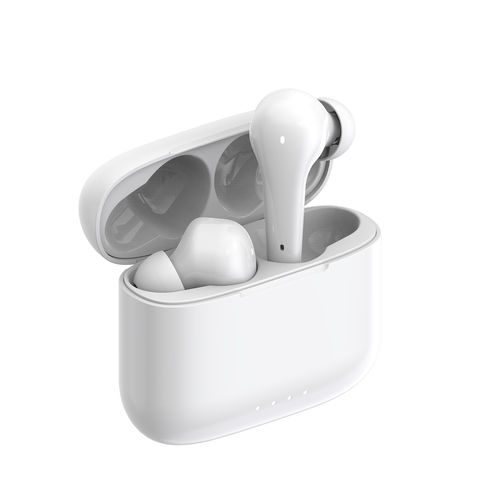
Model 12N from Gold Fingers are TWS earbuds with 10mm speaker drivers that feature hybrid, or feedback (FB) plus feed forward (FF), active noise cancelation as well as environmental noise cancelation capability. The unit is Bluetooth 5.2-enabled and supports HFP, HSP and AVRCP. It uses Bluetooth’s advanced audio codec (AAC). The unit has volume control on the earbuds and works with Siri and Google Home voice assistance technology.
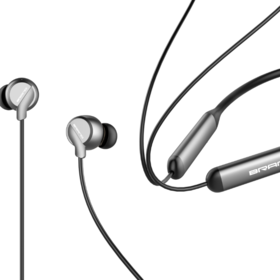
The HN1-G1 TWS earphones from Lighkeep have active-noise canceling and environmental noise canceling features. They are Bluetooth 5.0-enabled and support HFP, A2DP and AVRCP. Operating range is up to 12m. Speaker drivers are 13mm/16ohms and sensitivity is 100dB. The unit supports up to 20 hours of play time on a two-hour charge.
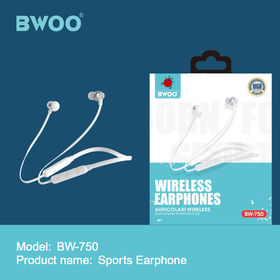
The BW750-B from Wusen is a Bluetooth 5.0 neckband model with -85dBm sensitivity, 10m range, and 3mW horn power. Its signal-to-noise ratio is ≥90dB and frequency response range is 50Hz to 20kHz. It has 12mm/32ohm speakers, and its microphone sensitivity is -42dB. The unit has 3.7V/165mAh batteries that an average of eight hours’ music/talk time on a two-hour charge. Unit dimensions are 160x130x22 mm and weight is 25g.
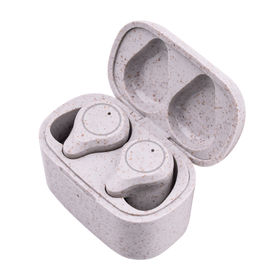
The C11112 TWS earbuds from Atlantis come with a charging case, the main material of the set being environment-friendly wheat straw. The earbuds support Bluetooth 5.0, with a transmission distance of up to 10m. They have 6mm copper ring horns with 50mAh batteries. Average playing time is four to five hours after one hour of charging in the case, whose battery is 230mAh.
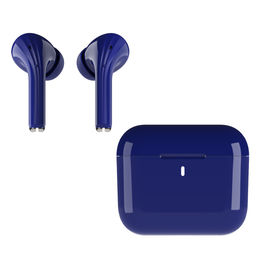
Model AKPods 01 from AVLink is a set of Bluetooth 5.1-enabled earphones with active noise canceling up to 25dB. The ANC level can be controlled by double-tapping the earbuds. The unit has a Realtek RTL8773B chipset and 12mm speaker drivers. Its operating range is 10m. The battery capacity of each earbud is 40mA, while that of the charging case is 730mA. Average working capacity for the earbuds is four hours on a single charge.
Global Sources is a trusted, internationally recognized B2B sourcing platform that has been driving global trade for more than 50 years. The company connects authentic buyers and verified suppliers worldwide with tailored solutions and trusted market intelligence through trade shows, digital platforms and magazines. Visit our website to source the right product for your market and contact verified suppliers:
Helpful Industry Sourcing Knowledge Center>>
Best Trendy Home Decor Iterm for 2022>>
Buyer's Guide: 4 Best Aftermarket Car Headlights>>
More Sourcing News
Read Also

关注 “环球资源外贸” 官方微信,获取实时外贸资讯
iOS & Android
iOS & Android(Mainland China)
Copyright © 2026 Publishers Representatives Limited. All rights reserved.




