Download App
Better Online and Trade Show Sourcing Experiences.Scan the QR code to download.
Learn More
Hot Topics
Download a free and ready-to-use product inspection checklist (Word document).
This comprehensive template has been created exclusively for Global Sources' buyers and is not available anywhere else.
If you let a Chinese supplier ship the goods out without inspecting them, and if you discover quality problems after delivery in your country, is there anything you can do? For most importers, the reply is no.
In a nutshell, the quality inspector is the last defense of the customer!
If the size of your orders does not justify the cost of at least one inspection before shipment, you need to mitigate your risks in any way you can - for example, by always working with the same reliable manufacturer, and by keeping some stock in your warehouse at all time (in case a shipment needs to be scrapped).

2. At what stage should you check production quality?
It depends on the major risks you identify:
The two most common types of inspections are:
1. The final random inspection, because it is the only time when samples can be picked at random and when most of the bulk is packed.
2. The inspection of the first finished products, to catch issues as early as possible.
But when do the first finished products appear?
It really depends on the organization of production:
3. Checking production status
3.1 If production is under way
You might want to ask these questions:
3.2 If production is in an advanced stage
If you come for a final inspection, you need to put pressure on the manufacturer to present all the products (or at least 80 percent of them) fully packed. Above a certain order quantity, this is the only way for you to count the pieces. And this is important because you want to pick samples from the entire production run - you do not want 30 percent of the goods to be hidden in a back room!
Important note: if some products are packed and others are waiting to be packed, make sure to pick both unpacked and packed samples - ideally in the same proportions as the total batch.
4. Checking product and packing specifications
4.1 Preparing the checklist
Now is the time to make use of the product specification sheet that, hopefully, you have prepared before production started.
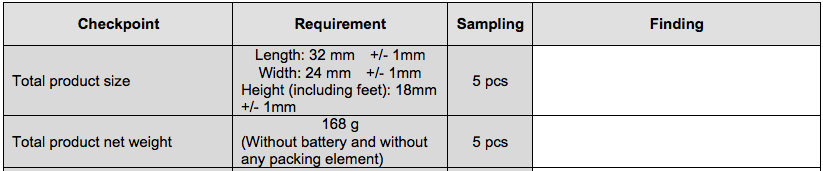
Before inspection, you simply need to paste the checkpoints and requirements (from the specification sheet) into the columns on the left of the inspection template. And, during the inspection, you enter findings on the right (in the white column).
This information coming from the product specification sheet...

...is pasted this way in the product inspection report:
4.2 Notes about the template
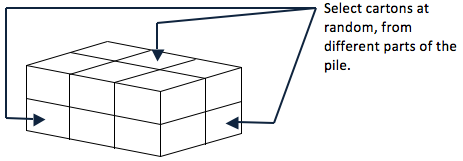
4.3 The procedure to follow
5. Checking visual defects
5.1 Checking more samples
After checking a few cartons and a few pieces in detail, you need to check more products visually. You will look for aesthetic defects (for example, stains, scratches, poor alignment), but you should also run quick tests (for example, plugging in an electrical product and switching it on/off, or stretching the stitching of a garment).
You should only select a few "quick tests" to check on all samples. Actually, you will need to make a trade off. Conducting many tests (or a few time-consuming tests) on the whole sample size might take you a lot of time. But if you do not run any test on the whole sample size, you might miss some quality issues.
5.2 Following industry-standard statistical rules
I strongly advise to draw a representative sample by following industry-standard statistical rules (MIL-STD 105E or commercial equivalents ANSI/ASQC Z1.4, ISO2859).
These rules will give you two pieces of information:
5.3 How many samples to check this way?
For simplicity, let us say you follow the same settings as 90 percent of importers of consumer goods:
There are two statistical charts that you need to be familiar with:
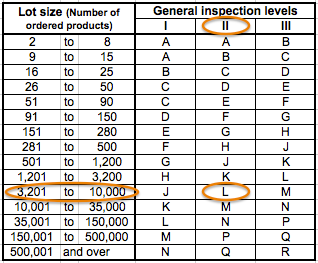
Let us assume that the order quantity is comprised between 3,201 pieces and 10,000 pieces. The code letter is "L".
2. Second table: Single sampling plans for level II inspection (normal severity)
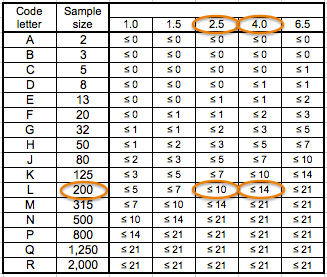
Your code letter is "L", so you will have to draw 200 pieces randomly from the total lot size.
And here are the limits -- the products are accepted if NOT A SINGLE critical defect AND NO MORE than 10 major defects AND NO MORE than 14 minor defects are found.
Read more about these concepts: What is an inspection level in ISO 2859? What is the "AQL", and when it is applicable?
6. Checking the loading of a container
Like in part 4, you will need to define your requirements before conducting the inspection. Here is some information you should try to specify:
6.1 The products to ship
6.2 The packing
6.3 Condition of the container(s)
6.4 The loading process
Renaud Anjoran is the founder of Sofeast Quality Control and helps importers to improve and secure their product quality in China. He writes advice for importers on the Quality Inspection blog. He lives full time in Shenzhen, China. You can contact him at info@sofeast.com.
More Sourcing News
Read Also

关注 “环球资源外贸” 官方微信,获取实时外贸资讯
iOS & Android
iOS & Android(Mainland China)
Copyright © 2026 Publishers Representatives Limited. All rights reserved.




