




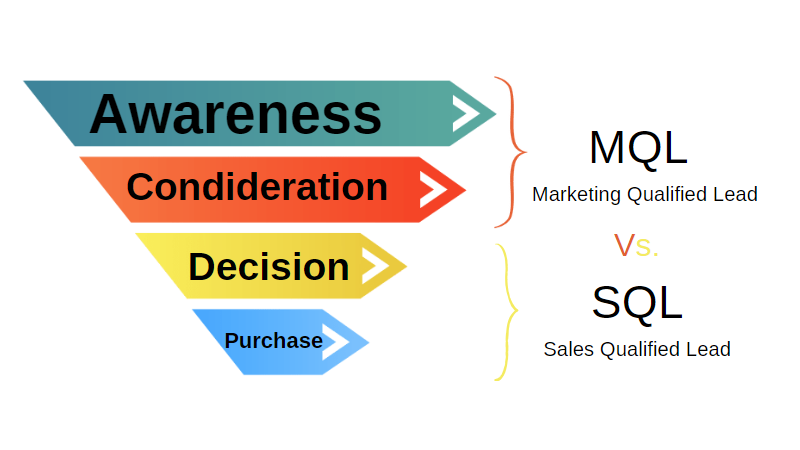
Businesses are looking for qualified leads. When it comes to the marketing and sales teams of a business, the two types of leads that the teams are exclusively concerned with are MQL/Marketing Qualified Leads and SQL/Sales Qualified Leads. In most cases, both teams face a common area of disagreement when differentiating MQL and SQL. Understanding the concept of MQL vs SQL is crucial for all businesses as it allows for a proper lead qualification process of the business. This is a common problem as the definition of MQL and SQL depends on the type of the business and its marketing and sales goals.
The MQL and SQL criteria of a business will depend on its strategy. However, having a clear understanding of these two types of leads and their differences will allow the teams to categorize and convert all leads effectively for the best result. Thus, the marketing and sales teams should work with each other with a clear concept of MQL vs SQL as it is one of the most effective methods to maximize the business's conversion rate and revenue rate. A proper flow of information will ensure a proper generation, movement, and conversion of leads through the sales funnel.
Both MQLs and SQLs are crucial for a business. Hence, having a clear understanding of the concept of MQL vs SQL is necessary for all businesses looking to convert their potential customers into paying customers.
Table of Contents
MQL vs. SQL: Head-to-head Comparison Chart
Why is the lead qualification process vital?
Identifying MQL and SQL criteria
MQL vs SQL: Understanding the difference
Why Differentiating Between MQLs and SQLs is Important
MQL vs. SQL: What's the Difference?
How to Transition a Lead from MQL to SQL
When is an SQL ready for sales?
FAQ: What is the difference between SQL and MQL?
What's an MQL?
An MQL, short for Marketing Qualified Lead, is a term commonly used in marketing and sales to describe a prospect who has shown a certain level of interest or engagement with a company's marketing efforts. These leads have typically interacted with the company's website, downloaded content, filled out forms, or engaged with marketing campaigns.
The purpose of identifying MQLs is to distinguish potential customers who have shown some interest in a product or service from general inquiries or casual website visitors. By identifying MQLs, marketing teams can focus their efforts on nurturing and further qualifying these leads, providing them with relevant and targeted information to move them closer to becoming paying customers.
Once an MQL has been identified and assessed, it is typically passed on to the sales team for further engagement. The sales team can then focus on converting these MQLs into sales-qualified leads (SQLs) and ultimately into paying customers. Overall, identifying and effectively managing MQLs helps streamline the marketing and sales process, ensuring that resources are efficiently utilized to maximize revenue generation.
What's an SQL?
An SQL, or Sales Qualified Lead, is a term used in the realm of marketing and sales to represent a lead that has been assessed and determined to have a higher potential for becoming a paying customer. Unlike an MQL, an SQL has undergone further qualification steps to determine their readiness to make a purchase.
To qualify as an SQL, a lead typically needs to meet certain criteria set by the sales team. These criteria often include factors such as the lead's level of interest, budget, authority to make purchasing decisions, and specific requirements that align with the company's offerings. The purpose of identifying SQLs is to prioritize sales efforts on leads that are more likely to convert and generate revenue.
Once an SQL is identified, the sales team will focus on engaging the lead, addressing their specific needs, and guiding them through the sales process. This may involve product demonstrations, personalized proposals, negotiations, and other activities aimed at closing the sale. By differentiating SQLs from other leads, businesses can allocate their sales resources more effectively, resulting in increased conversion rates and revenue growth.
MQL vs. SQL: What's the Difference? Head-to-head Comparison Chart
Here is a look into the major differences between MQL and SQL in a tabular format that both the marketing and sales team should be familiar with:
| Marketing Qualified Lead (MQL) | Sales Qualified Lead (SQL) | |
|---|---|---|
| Criteria | Based on engagement with marketing efforts (e.g., website visits, downloads, form submissions) | Based on specific qualification criteria set by the sales team (e.g., interest level, budget, decision-making authority) |
| Readiness | Shows interest but not fully ready for immediate purchase | Considered more ready and likely to make a purchase |
| Marketing Focus | Nurturing and educating through marketing activities | Needs-focused engagement and personalized sales efforts |
| Responsibility | Managed by marketing team | Managed by sales team |
| Handoff | Passed from marketing to sales for further qualification and engagement | Passed from marketing to sales for personalized sales efforts and closing |
| Goal | Increasing lead quantity and quality | Maximizing conversion rate and revenue |
| Outcome | Conversion from lead to MQL | Conversion from MQL to customer |
Why is the lead qualification process vital?
Businesses prioritize the vital process of lead qualification, as it is one of the most effective methods for achieving key business goals. Some advantages of identifying MQL and SQL properly through an effective lead qualification process are the following:
Alignment of Marketing and Sales Efforts
Defining MQL and SQL for a business becomes easy and effective through the process of lead qualification. This establishes a clear flow of information and order between the marketing and sales teams. Such a successful alignment between marketing and sales teams allows effective targeting of the right leads and proper prioritization of resources only on the most appropriate leads.
Effective Resource Usage
An effective lead qualification process informs a business about its potential customers who are ready to convert into paying customers. A business can use this information to invest their time, effort, and resources on such customers accordingly to ensure a quick conversion of the potential customers to paying customers. This also ensures overall cost reduction.
Enhanced Lead Conversion Rate
With the help of a successful lead qualification process, a business's sales team can successfully pinpoint customers who are ready to turn into paying customers. Proper investment in the right leads ensures reduced sales cycle length, streamlined sales processes, and an increased rate of conversion. A business can mitigate potential conversion risks as a proper lead qualification process can help in identifying and addressing potential roadblocks in the sales process.
Identifying MQL and SQL criteria
A business must understand the defining criteria for MQL and SQL as it leads to a successful lead generation process. A business can enjoy the advantages of an effective lead generation process if it knows the steps involved in setting the MQL and SQL criteria for that particular business's marketing and sales goals. Here is what a business focuses on for this purpose:
Key Buyer Personas
A business needs to focus on understanding its ideal customers along with their specific pain points. This will ease the process of key buyer personas identification. A business can use the information to create targeted marketing and sales campaigns that ensure a quick move of customers down the marketing and sales funnel. A business will have the insight to address customers' needs and challenges accordingly and effectively.
Lead Scoring Metrics
A business has to focus on determining its lead scoring metrics next. A business needs to rank its leads for this purpose based on the customers' engagement with the business and also the set key buying personas. This can be done by focusing on the points of various lead activities (for example content download, website visits, product inquiry, etc.).
Lead Qualification Framework
A business also needs to understand the concept of MQL vs SQL properly to determine the criteria as per its marketing and sales targets. If a business operates as per its established lead qualification framework, it can take the required actions to convert MQL into SQL effectively and quickly. As the framework is data-driven, businesses must also take steps to ensure the framework's optimal efficiency in every situation.
MQL vs SQL: Understanding the difference
Out of the many differences that are stated in the table above, the intent to buy between an MQL and an SQL is the most important difference that all businesses involved in the lead qualification process should know about. The intent to buy determines if a lead is MQL ready to become an SQL or an SQL that can be converted into sales. With the determined defining criteria for MQL, the marketing team can categorize the leads as marketing-ready and sales-ready. So, a business's marketing team should have a clear idea of what is defined as an intent to buy for the business in question and categorize it accordingly. The intent to buy for a lead required to determine if it is an MQL or SQL is done based on the following differentiations:
Difference between First-Time Visitor and Returning Visitor
In most cases, a first-time visitor cannot become a paying customer. The customer probably visited the business's website to gather insight to determine if the purchase would be worth it or not. Hence, a business should categorize a first-time visitor as a potential MQL.
On the other hand, returning visitors are those customers who have an interest in being paying customers. Thus, can be categorized as an SQL. Such customers are usually found downloading bottom-funnel content offers and browsing key pages. Such SQLs can be transformed to the sales team for a potential conversion into sales.
Difference between the Sales Funnel's Top and Bottom Offers
An MQL will be interested in downloading content offers that are present at the funnel's top. Such MQLs are looking for information and the marketing team should focus on educting such MQLs to ensure a quick conversion into SQLs.
Similarly, SQLs are those customers interested in only bottom-of-the-funnel content offers. Such customers are educated and looking for offers and other such benefits that will make their buying process effective and profitable. The sales team must ensure proper usage of resources as per the SQLs' need for a quick conversion of these SQLs into paying customers.
Why Differentiating Between MQLs and SQLs is Important
For all businesses interested in the lead qualification process, having a proper understanding of the difference between MQLs and SQLs is highly necessary. The marketing and sales team with the same proper knowledge will be able to provide many benefits for the business in question including enhanced collaboration and networking between both teams, proper resource allocation and optimization, enhanced customer experience, and effective lead conversion efforts.
Here is a more detailed look into the importance of having a clear concept of MQL vs SQL:
1. Effective Resource Allocation
By distinguishing between MQLs and SQLs, businesses can allocate their resources more effectively. MQLs require ongoing nurturing and engagement from the marketing team, while SQLs are ready for more personalized sales efforts. This ensures that resources are targeted appropriately, increasing efficiency and the likelihood of conversion.
2. Sales Focus
Differentiating between MQLs and SQLs enables the sales team to prioritize their efforts on leads that are more likely to convert into paying customers. SQLs have been further qualified and are considered ready for more personalized and targeted sales interactions. This allows the sales team to allocate their time and energy more efficiently.
3. Lead Nurturing
Identifying MQLs allows the marketing team to focus on nurturing these leads through personalized marketing campaigns. By understanding which leads are in the early stages of the buying journey, marketers can tailor their content and communications to educate and engage MQLs, moving them closer to becoming SQLs.
4. Alignment between Marketing and Sales
Distinguishing between MQLs and SQLs fosters better alignment between the marketing and sales teams. By clearly defining the handoff criteria from marketing to sales, both teams can work together more effectively to convert leads into customers. This collaboration ensures a smoother transition and enhances the overall customer experience.
5. ROI Measurement
Differentiating between MQLs and SQLs allows businesses to track and measure the return on investment (ROI) of their marketing and sales efforts. By monitoring the conversion rates from MQL to SQL and SQL to customer, organizations can assess the effectiveness of their lead generation and conversion strategies, making data-driven decisions for future campaigns.
6. Improved Customer Experience
Differentiating between MQLs and SQLs helps businesses deliver a more personalized and relevant experience for their leads. By tailoring marketing content and sales interactions to each stage of the buyer's journey, companies can provide the right information at the right time, increasing the chances of conversion and enhancing customer satisfaction.
MQL vs. SQL: What's the Difference?
Having a clear idea to effectively distinguish between MQL and SQL holds significant importance in the current dynamic landscape of lead generation and sales conversion. The marketing and sales team will be able to get an accurate view of a prospect's journey from a potential customer to a paying customer. Businesses determine and educate its MQL and SQL criteria to both teams for shaping sales strategies effectively to influence the overall customer's decision-making and experience.
Let's explore the fundamental difference between MQL and SQL in more detail:
1. Lead Generation
MQLs (Marketing Qualified Leads) are generated through marketing efforts, such as content marketing, social media campaigns, or website forms. These leads express initial interest in the company's products or services and are captured as potential prospects.
SQLs (Sales Qualified Leads) are generated through sales-specific activities, such as outbound prospecting, referrals, or direct inquiries from potential customers. These leads have shown a higher level of interest and have engaged in interactions that indicate their readiness for the sales team's attention.
2. Qualification Criteria
MQLs are typically qualified based on general criteria such as demographic information, engagement with marketing content, or specific actions taken on the company's website. These criteria indicate a level of interest but may not directly align with immediate purchasing intent.
SQLs, on the other hand, are further qualified based on specific criteria that indicate a higher likelihood of conversion. This may include factors like budget availability, purchase timelines, specific needs or pain points, or clear indications of readiness to engage in a sales process.
3. Nurturing Process
MQLs require ongoing nurturing from the marketing team to educate and engage them further. This nurturing process involves delivering relevant content, personalized communications, and building a relationship with the lead until they are deemed ready to be passed on to the sales team as SQLs.
Once leads are identified as SQLs, the sales team takes over the nurturing process, focusing on more personalized and targeted interactions. SQLs receive customized sales pitches, product demonstrations, pricing discussions, and negotiation processes aimed at converting them into paying customers.
4. Handoff and Sales Efforts
The handoff from marketing to sales typically occurs when an MQL meets specific criteria set by the company, indicating their readiness to engage with sales. At this point, the MQL is identified as an SQL and is passed on to the sales team. The sales team then dedicates their efforts to these SQLs, prioritizing them over other leads to maximize conversion rates.
In summary, MQLs are leads generated and nurtured by the marketing team, while SQLs are leads that meet specific qualifying criteria and are ready for more personalized sales efforts. The differentiation helps streamline the lead qualification process, optimize resource allocation, and improve the overall sales effectiveness.
How to Transition a Lead from MQL to SQL
The transition of a lead from MQL to SQL is a significant moment in the lead qualification and sales processes of a business. A proper or effective transition will significantly impact the trajectory of the teams' marketing and sales efforts. So, the team must focus on the shift seen in customers that resulted in a higher engagement with the business and greater potentiality of sales. MQL conversion to SQL ensures the possibility of increased sales rate for the business as well.
Transitioning a lead from MQL (Marketing Qualified Lead) to SQL (Sales Qualified Lead) involves a carefully designed process. Here are the key steps to facilitate this transition:
1. Establish Clear Qualification Criteria
Define specific criteria that indicate when an MQL should be considered an SQL. This may include factors like explicit interest in purchasing, budget availability, decision-making authority, and alignment with your target customer profile. Clear and agreed-upon criteria will help ensure consistent lead qualification.
2. Lead Scoring
Implement a lead scoring system to assign a numerical value to each lead based on their engagement level, actions taken, and fit with your ideal customer profile. This helps prioritize leads and identifies those with higher potential for conversion. Leads that reach a certain score threshold can be considered ready for the SQL stage.
3. Sales and Marketing Alignment
Establish effective communication and alignment between your sales and marketing teams. Regular meetings, shared metrics, and joint planning sessions can help foster collaboration and enable a smooth handoff of leads from marketing to sales. This ensures a seamless transition for the lead during the MQL to SQL process.
4. Lead Nurturing and Education
Provide targeted content and personalized nurturing to MQLs to further educate them and gauge their readiness for sales interactions. This can include email campaigns, webinars, case studies, and relevant content that addresses their pain points. By providing valuable information, you can increase the likelihood of MQLs becoming SQLs.
5. Implementation of Sales Tools
Equip your sales team with appropriate tools and technologies to effectively manage and track leads during the transition. Customer relationship management (CRM) systems, sales automation platforms, and lead management tools can streamline the process and provide insights into the lead's journey from MQL to SQL.
6. Qualifying Conversations
Encourage your sales team to engage in qualifying conversations with MQLs to understand their specific needs, budget, timeline, and decision-making process. This helps determine if the lead meets the defined SQL criteria and is ready for more personalized sales efforts.
7. Continuous Analysis and Refinement
Regularly review and analyze the effectiveness of your lead qualification process. Monitor conversion rates, gather feedback from sales and marketing teams, and make necessary adjustments to your criteria, lead scoring, and nurturing strategies. Continuous improvement ensures an optimized transition from MQL to SQL.
By following these steps and maintaining a collaborative approach between sales and marketing, you can effectively transition leads from MQLs to SQLs and increase the likelihood of conversion into paying customers.
When is an SQL ready for sales?
An SQL has more interest in becoming a paying customer than an MQL. An SQL undergoes many qualification steps for conversion potentiality. So, an SQL cannot be considered a sale. The sales team needs to take active steps to ensure the sales process is successful which means a successful conversion of SQLs into sales. A sales team takes many steps to ensure this, such as personalized proposals, product demonstrations, negotiations, etc. The steps from SQL to sales conversion are determined by the business as per its resources and goals. Even though the process is personalized, most businesses choose the BANT system for an accurate and successful lead qualification process. The system stands for the following:
1. Budget
A business must understand that an effective solution for its prospects may not suit all prospects even if they all like it. Not all prospects will be able to match a business's asking price with their fixed budget. No prospects would want to pay more than their determined product, and a business or its marketing team must take active steps to help such prospects become potential prospects. The marketing team should determine if the prospect can be converted or not and act accordingly to ensure no loss of the business's valuable time and efforts.
2. Authority
A business's returning visitors or prospects interested in its bottom-funnel content may not have the buying authority in some cases. A business should focus only on those leads (customers) for the qualification process that have the authority to make the buying decision. Business needs to ensure the conversion of MQLs to SQLs accordingly to ensure the sales is realized in the end. Thus, the sales team must ensure the SQLs selected for conversion have the authority to make the purchasing decision to facilitate an easy and quick overall conversion process for the business.
3. Needs
SQLs must have the requirement for the product or service that the business is involved in. The intent to buy becomes stronger for a customer if the customer feels or realizes the product/service is a requirement. Thus, the marketing team needs to hand over potential SQLs if they see the need. The sales team will be able to facilitate proper and quicker conversion if the need is high in the selected SQLs for conversion. MQLs and SQLs may take a long time to get convinced by the marketing and sales team. If the factor of need is taken into consideration when converting an SQL, the potentiality of effective conversion to sales increases.
4. Timeline
A business has to take into consideration different factors to ensure the sale process is conducted optimally. So, businesses need to focus on the different risks that can hinder the process of SQL to sales conversion (for example, SQLs interested, but waiting for funding). Thus, taking into consideration a lead's timeline before converting an MQL into SQL is necessary. The sale process will be quicker if the SQL prospect's timeline matches the SQL criteria for conversion to sales.
FAQ: What is the difference between SQL and MQL?
What is the difference between SQL and MQL?
SQL (Structured Query Language) and MQL (Marketing Qualified Lead) serve different purposes in the world of data management and marketing. Here's a breakdown of their differences:
SQL
SQL is a programming language used for managing and manipulating relational databases. It allows users to store, retrieve, and modify data stored in a database. SQL queries are used to perform various operations such as creating tables, inserting data, updating records, and querying data based on specific criteria. SQL is primarily used by developers and database administrators to interact with databases.
MQL
MQL, on the other hand, stands for Marketing Qualified Lead. It is a term commonly used in marketing and sales to describe a lead that has met certain criteria and is considered ready for further nurturing and engagement. MQLs are prospects who have shown interest in a company's products or services but may not be fully ready to make a purchase. Marketing teams use various methods to identify MQLs, including lead scoring, demographic information, and engagement metrics.
In summary, SQL is a programming language used for data management, while MQL is a marketing term used to qualify leads based on their level of interest and readiness to engage with a company's offerings.
What comes first, MQL or SQL?
In the context of lead management and the customer journey, MQL (Marketing Qualified Lead) generally comes before SQL (Sales Qualified Lead).
When a potential lead first interacts with a company's marketing efforts, they typically enter the top of the marketing funnel as a visitor or prospect. Marketing teams aim to convert these prospects into MQLs through various nurturing activities, such as capturing their contact information, engaging them with targeted content, and assessing their level of interest.
An MQL is a lead that has reached a specific threshold of interest, engagement, or qualification criteria set by the marketing team. It signifies that the lead has demonstrated potential readiness to move further down the funnel and requires additional nurturing before they can be handed over to the sales team as an SQL.
Once an MQL meets the predefined criteria, it gets passed on to the sales team for further evaluation and qualification. The sales team reviews the MQLs, conducts further discussions, and determines if a lead meets the qualification standards to become an SQL. An SQL is a lead that demonstrates a higher level of readiness to make a purchasing decision.
So, in the lead management process, MQLs typically come before SQLs. Marketing teams focus on nurturing and qualifying prospects to become MQLs, and then the sales team assesses and qualifies them further to become SQLs.
When to convert MQL to SQL?
The conversion of a Marketing Qualified Lead (MQL) to a Sales Qualified Lead (SQL) typically occurs when the lead meets specific criteria indicating a higher level of readiness for a sales engagement.
The criteria for converting an MQL to an SQL vary depending on the organization's specific lead management process, marketing strategies, and sales objectives. However, here are some common factors that may contribute to the decision of when to convert an MQL to an SQL:
Engagement and Actions
An MQL who consistently engages with marketing content, such as downloading whitepapers, attending webinars, or submitting contact forms, may demonstrate a higher level of interest and engagement. These actions indicate that the lead is actively seeking more information and may be ready for a sales conversation.
Lead Score
Many organizations use lead scoring systems to assign a numerical value to leads based on their behavior, demographics, and firmographics. Once an MQL reaches a certain lead score threshold, it can be considered ready for conversion to an SQL.
Demographic and Firmographic Alignment
An MQL that matches the ideal customer profile in terms of demographics (e.g., job title, company size) and firmographics (e.g., industry, location) may have a higher likelihood of converting into an SQL. Aligning the lead's attributes with the target audience helps ensure that the sales team focuses on leads with higher potential for conversion.
It's important for organizations to establish clear criteria for MQL to SQL conversion collaboratively between marketing and sales teams. Regular communication and data-driven analysis can help refine and optimize the conversion process.
How do MQLs become SQLs
Moving leads from the Marketing Qualified Lead (MQL) stage to the Sales Qualified Lead (SQL) stage involves a combination of marketing and sales efforts. The transition is typically driven by a continuous nurturing and qualification process. Here's an overview of how MQLs become SQLs:
Nurturing
Marketing teams nurture MQLs by providing them with relevant and valuable content tailored to their interests and needs. This can include email campaigns, personalized product recommendations, educational resources, or invitations to webinars or events. By delivering targeted content, marketing aims to build trust, strengthen relationships, and further educate the lead about the product or service.
Scoring and Tracking
MQLs are often assigned lead scores based on their engagement level, actions, and fit with the ideal customer profile. Ongoing tracking and monitoring allow marketing teams to identify MQLs who consistently engage, express buying signals, or meet specific criteria. The lead scoring process helps prioritize leads for sales outreach and indicates the potential to become an SQL.
Handover and Evaluation
When an MQL meets the defined criteria for conversion, it is handed over to the sales team for further evaluation. Sales reps review the lead's activity history, engagement level, and qualifying attributes. They may conduct conversations, gather additional information, and assess the lead's readiness to move forward with a purchasing decision.
Qualification and Acceptance
The sales team determines whether the lead meets the predefined criteria for an SQL. This evaluation typically involves assessing the lead's budget, authority, need, and timeline (BANT). If the lead aligns with the criteria and demonstrates a strong potential to convert, it is accepted as an SQL. The sales team then proceeds with deeper engagement, such as sales presentations, product demos, negotiations, or proposal discussions.
It's crucial for marketing and sales teams to maintain open communication throughout this process. Collaboratively defining and refining the MQL to SQL conversion criteria helps ensure a smooth transition and alignment between marketing efforts and sales objectives.
How to move a lead through the sales funnel?
Lead qualification as per MQL and SQL is done for the ultimate goal of the business - conversion of potential customers into paying customers. Hence, businesses need to plan accordingly to ensure an effective move of a lead from the top of the funnel to the bottom to make the sale happen. Here are some strategies businesses (the marketing and sales teams) usually use to move MQL leads through the sales funnel for an effective SQL to sales conversion:
Proper Planning
Proper separation and gradation of leads as per MQL and SQL is important for a quick and impactful sale. The marketing and sales teams must take proper steps to convert the leads for sale by nurturing leads continuously.
Effective Networking
The marketing and sales teams must know the MQL and SQL criteria of the business to ensure they are networking properly for a successful conversion.
Proper Information Exchange
Businesses need to understand that the requirements for all MQLs and SQLs cannot be the same. Hence, it is important to customize the information-sharing method so that the communication between "team and prospects" and "team and team" is done accurately and transparently.
Follow-up Calls
Both marketing and sales teams need to follow up with the leads via CRM or call-tracking to ensure no lead is lost. Such a strategy also brings proper engagement which can facilitate the sales conversion process for all prospects.
To Conclude
The marketing and sales team of a business needs to have a clear concept of MQL vs SQL as it can streamline the entire process of converting a first-time visitor or potential customer into paying customer. An MQL is a prospect showing interest in the business, while SQL can be defined as a qualified MQL that is ready to become a paying customer of the business as soon as all factors for the purchase align with its requirements, preferences, and budget. Businesses must delve deeper for a clearer picture and more effective conversion.

