Download App
Better Online and Trade Show Sourcing Experiences.Scan the QR code to download.
Learn More
Hot Topics
by Renaud Anjoran

What are the strategies you can follow to combat increasing raw material prices? I tried to come up with a shortlist of 6 strategy approaches that might make sense for you:
This one makes sense in some industries. Most apparel buyers seem to always be looking for the ‘cheapest needle’, taking their business and production all the way to Myanmar (which is going through a severe political crisis) and East Africa.
In many industries, the gains from this approach are negligible. Manufacturers of commoditized products already operate on thin margins and can’t give more concessions.
As the drawing below suggests, there are other ways to cut costs.
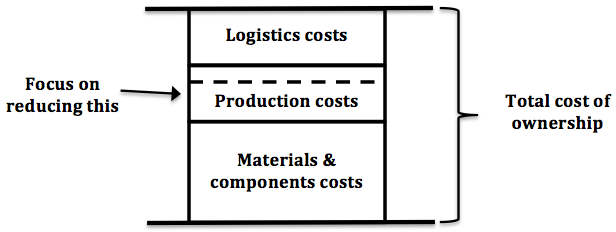
(By the way, if you are working with suppliers that are causing all sorts of cost overruns on your side, you do need to look for more reliable sources. Sometimes, paying an extra 5% and getting better performance is a great deal.)
Take a more holistic view of the costs:
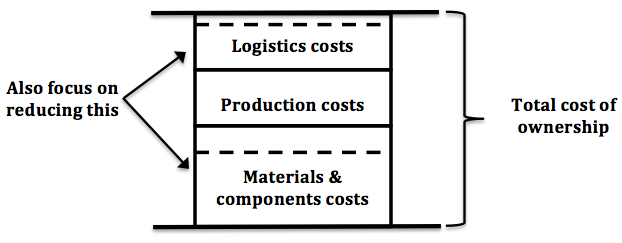
Try to think of ways to redesign your product itself with a different structure, different materials & components, without unneeded features, and so on.
That’s what they call ‘value engineering’.
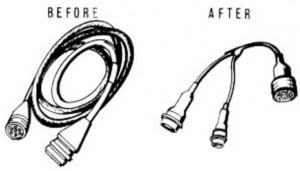
Here is an example from GE in the 1960s:
In the original design, custom molding was required and six types of cable assemblies were used. Typical costs for one type was $250 each […]. After value analysis was used, the leads, breakouts, and connectors were assembled using oversized tubing, then heat-shrink tubing was used. Typical costs for each unit fell to $100 […].
The production process might be unnecessarily expensive. Maybe your metal parts are CNC-machined out of a block of material, while some competitors use die casting with a bit of CNC finishing. Their unit cost may be 35% lower than yours.
Take a hard look at the packaging, too. Is it unnecessarily bulky and complicated? Sometimes, a thinner, more compact packaging protects the product better. (Read about an example here.)
And look at logistics – for example, using slip sheets instead of pallets to save on volume, working with regional distribution centers, etc. There are often many unexplored ways to save money.
This approach works particularly well if you develop new products and you have an open and productive relationship with key suppliers that contribute engineering resources and ideas.
Ikea realized cost savings between 5 and 15% by following this approach. Chrysler set up a system in the 1990s that generated more than a billion USD of annual savings.
Maybe your sales are not very seasonal and the manufacturing of your product (at least their final assembly) does not require very expensive equipment or deep know-how. Starting at a certain level, you might generate substantial benefits by handling the production yourself:
Raising your prices may be impossible if you sell the same product to retailers or even directly to consumers. You might actually be forced to decrease your prices!
The solution is often to develop new versions of your key products:
Not only are costs going up, but Chinese companies are becoming better at selling directly on your market. B2C marketing is a serious weakness of most manufacturers here, but more and more specialists are helping them set up a Kickstarter campaign, an Amazon account, and so on.
What is a key advantage that they don’t have? An understanding of the segments of your market, and the ability to pick the right message to reach some of those segments.
******
Are rising raw material prices affecting your business? What measures are you taking to combat them? Let me know in the comments, please.
Renaud Anjoran is a Certified ISO 9001 & 14001 lead auditor, ASQ certified Quality Engineer, and Quality Manager who has been working in the Chinese manufacturing industry since 2005.
This article originally appeared on QualityInspection.org and is reproduced here with the kind permission of the author.
More Sourcing News
Read Also

关注 “环球资源外贸” 官方微信,获取实时外贸资讯
iOS & Android
iOS & Android(Mainland China)
Copyright © 2026 Publishers Representatives Limited. All rights reserved.




