Download App
Better Online and Trade Show Sourcing Experiences.Scan the QR code to download.
Learn More
Hot Topics
A new crowdfunding campaign wants to prove that having full Windows on a smartphone can meet most of a user's needs.
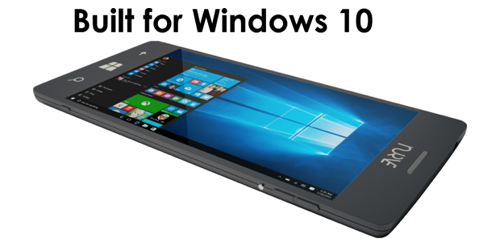
The SyncPhone runs full Windows 10, has a kickstand, a stylus and an optional keyboard cover to give it functionality similar to a Surface tablet, but in a much smaller form factor (Image from Nurve)
As smartphones have become more powerful, multiple companies have toyed with the idea of turning the phones into full-blown computers that can replace laptops and desktops for normal, everyday tasks. No one has yet created the perfect balance between mobile and desktop capability, but a company called Nurve wants to put full Windows 10 on a smartphone it calls SyncPhone.
The basic model of the SyncPhone uses an Intel Atom x5-Z8300, so it can run all of Windows legacy programs, making it a more capable phone even than Microsoft’s own Lumia series, which runs a mobile version of Windows 10. The phone also has 2GB of RAM and 32GB of internal storage, and includes a microSD card slot for expandable storage. Options for the phone go up to 8GB of RAM and 128GB of internal storage running on an Atom x7-Z8700.
Windows tablets have slowly been growing in popularity because of the full PC functionality that Windows 10 allows. Screen size is important with Windows, though, because some things are not fully optimized for touch, making certain items difficult to tap with fingers. The SyncPhone does have a stylus, which should alleviate some of those issues. Nurve is also working on a keyboard case for the phone.
For whatever struggles the phone might have with a touch-based interface, the Lumia phones have the opposite problem. Microsoft has been promoting the Continuum feature in its smartphones that shows a desktop-like interface when plugged into an external display. Unfortunately, without full Windows 10 and an Intel processor, the phones cannot run full desktop programs. Nurve is targeting the demographic that wants that functionality in their phones. SyncPhone starts at $199 on Indiegogo, but with the crowdfunding campaign having just started, the company has not yet raised much money and is a long way off from its $750,000 goal. The company said it will provide an option to dual boot the phone with Android once it reaches the $1 million mark.
This is likely a limited market for now, but large-screen smartphones have been eating into tablet sales for a while. The SyncPhone has a 5.4in screen, which is almost within the 5.5in range referred to as the “phablet” territory. This kind of device could cater to a market that finds it too onerous to carry a second device when they do not need it formost of the day. Technologically speaking, there is nothing complicated about putting Windows on a phone. XPPhone Technology from Hunan has already been producing phones running full Windows 8.1 with Intel chips. Windows 10 is a free upgrade until July 2016 and new licenses are free for devices smaller than 9in. The main advantage of Windows 10 is that it has a more seamless transition between the desktop and mobile environments. Windows 8.1 is perfect for phones, though, as it offers the same functionality and is built with a mobile-first mentality.
More Sourcing News
Read Also

关注 “环球资源外贸” 官方微信,获取实时外贸资讯
iOS & Android
iOS & Android(Mainland China)
Copyright © 2026 Publishers Representatives Limited. All rights reserved.