Download App
Better Online and Trade Show Sourcing Experiences.Scan the QR code to download.
Learn More
Hot Topics
Discover how locks evolved through the years.
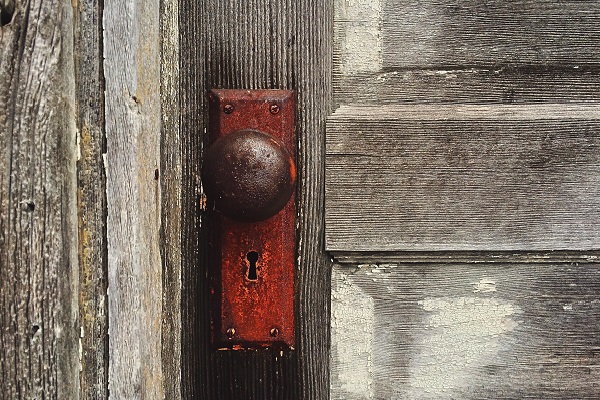
A smart home is not a house without smart security. Smart security is incomplete without smart door locks. The popular smart door locks won’t be here if not for the oldest locks.
Let’s look back at a smart home security essential’s humble beginnings and find out how it has evolved to how smart it is today and what’s in store for the future.
The oldest known lock (4,000 B.C.)
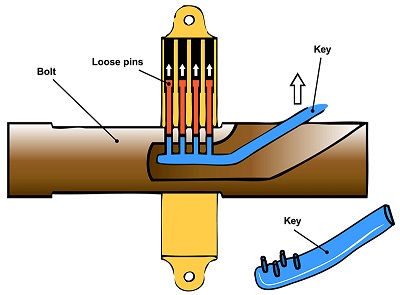
Wooden Egyptian lock. Image from storiesofworld.com
According to educational site ThoughtCo., the oldest known lock – the Egyptian lock – is about 4,000 years old, discovered in Khorsabad palace ruins in Iraq. As regards the mechanism, it’s a wooden bolt attached to a door. The bolt has holes with wooden pins of various lengths inside. It comes with a wooden “key” that has a brushlike head that inserts into the holes and should match the pins.
The pin lock was later improved by Romans who created more compact and metal versions. The use of metal was said to benefit the locks for metal was more durable than wood. Also, metal was lighter so it made way for keys to be hung as necklace pendants, worn as rings or be put inside pockets.
Warded locks (18th & 19th Century)
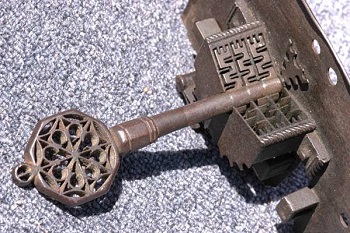
Stylish warded lock. Image from reddit/imgur
Used by the English during the middle ages, these locks have projections inside called “wards” that allow only the correct inserted key to turn. They can be made entirely out of metal.
Warded locks, however, were not secure against tampering, hence, the emergence of more lock innovations.
Double-acting tumbler lock (1778)
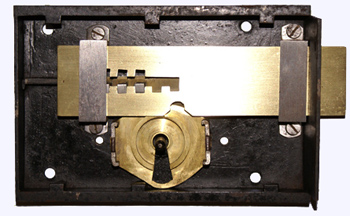
Barron’s lock. Image from historyoflocks.com
With warded locks vulnerable to skeleton keys and lock picks, locksmith Robert Barron of England came up with the double-acting tumbler lock in 1778.
The idea behind the lock, according to Gizmodo, is that levers need to be lifted to a specific height after the key matches all pins.
Safety lock (1784)
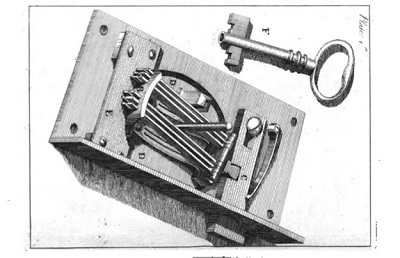
Bramah’s lock. Image from Jim Cooke/Gizmodo
Patented by locksmith Joseph Bramah in 1784, safety locks were said to resist lockpicking. The locking mechanism features wafers that when hit with the right cylindrical key retracts the bolt.
Bramah’s lock stayed “unpickable” for 70 years, according to a Gizmodo report.
Yale locks (1843 to 1862)
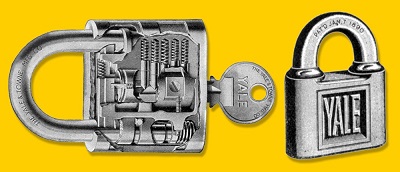
Yale lock. Image from Yalelock.com.au
Ever heard of the word Yale? You sure have, for it has been among the biggest brands in the lock industry. It started in the US in 1843 when locksmith Linus Yale got a patent for the pin-and-tumbler lock – now Yale lock.
Gizmodo sees the Yale lock as version 2.0 of the Egyptian lock but the difference is that the inner ends of the pins are attached to springs. When the notched and grooved key is inserted, making the pins align to a specific height, a plug must be twisted to unlock the lock. That’s exactly the concept behind the traditional keyed door locks and padlocks we know today.
Yale’s next innovation was reported to be the modern combination lock in 1862.
Schlage lock (1909)
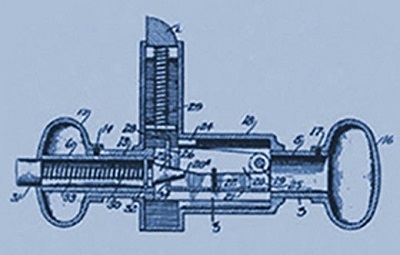
Schlage’s patented lock. Image from Schlage.com
If today, there are locks that pair with and control lights and appliances via a voice assistant, in 1909, there’s already lock that can turn lights on and off. It was Walter Schlage’s innovation.
Because of improving the lock into a smart one, Schlage, like Yale, has also become a known brand of locks.
Jimmy-proof locks (1912)
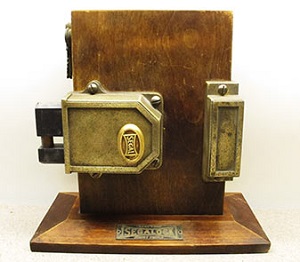
The first jimmy-proof lock. Image from Segal Lock Co.
Who’s Jimmy? Or rather… what’s a jimmy? The word refers to a crowbar of a burglar. It also means to force open a door or window that’s why there’s a phrase “to jimmy a lock”.
The first jimmy-proof lock was created by New York policeman Samuel Segal in 1912 to protect residents from thieves “jimmying” – “spreading the door frame”for access, according to Segal Lock Co.
It’s not like a deadbolt. US-based locksmith company All American Locksmiths explains the difference between the two: need for pin cylinder, lock location and installation.
Jimmy proof locks need the pin cylinder but are a good alternative to deadbolts for they are located on the inner side of the door, cannot be pried from outside and are easier to install.
Card & Electronic locks (1974)
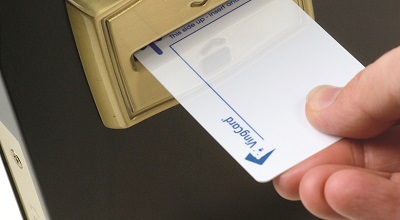
VingCard Allure. Image from Hotel News Resource
The card lock began in 1974. hotel lock specialist Assa Abloy (formerly VingCard Elsafe) tells that the story started with a lock maker named Tor Sørnes. He made the door lock, VingCard, as a solution for hotels after a woman was reported to be attacked by someone who broke into her hotel room.
Another maker, Bjørn Lyng, made the world’s first recordable keycard door lock that time and had partnered with the VingCard maker in 1994, founding VingCard Elsafe.
Smart locks (2000s to present)
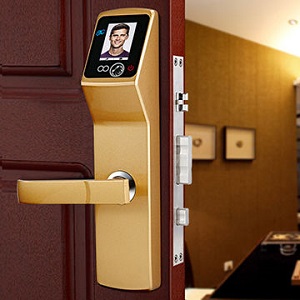
Face-recognition lock from China. Image from Fortune Mount
Fast forward to the time we’re living in. There are already plenty of new lock types consumers can choose from. Each varies in tightness of security and most are smart.
One definite direction locks are heading toward to is the path to keyless. In 2016, Kwikset and a few other manufacturers have started to release totally keyless locks. These locks are using biometrics, Wi-Fi, smartphones and touchscreens as alternative to the physical key. Some locks combine two or more of these methods for better security.
The trend continues. Smart door locks that can identify faces even in total darkness, send alerts to phones or apps, still look traditional,
unlock fast and support five or more methods, including palm recognition are increasing and showing that there’s an exciting future for smart locks.
Given these, the future of smart locks will be all about better biometrics and accuracy, remote unlocking and design.
More Sourcing News
Read Also

关注 “环球资源外贸” 官方微信,获取实时外贸资讯
iOS & Android
iOS & Android(Mainland China)
Copyright © 2026 Publishers Representatives Limited. All rights reserved.




