
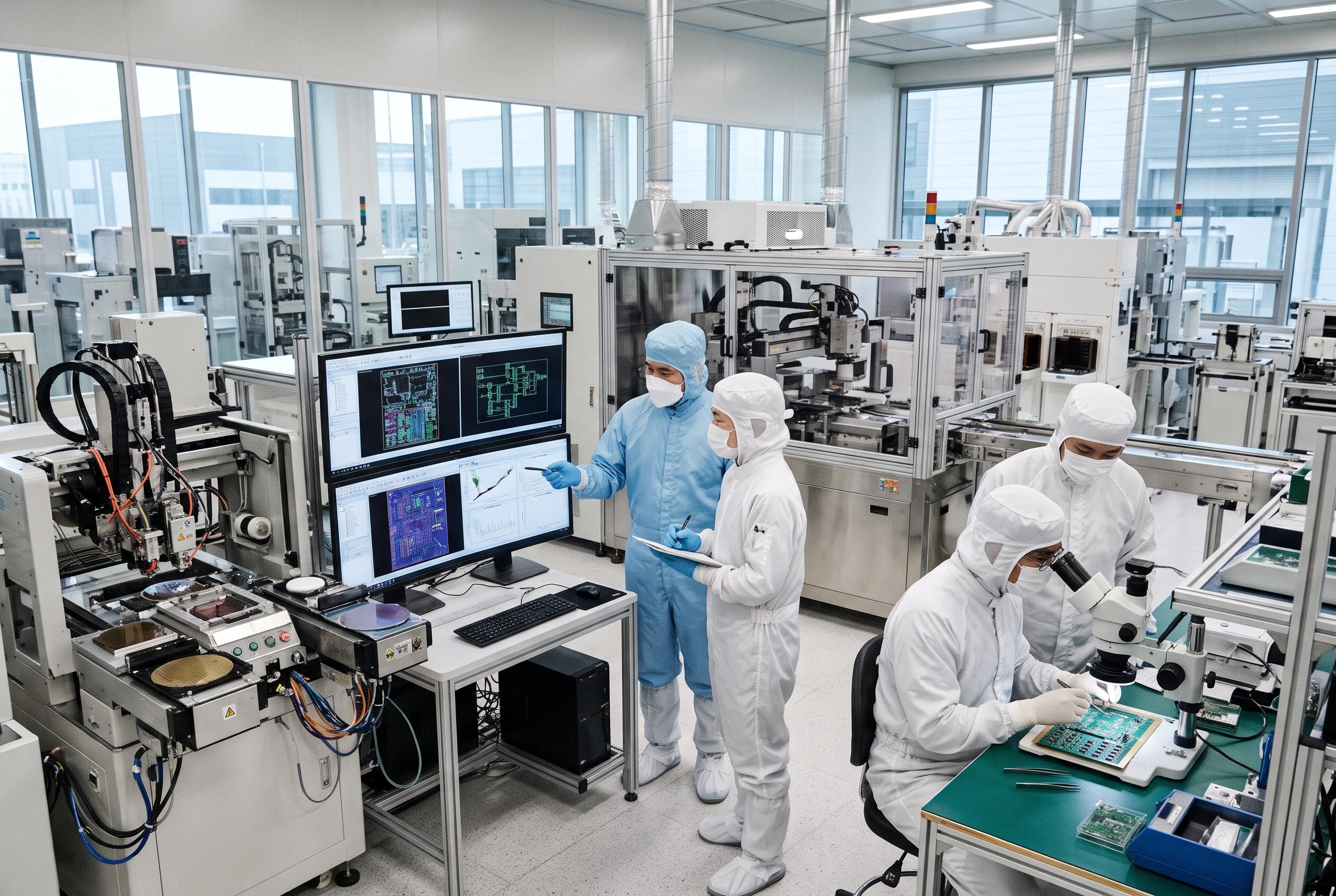
Engineers are turning to encrypted and reduced-order semiconductor models as advanced packaging links more suppliers, materials, and chiplets than ever. The appeal is obvious: companies can protect trade secrets while sharing enough behaviour to support thermal, mechanical, and electrical design. But the model's limits matter just as much as its accuracy.
Advanced packaging is making the black box harder to manage
The strongest shift in semiconductor packaging isn't simply that models are becoming more sophisticated. It's that their answers increasingly depend on information held by several different companies.
A chiplet, substrate, interposer, adhesive, or thermal structure may each be designed and characterised by a separate supplier. Once those parts meet inside one package, however, their behaviour is no longer neatly separated. A small change in one material can affect stress, heat flow, warpage, reliability, or electrical performance elsewhere.
That creates an awkward commercial balance. A supplier understandably wants to protect its formulation or manufacturing recipe, while the customer needs more than a single nominal value. According to Siemens' semiconductor packaging coverage, three-dimensional integrated circuit design increasingly requires system-level thermal thinking rather than isolated component analysis.
Traditional datasheets worked reasonably well when components could be treated as independent building blocks. Advanced packaging has narrowed that comfort zone. The package behaves like a system, even when the information behind it remains divided across the supply chain.
Secure models protect intellectual property, not engineering judgement
Encryption offers a clean answer to one part of the problem. A supplier can provide a simulation model that customers can run without seeing the geometry, material stack, or process details inside it.
That is useful, particularly for electromagnetic and high-frequency analysis. But security doesn't automatically equal suitability. An encrypted model may still have been created for a particular package configuration, temperature range, process window, or set of assumptions.
This is where model sharing needs a second layer of information. The engineer using the model should know what it represents, how it was calibrated, which conditions it covers, and what kind of decision it supports. The recipe can stay private, but the model's operating envelope shouldn't.
Research into model-based engineering and semiconductor packaging points to the same practical lesson: a secure model must communicate enough context for the recipient to judge whether its output applies. Otherwise, a precise-looking result can inspire false confidence, which is a particularly expensive kind of surprise.
Why material properties can't live in one neat column
Materials are where the limits become easiest to see. A datasheet might list coefficient of thermal expansion, modulus, adhesion, viscosity, or other properties, but those figures can change with temperature, degree of cure, moisture, time, and interface conditions.
That matters because package materials don't experience one tidy laboratory condition. They move through processing, assembly, operation, and thermal cycling. A value measured before curing or near a material's glass transition temperature may not describe behaviour later in the product's life.
Studies on semiconductor packaging and thermal simulation reinforce the need for condition-aware material data rather than isolated constants. A designer doesn't necessarily need the supplier's formulation, but they may need a curve, a range, a confidence level, or a description of how the property changes under realistic conditions.
For buyers and design teams comparing modelling tools, this is a useful test: ask whether the model carries behaviour across the intended temperature, moisture, time, and process ranges. If it offers only one number, treat that number as a starting point, not the whole story.
Fast surrogate models still need boundaries
Reduced-order and surrogate models make complex analysis more practical. Instead of running a high-fidelity physical simulation every time, engineers can use a faster approximation trained or derived from a more detailed representation.
The catch is familiar from many forms of machine learning. A surrogate tends to be most dependable inside the design or process space represented by its underlying data. Outside that range, it may still return a smooth, convincing answer, even though the result is no longer well supported.
Research on thermal modelling for complex interconnects and 3D structures highlights why this matters. Heat moves through the full stack, not just the die, so a model that was adequate for one arrangement may not remain adequate after materials, dimensions, power levels, or cooling conditions change.
The practical fix is an explicit validity envelope. Users should look for the covered geometries, temperature ranges, material states, calibration data, uncertainty estimates, and extrapolation warnings. If those details are missing, the model may be quick to run but slow to trust.
The interface is where accurate models can disagree
A package can contain several individually respectable models that don't quite fit together. One may assume a fixed temperature, while another expects temperature-dependent behaviour. A material model may describe a cured state, while a process model still assumes the material is evolving.
That mismatch is more than a formatting nuisance. It can change the physical meaning of the data as it passes from one tool or supplier to another. Research on thermal and electrical modelling for advanced interconnects shows how closely power distribution, heat flow, geometry, and reliability can be linked in 3D structures.
The best handoffs therefore carry more than dimensions and nominal properties. They should include measurement conditions, calibration history, process state, assumptions, uncertainty, and intended use. Think of it as a compact engineering contract: this is what the model describes, this is where it works, and this is where you should stop relying on it.
Advanced packaging won't make proprietary boundaries disappear. It will, however, make weakly documented boundaries increasingly visible. As packages become more tightly integrated, the winning model won't necessarily be the most open one. It'll be the one that protects the recipe while making its consequences clear enough for the next engineer to work safely.
A model is only as useful as the limits it carries with it.
Disclaimer: This article may have been created with AI assistance and reviewed by our editorial team. It is provided for general informational purposes only. Readers should verify information independently before relying on this content.
