
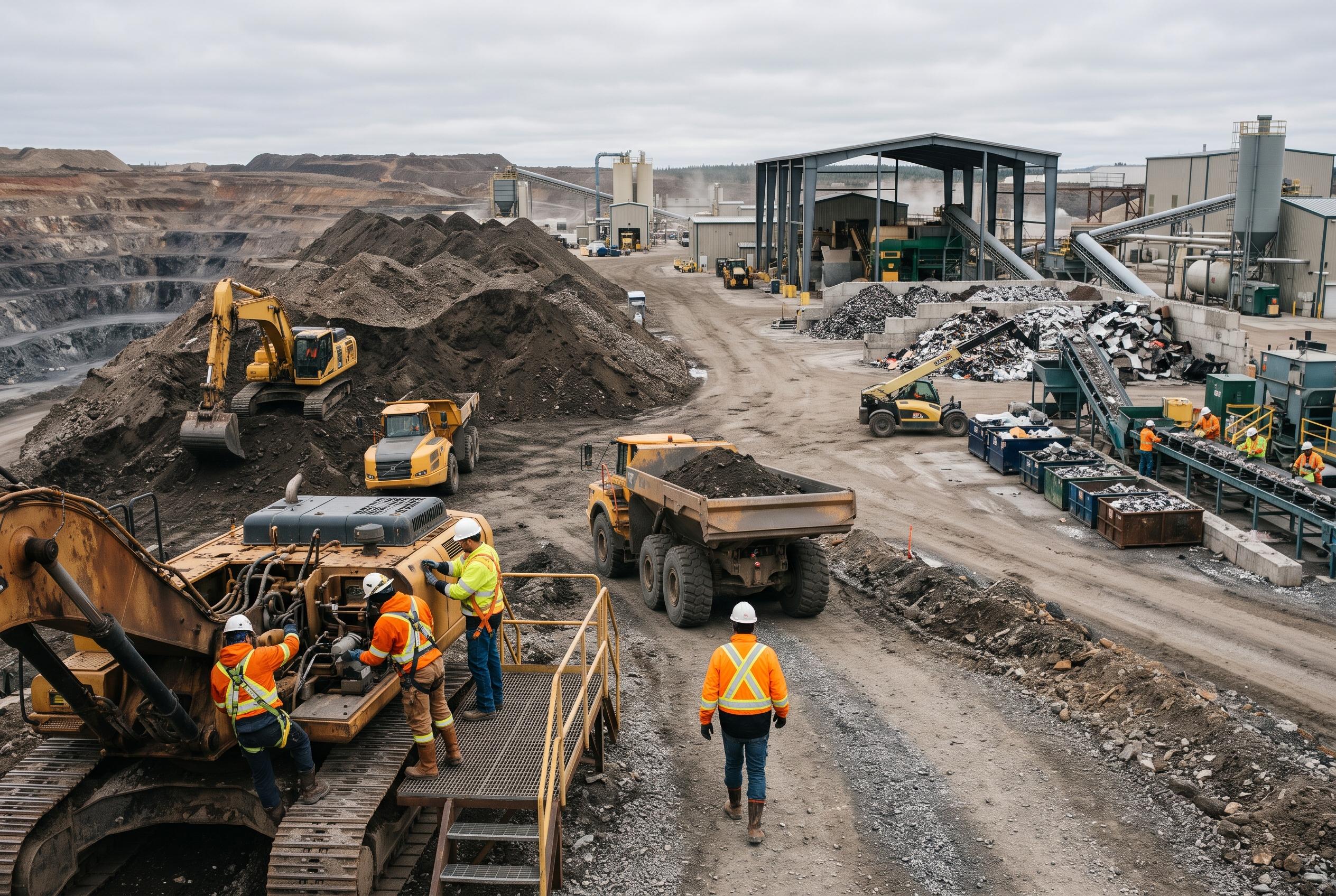
Manufacturers and policymakers are racing to build battery supply chains that rely less on China, but a complete break remains wildly expensive. The real pressure point isn't mining alone. It's refining, cathode and anode production, graphite, magnets, equipment and know-how, all of which shape how quickly electric vehicles and energy storage can scale.
The biggest battery vulnerability sits in the middle
The West may have access to lithium, nickel, cobalt and rare earth deposits, yet still struggle to turn those resources into usable battery materials. China’s advantage is its enormous processing and manufacturing network, not simply the rock beneath its soil.
That distinction matters. A mine outside China doesn't guarantee independence if its concentrate is shipped to Chinese refineries, or if the resulting material is processed with Chinese equipment and technology. According to GIS Reports, China remains the leading refiner for 19 of 20 strategic minerals, with an average share of roughly 70 percent.
For battery makers, this is the less glamorous but more consequential part of the story. A shiny new cell plant can still depend on imported graphite, cathodes, machinery or chemical inputs. The supply chain may look global on a map while remaining tightly concentrated in practice.
Why a China-free battery system is so difficult
Building alternative processing capacity is possible, but it takes time, money and dependable customers. Refineries need specialized chemistry, skilled workers, substantial energy and water supplies, careful waste handling and long-term contracts that protect investors when prices fall.
That last point is crucial. Chinese facilities benefit from scale and closely connected suppliers, while newer Western projects may be more expensive for years. Industry analysis from the Responsible Battery Coalition argues that China’s dominance in battery processing presents a national-security concern for the United States, particularly when critical materials can be restricted or redirected.
The numbers make a full separation look even less practical. GIS Reports says China could still account for more than 60 percent of refined lithium and cobalt production by 2035 under current policies. Its position in battery-grade graphite and rare earth magnet materials is expected to remain especially strong.
Export controls have turned supply chains into strategy
Recent restrictions have shown how quickly a materials problem can become an industrial one. Skillings reported that export controls are shifting the risk landscape for critical minerals, while S&P Global has warned that rare earth supply bottlenecks are likely to persist through 2026.
The impact reaches far beyond battery prices. Automakers, electronics companies and equipment manufacturers can be forced to slow or pause production when a small number of specialized inputs become unavailable. Tom's Hardware reported that TSMC has asked suppliers to find motors and chipmaking equipment that don't use Chinese rare earth magnets, a sign that the concern now extends into factory machinery itself.
China wouldn't necessarily need to impose a sweeping embargo. Tighter licensing, delayed approvals, broader rules for dual-use goods or aggressive pricing could put pressure on rival projects without creating the backlash that a total cutoff might trigger. That's why resilience matters more than a dramatic claim of total independence.
Allies are building a patchwork alternative
No single country can economically reproduce the entire battery chain. The more realistic approach is a coalition: resource-rich countries supply minerals, industrial powers develop refining and cell production, and major markets help guarantee demand.
The United States brings financing, vehicle demand and incentives. Australia and Canada offer mining strength and the potential for politically reliable processing. Europe contributes chemical expertise and regulatory influence, while Japan and South Korea bring materials knowledge, battery manufacturing and established industrial networks.
The Global Centre for Industrial and Resource Dynamics describes the battery chain as part of a broader system of industrial power, rather than a simple trade relationship. That framing is useful because it shifts attention from individual mines to the full network of factories, contracts, engineers and standards needed to keep production moving.
For consumers, the practical takeaway is simple: a battery labeled as assembled locally may not be locally sourced at every stage. Buyers comparing electric vehicles should focus less on slogans and more on battery chemistry, manufacturing location, warranty support and the automaker's ability to secure replacement parts over time.
New battery chemistries will help, but not save the day
Technology could reduce the pressure on certain minerals. Sodium-ion batteries are promising for affordable vehicles, two- and three-wheelers, stationary storage and colder climates because they can reduce reliance on lithium, nickel and cobalt.
Still, sodium-ion technology has lower energy density and remains relatively early in its commercial rollout. Its own manufacturing base is also heavily concentrated in China, so it changes some material requirements without automatically creating a fully independent supply chain.
Solid-state batteries could offer a bigger long-term shift, potentially improving safety and energy density while changing demand for graphite and some cathode materials. But GIS Reports expects early solid-state adoption to remain concentrated in premium vehicles through much of the first half of the 2030s. In other words, the next battery breakthrough probably won't arrive quickly enough to remove today's bottlenecks.
What a resilient battery future looks like
The likely outcome is selective de-risking, not total decoupling. Governments and companies will build enough non-Chinese refining, recycling, magnet and battery capacity to ensure that a supply disruption causes delays and higher costs, rather than an industrial shutdown.
That will require stockpiles, long-term purchase agreements, public financing and faster project approvals. Recycling should become more important too, particularly as early EV batteries reach the end of their driving lives and manufacturers seek materials closer to home.
S&P Global's warning about persistent rare earth bottlenecks underlines the scale of the challenge. The transition to electric transport isn't just a race to build more cars. It's also a test of whether the industry can create a deeper, sturdier and more geographically balanced industrial base.
The smartest strategy may be less dramatic than full separation, but it's far more achievable. As one industry observer might put it, the goal isn't to pretend China doesn't matter. It's to make sure one supply route can't bring the whole system to a stop.
Disclaimer: This article may have been created with AI assistance and reviewed by our editorial team. It is provided for general informational purposes only. Readers should verify information independently before relying on this content.
