
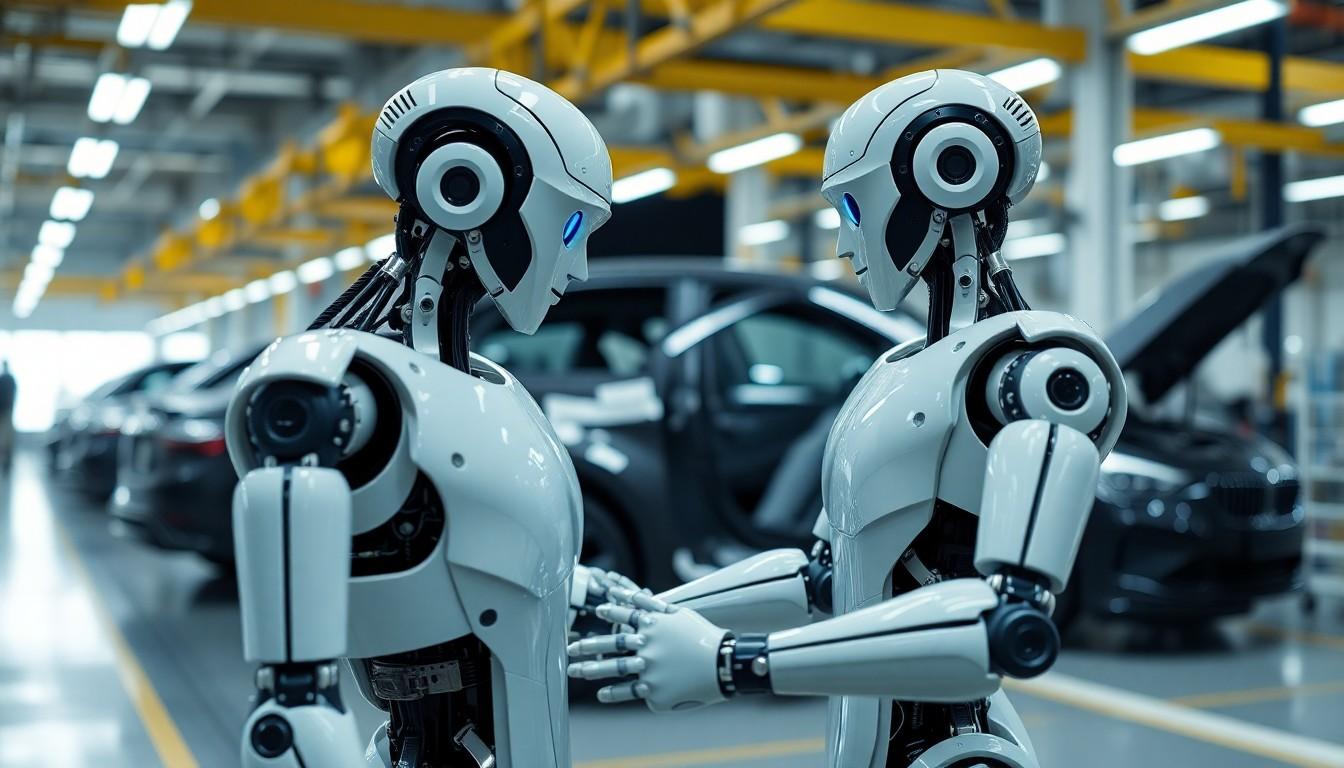
- Automakers are testing humanoid robots for factory tasks, but humans still outperform them in speed and flexibility.
- Companies like BMW, Hyundai, and Tesla are expanding robot trials, highlighting both potential and limitations.
- Cost, integration, and labor debates shape the future of robot use in manufacturing plants.
Automakers are expanding the use of humanoid robots in factory environments, testing whether machines designed to move and operate in ways similar to humans can perform repetitive assembly-line tasks. Early results indicate that the technology remains under development. Industry participants have acknowledged that humanoid robots still lag human workers in areas such as speed and flexibility.
BMW has highlighted the gap in its testing of Figure AI’s Figure 02 robot at its plant in Spartanburg, South Carolina. The robot has been used to move sheet metal parts and support welding preparation. BMW states that the robot can walk, grasp different parts, and transport containers. Ulrich Wieland, BMW’s logistics chief, told The New York Times that the robots remain slower than workers despite their development, leaving human workers ahead in overall task performance.
BMW is also expanding its testing beyond the United States. According to company materials, BMW plans to introduce the AEON humanoid robot at its plant in Leipzig, Germany, where it is expected to support battery assembly and component handling. The deployment represents BMW’s first use of humanoid robots in Europe and follows its testing activities in Spartanburg.
Other automakers are pursuing similar projects. Hyundai Motor Group plans to deploy AI-powered humanoid robots at its Georgia factory starting in 2028. Boston Dynamics is developing the robots for tasks including parts sequencing and production support. Industry and media reports have also indicated that Hyundai is considering broader use of robots across vehicle manufacturing operations. Tesla has also been developing its Optimus humanoid robot as part of its automation strategy and has made changes at its California facilities to accommodate robot-related production activities.
Some manufacturers and industry experts are questioning whether humanoid robots are the most suitable design for factory applications. Ben Armstrong, executive director of MIT’s Industrial Performance Center, told The New York Times that humanoid systems can be expensive for relatively simple manufacturing tasks, particularly at facilities that already use extensive automation. General Motors is focusing on robots with arms and hands rather than legs, while Renault has demonstrated a headless robot design, reflecting different approaches to industrial automation.
Labor is another consideration in the adoption of humanoid robots. Automakers have said the technology could address worker shortages, perform repetitive tasks, and allow employees to focus on roles such as maintenance and programming. Labor advocates have raised concerns that increased automation could reduce employment in some areas. Current deployments remain limited, with human workers still outperforming robots in some factory applications.
The development of humanoid robots also has implications for manufacturing, logistics, and industrial sourcing. The systems are being evaluated for applications including repetitive handling, labor-intensive processes, and operations requiring movement within existing production environments. Factory conditions can make these tasks more complex than demonstrations, as robots must perform reliably over repeated cycles while operating alongside workers, machinery, and changing production schedules.
The technology also involves components and systems used across the broader electronics and automation industries. Sensors, processors, machine learning systems, and edge-computing technologies are being incorporated into industrial robots. Their development therefore involves mechanical engineering as well as software, batteries, vision systems, electronics supply chains, and component sourcing. Humanoid robots combine these technologies within a mobile platform, resulting in different cost and sourcing requirements from conventional fixed robotic systems.
For factories, the selection of robotic systems depends on the requirements of each application. Humanoid robots may be suitable for facilities designed around human workflows, narrow spaces, or processes where existing infrastructure is intended to remain largely unchanged. Specialized machines, meanwhile, can continue to provide advantages for applications that prioritize speed, precision, and uptime. The comparison therefore involves the operational and economic requirements of each use case.
Logistics is another area being evaluated. Automotive production requires the movement of parts, containers, and subassemblies across large facilities. Robots used for internal logistics need to integrate with existing workflows, communicate with other systems, respond to disruptions, and avoid creating bottlenecks. Testing at BMW and other automakers is therefore also examining how humanoid robots operate within production and logistics processes.
The increasing visibility of industrial robots is also affecting public discussion around manufacturing and employment. Automation is becoming more visible through factory deployments and demonstrations, linking robotics with discussions about jobs, industrial technology, and future production models. These developments also connect industrial robotics with the electronics and global supply chains that support automotive manufacturing.
The current wave of humanoid robot testing remains focused on evaluating potential applications and operational limitations. Automakers are assessing where the systems can be deployed, what tasks they can perform reliably, and how they compare with existing automation and human labor. Human workers continue to provide advantages in speed, adaptability, and cost in some applications, while automakers continue to test humanoid robots as part of their broader automation strategies.
Takeaways
- - Humanoid robots are advancing quickly, but factory performance still trails human workers in many real-world tasks.
- - Automakers are testing them in logistics, welding prep, battery assembly, and parts handling.
- - The biggest challenges are speed, cost, flexibility, and integration with existing production systems.
- - The debate is not just technical; it also involves labor, sourcing, and the future of industrial work.
- - For now, most factories seem to be treating humanoid robots as pilots, not replacements.
Disclaimer: This article may have been created with AI assistance and reviewed by our editorial team. It is provided for general informational purposes only. Readers should verify information independently before relying on this content.
Source Reference Map
Inspired by headline at: 1
Sources by paragraph:
