
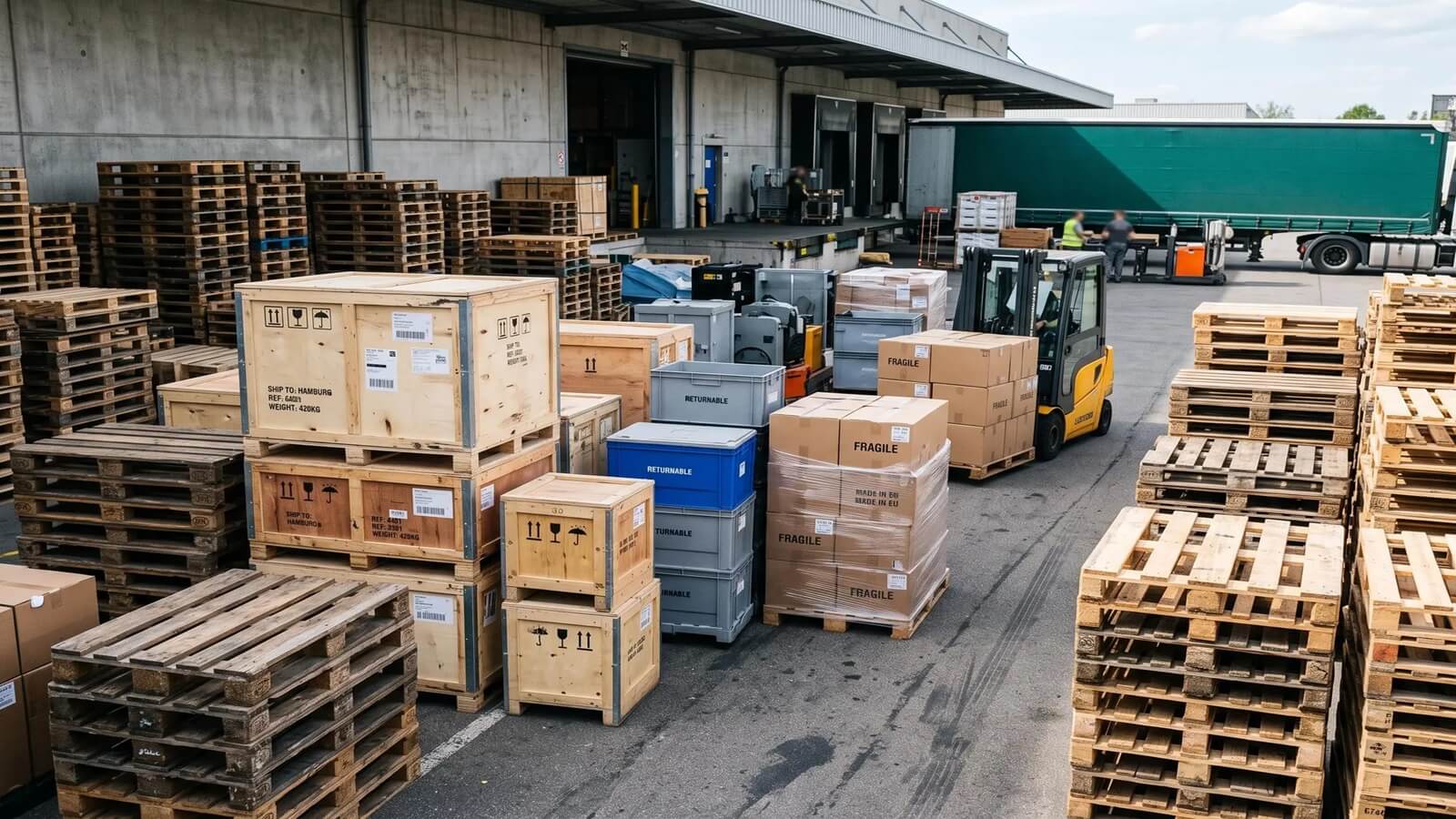
The EU is rolling out new packaging rules taking effect from 12 August 2026, prompting UK retailers, manufacturers and fast-moving consumer goods (FMCG) suppliers to review how pallets, crates and other transport packaging are managed when exporting to the EU.
With the Packaging and Packaging Waste Regulation in place, businesses using specified transport packaging will need to ensure at least 40 percent is reusable within a reuse system from January 2030. The rules cover pallets, boxes, trays, plastic crates, drums and other containers.
Commonwealth Handling Equipment Pool (CHEP) has urged exporters to improve tracking, recovery, repair and data processes. The regulation applies after imported goods enter the EU market and move through its supply chain, increasing the need for clear responsibility and reliable compliance data.
For many businesses, the immediate takeaway is that packaging can no longer be treated as a purely operational detail. It now sits at the intersection of sourcing, logistics and compliance, with direct implications for cost, inventory planning and supplier relationships. Companies that export regularly into the EU may need to map where transport packaging is used, how it circulates, who controls it at each stage, and what data can prove whether it is reusable, recovered, repaired or replaced. That level of visibility is especially important for firms managing complex cross-border flows, where pallets and crates may move through multiple distribution points before goods reach their destination.
The shift also raises practical questions for day-to-day operations. For example, if a retailer relies on a mix of one-way and reusable packaging, what proportion of that flow can realistically be converted into a reuse system by 2030? If a manufacturer ships to multiple EU markets, can the same packaging format work across different routes and customers, or will logistics need to be redesigned country by country? These are not just packaging questions; they affect warehouse handling, transport efficiency, mobile scanning processes, and the quality of data captured at handoff points. In that sense, the regulation encourages a broader rethink of packaging as a managed asset rather than a disposable cost line.
Businesses should also consider supplier engagement early. Packaging specifications often sit with sourcing teams, while usage and return systems are managed by operations, and compliance evidence may fall to quality or sustainability teams. That split can create gaps unless responsibilities are clearly defined. A supplier can provide the right pallets or crates, but if return cycles are not tracked properly, or if repair and recovery arrangements are inconsistent, the business may struggle to demonstrate compliance. Bringing together procurement, logistics, finance and compliance teams now may reduce disruption later and help identify where the biggest operational changes will be needed.
Data is likely to be a central theme. The regulation’s emphasis on reuse systems means businesses will need records that can stand up to scrutiny. That may include information on packaging type, ownership, cycle count, return rate, repair activity and location of use. It may also require more reliable reporting from third-party logistics providers and partners further down the supply chain. For companies already investing in digital logistics tools, barcode systems or mobile warehouse applications, this could be an opportunity to improve traceability and standardize how packaging movements are recorded. For others, it may mean building new processes from the ground up.
There is also a commercial angle. Reusable transport packaging can offer long-term value if it is managed well, but the transition requires coordination. Poorly planned reuse systems can create bottlenecks, unreturned assets or higher handling costs. Well-managed systems, by contrast, may support better packaging efficiency, less waste and more predictable replenishment. The challenge for businesses is to balance upfront change with longer-term operational benefits. This is particularly relevant for FMCG suppliers and retailers that rely on high-volume, fast-moving networks where even small disruptions can have a large effect on service levels.
The 2026 start date and the 2030 reuse threshold give businesses time, but not much. Companies that wait until the final year may find that packaging redesign, supplier onboarding, contract updates and compliance testing take longer than expected. A phased approach is likely to be more practical: first identify the packaging categories affected, then assess current reuse potential, then build recovery and repair processes, and finally test whether the data needed for compliance can be captured consistently across markets. This kind of staged planning can help reduce risk and may also reveal opportunities to simplify packaging portfolios.
In addition, firms should pay attention to customer expectations. EU packaging rules are part of a wider shift toward more accountable, circular logistics. Customers, investors and retail partners are increasingly looking for evidence that packaging systems are efficient and responsibly managed. Clear messaging on reuse, recovery and traceability can support broader sustainability goals, but only if the underlying systems are credible. That makes implementation detail important: internal controls, supplier contracts, handling procedures and reporting methods all need to align.
For UK exporters, the message is straightforward. The new EU packaging regime is not just a policy change to note; it is a business issue that touches sourcing decisions, logistics design and operational data. Companies that begin reviewing transport packaging now will be better placed to adapt their systems, manage costs and avoid last-minute compliance pressure as the 2026 deadline approaches.
Takeaways:
- Review all transport packaging used for EU exports, including pallets, crates, trays, drums and boxes.
- Map who owns, handles, tracks and returns packaging across the supply chain.
- Strengthen data collection for reuse, recovery, repair and cycle counts.
- Align sourcing, logistics and compliance teams early to avoid gaps.
- Treat reusable packaging as a managed asset, not just an operational consumable.
Disclaimer: This article may have been created with AI assistance and reviewed by our editorial team. It is provided for general informational purposes only. Readers should verify information independently before relying on this content.
