
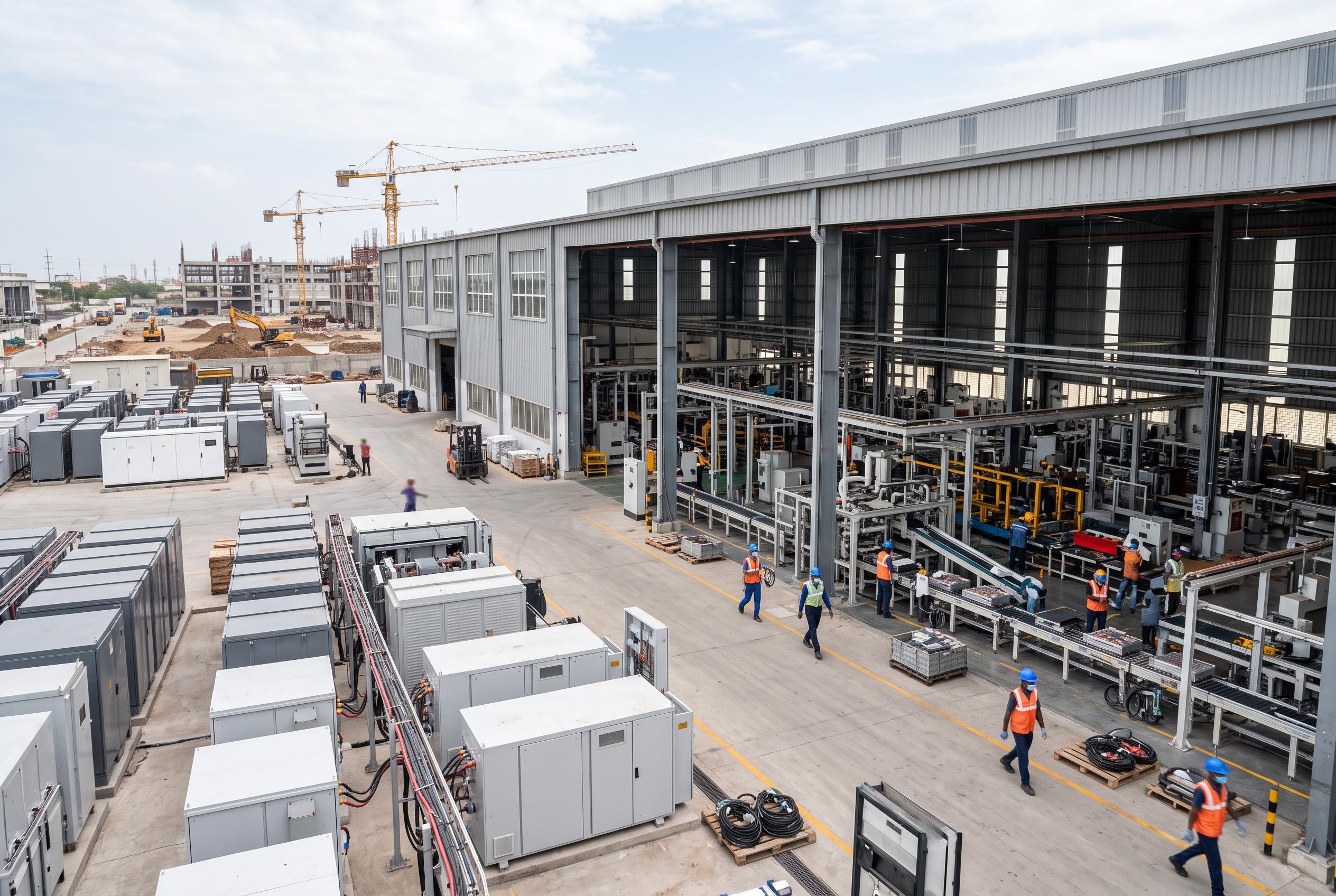
India’s battery storage manufacturing capacity has reached a notable milestone, but the country’s energy transition still rests on imported cells. New figures show downstream factories are expanding quickly, while domestic cell production remains limited, making scale, demand and reliable supply crucial to India’s storage ambitions.
India’s battery storage factories are growing, but the weak spot is clear
India's battery storage manufacturing story looks impressive at first glance. Across operational, planned and under-construction facilities, identified capacity has reached roughly 86 GWh, a scale that points to serious momentum in the country's energy economy.
But the more revealing detail sits beneath that headline. According to Mercom India, downstream manufacturing accounts for 92% of operational capacity. That includes battery packs, containers and complete energy storage systems, rather than the cells that sit at the heart of them.
The result is a growing domestic assembly base with a distinctly international core. Manufacturers can build and integrate systems in India, but many still rely on imported cells, materials and specialist equipment. The finished products may look local, yet the most important component often isn't.
Why cell production matters more than another assembly line
Cells represent a major share of battery system costs, so their price and availability directly affect the economics of utility-scale storage projects. Battery systems accounted for more than half of capital expenditure in India's utility-scale storage projects during the second quarter of 2026, making sourcing decisions especially important.
Mercom Capital Group CEO Raj Prabhu said the industry is expanding rapidly, while domestic cell production remains at an early stage. He noted that the real test will be turning announced and construction-stage projects into dependable commercial production.
That distinction matters. A factory announcement creates optimism, but a functioning plant needs competitive costs, consistent quality, strong yields and enough orders to stay busy. In battery manufacturing, an impressive nameplate figure is only the beginning.
Gujarat is becoming India’s battery manufacturing centre
Geography is also shaping the sector. Gujarat accounts for 51% of battery storage manufacturing capacity under construction, while Maharashtra follows with 20%, according to the Mercom report.
That concentration can offer practical advantages, including supplier networks, industrial infrastructure and easier coordination between manufacturers. It can also make the ecosystem more efficient as companies move from imported components toward locally produced cells, materials and equipment.
New entrants are playing a significant role, too. They account for 53% of identified operational and planned capacity, compared with 47% for existing manufacturers. That balance suggests India's storage market is attracting fresh capital, although newcomers will still need to prove they can deliver reliable output rather than simply announce ambitious targets.
Big projects could change the balance
Several companies are positioning themselves to close the gap. Pace Digitek, for example, is targeting 10 GWh of battery energy storage manufacturing capacity by the 2027 financial year, a plan that reflects the sector's appetite for large-scale expansion.
Reliance has also outlined a much larger ambition, targeting 120 GWh of annual battery and cell manufacturing capacity in its first phase. Such projects could materially improve domestic supply if they move from construction and commissioning into stable production.
Still, forecasts from Wood Mackenzie suggest India's battery storage self-sufficiency remains more than a decade away. That is a useful reality check: even large investments won't instantly replace established overseas supply chains, particularly when manufacturers must also develop expertise in cell chemistry, equipment, quality control and recycling.
Government support helps, but demand must keep pace
Policy is pushing the market forward. India's Production Linked Incentive programme for Advanced Chemistry Cell manufacturing has an allocation of INR 181 billion to support 50 GWh of capacity, with another 5 GWh reserved for niche technologies. Among supported projects, 6.4 GWh is operational and 28.6 GWh is under construction.
The Viability Gap Funding programme also includes a 20% local-content requirement for supported projects. However, qualifying downstream components and services can meet that threshold without using domestically manufactured cells, which limits the policy's immediate impact on cell demand.
That leaves manufacturers watching the project pipeline closely. As Prabhu explained, companies need clearer visibility on storage deployment, project awards and equipment demand before committing large amounts of capital. Put simply, factories need customers as much as customers need factories.
What this means for India’s energy transition
A stronger domestic storage industry could bring more than bragging rights. Local manufacturing may eventually improve supply security, shorten lead times and help developers manage costs as renewable power expands.
For now, though, India's battery ecosystem is best understood as a fast-growing downstream market with an unfinished cell industry. The next few years will show whether planned capacity becomes productive capacity, and whether demand grows quickly enough to support it.
The opportunity is substantial, but battery manufacturing rewards steady execution rather than flashy capacity announcements. India's storage future will depend on making cells competitively, filling factories consistently and proving that domestic systems can perform reliably in the field.
Disclaimer: This article may have been created with AI assistance and reviewed by our editorial team. It is provided for general informational purposes only. Readers should verify information independently before relying on this content.
