
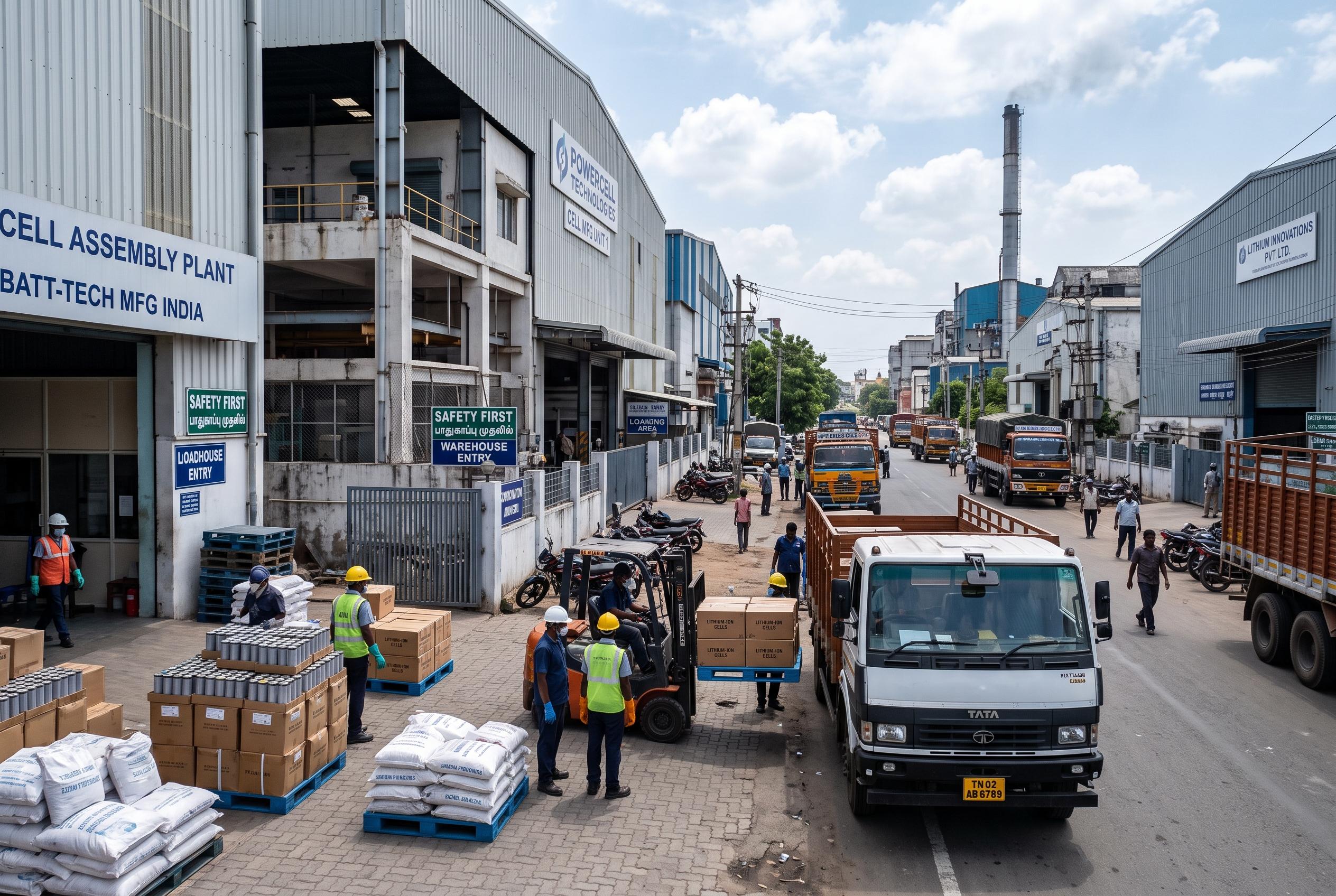
India’s lithium-ion cell imports are soaring despite a Rs 18,100 crore manufacturing incentive, exposing bottlenecks in technology, raw materials and production scale. A proposed Rs 12,000 crore program would shift support upstream to the components behind the cells.
India’s dependence on imported battery cells is deepening even as New Delhi pushes harder to electrify transport. Commerce ministry data cited by Business Today shows cell imports jumped 94% year on year to Rs 15,721 crore in the first quarter of 2026-27. In July alone, imports climbed 159% to Rs 7,209 crore, while full-year FY26 lithium-ion cell imports reached Rs 41,667 crore, with China supplying about 85% of the total.
The numbers underline a gap that government incentives have yet to close. The Union Cabinet approved the Rs 18,100 crore advanced chemistry cell incentive program in May 2021 with the aim of building 50 GWh of domestic capacity, plus another 5 GWh for niche chemistries. Yet four years later, progress remains limited. According to Business Today, only Ola Cell Technologies has begun commercial production, and even that at just 2.5 GWh, far below the 20 GWh awarded under the scheme. No beneficiary has received an incentive payment so far.
The stalled rollout has prompted officials and industry executives to look beyond final assembly and toward the upstream materials base. The government is now working on a new Rs 12,000 crore incentive program for battery-cell inputs such as cathode and anode active materials, electrolytes, copper foil, and separators. Industry leaders argue that this shift is overdue. Anurag Choudhary, chairman, managing director and chief executive of Himadri Speciality Chemical, told Business Today that the earlier program could not succeed without support for raw materials first, because cell makers would otherwise remain dependent on imported inputs.
That view is shared by other suppliers trying to localize production. Vikram Handa, founder and managing director of Epsilon Advanced Materials, said the only component routinely sourced domestically today is electrolyte, while the rest of the chain is still overwhelmingly tied to China. He estimated that more than 90% of cathode and anode active materials are processed there. Handa also said the challenge is not just policy but patient capital and a willingness to spend heavily on research and development, two conditions he believes remain in short supply in India.
Some domestic companies are nevertheless moving to build pieces of the ecosystem. Himadri says it plans a 2,000-ton cathode active material plant in Kolkata by December 2026 and a much larger 40,000-ton facility by FY28. It has also started a 200-ton anode plant in West Bengal. The company says cathode and anode together make up about 65% of a cell’s cost, making them central to any serious localization effort. Epsilon, meanwhile, says its graphite anode plant can support 2 GWh of cell capacity and that it aims to scale to 30,000 tons by 2028.
Even so, cost remains a major obstacle. Choudhary told Business Today that Indian-made cells could cost roughly 20% more than imported Chinese equivalents, while a separate executive at an Indian cell company said that even sourcing everything from China at the lowest price would still leave a locally made battery about 25% more expensive than a Chinese one. That pricing gap helps explain why many firms are hesitant to move faster without stronger policy support.
Several large Indian groups have also struggled to secure battery technology. Reliance Industries, which was allocated 15 GWh under the ACC program, has yet to install capacity. At the company’s latest annual meeting, Anant Ambani described access to battery technology as increasingly “weaponised” and called local manufacturing a strategic necessity. JSW Group has faced similar barriers: Parth Jindal said in August that LFP cell technology remains unavailable to the group, leaving its plans on hold. For now, India’s battery ambitions still depend on whether policy can do more than stimulate demand and actually build the full industrial stack behind it.
Why upstream battery materials matter
The figures point to a structural problem rather than a simple shortage of final cell assembly. India has sought to expand domestic battery manufacturing through incentives, but the companies expected to produce cells remain exposed to imported materials and technology. If cathode and anode active materials, copper foil, separators, and other inputs are not available locally, domestic production can still depend on overseas logistics and sourcing.
That dependence also affects cost. Cathode and anode materials account for about 65% of a cell’s cost, according to Himadri. As a result, localizing these components could influence the economics of the entire battery industry. However, the current cost gap shows why companies may hesitate to invest without support that addresses both production and research and development.
The proposed Rs 12,000 crore program therefore represents a possible change in emphasis. The earlier ACC scheme focused on creating cell capacity, while the proposed program would target the materials and components that sit behind that capacity. Industry executives believe the sequencing matters: cell manufacturing may be difficult to scale when crucial inputs remain overwhelmingly dependent on imports.
The issue also has wider implications for India’s electronics, mobility, and energy ambitions. Battery cells are central to electric transport, while the availability and price of those cells affect manufacturers, suppliers, and consumers. A weak domestic materials base can leave the broader ecosystem vulnerable to imported prices, technology constraints, and international logistics disruptions.
At the same time, building a domestic supply chain will not be immediate. Himadri’s planned facilities and Epsilon’s expansion goals show that companies are taking steps, but these projects still need time, capital, technology, and market support. The experience of the ACC program suggests that announced capacity and operating capacity can remain far apart. Ola Cell Technologies’ 2.5 GWh of commercial production, compared with the 20 GWh awarded under the scheme, illustrates that difference.
For policymakers, the challenge is to connect incentives with measurable production and a wider supplier network. For companies, the challenge is to invest despite higher costs and uncertain returns. For the electric mobility market, the outcome will determine whether India can build a battery industry that supports its transport ambitions or continues relying heavily on imported cells.
Key questions
Why are India’s battery-cell imports rising? Imports are rising as domestic cell production remains limited while demand linked to transport electrification continues to grow.
What is the main weakness in the current battery ecosystem? The upstream materials base remains underdeveloped. Most cathode and anode active materials are still processed in China, and domestic cell makers remain dependent on imported inputs.
What does the proposed Rs 12,000 crore program target? It would support battery-cell inputs including cathode and anode active materials, electrolytes, copper foil, and separators.
Why are Indian-made cells more expensive? Industry executives cited higher costs for locally made cells, with estimates ranging from roughly 20% to 25% above Chinese alternatives.
What must happen for localization to accelerate? India needs progress in materials production, technology access, patient capital, research and development, and commercial-scale manufacturing.
Disclaimer: This article may have been created with AI assistance and reviewed by our editorial team. It is provided for general informational purposes only. Readers should verify information independently before relying on this content.
Source Reference Map
Inspired by headline at: [1]
Sources by paragraph: - Paragraph 1: [2] - Paragraph 2: [3], [4], [6] - Paragraph 3: [2], [6] - Paragraph 4: [2] - Paragraph 5: [2] - Paragraph 6: [2] - Paragraph 7: [2], [5], [6], [7]
