
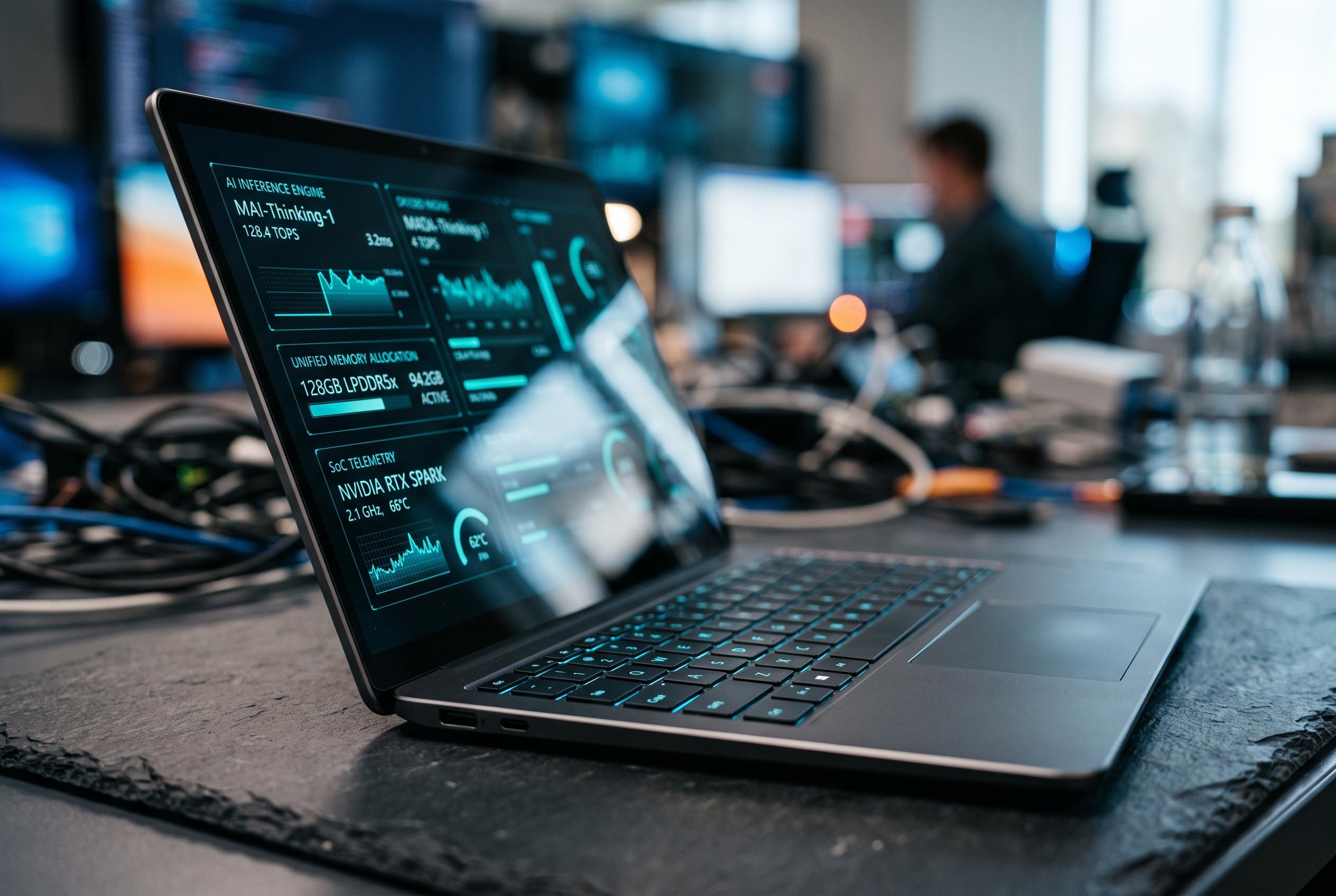
Microsoft's next Windows and Surface event could turn its MAI models into a practical on-device AI platform, with NVIDIA hardware, faster local processing, and tighter software integration all in the spotlight. The shift matters for shoppers and businesses weighing privacy, performance, price, and the growing risk of being locked into one ecosystem.
Microsoft wants AI to live inside the PC
The most important change isn't simply another chatbot. It's the move from cloud-only intelligence toward AI that can run directly on a computer, where responses can feel quicker and sensitive data may stay closer to the user.
Microsoft's MAI family, introduced through its broader developer and cloud strategy, includes reasoning, coding, image, voice, and transcription models. The company says its flagship MAI-Thinking-1 uses a mixture-of-experts design and a very large context window, giving it room to handle lengthy documents, complex instructions, and multi-step tasks.
That sounds impressive, but the real test will be whether ordinary users notice the difference. A model that quietly works offline, opens files faster, and avoids a spinning cloud connection could be more useful than one that merely wins a benchmark.
The October event could reveal Microsoft's full-stack plan
Microsoft's expected October 7 gathering is being watched as a hardware moment, not just a software presentation. Windows Central reported that the event is set to focus on Microsoft's Windows and Surface products, while the wider industry expects NVIDIA involvement to sharpen the AI-PC message.
The likely strategy is familiar but ambitious: control more of the stack. Microsoft can connect its models to Windows, Surface hardware, Microsoft 365, GitHub Copilot, and VS Code, creating a polished path from processor to application.
That convenience has a clear appeal for businesses. IT departments often prefer predictable support, consistent security policies, and fewer moving parts. The trade-off is less exciting: once a workflow depends on Microsoft's models, containers, APIs, and hardware recommendations, switching providers may become expensive and awkward.
NVIDIA and AMD are fighting for the local-AI crown
NVIDIA's reported RTX Spark platform is designed to make unusually large models more practical on a desktop or laptop. CNET's preview, as cited in the lead coverage, points to 128GB of unified memory and up to one petaflop of FP4 performance, specifications aimed at running heavily quantized models locally.
AMD isn't sitting quietly on the sidelines. Tom's Hardware reported that AMD is promoting its Gorgon Halo platform with AI benchmarks and says it has shipped more than half a million agentic PCs. Tom's Guide also highlighted the Ryzen AI Max Pro 495, a chip with up to 192GB of memory that could challenge NVIDIA's high-memory approach and appeal to users who want serious AI capability without a separate workstation.
For shoppers, this is good news. More competition should mean more choices, but raw numbers can be slippery. Memory capacity, software support, cooling, battery life, and model compatibility matter just as much as headline performance.
Why local AI could change the buying decision
Running models on-device can reduce latency, limit cloud usage, and help organisations keep private material within their own systems. It could also make AI more dependable in places with poor connectivity, from busy offices to travel scenarios.
Microsoft's reported Execution Containers are intended to give local agents an isolated, policy-controlled environment in Windows. That kind of system-level guardrail could matter more than flashy demos, especially when an AI tool can read documents, launch applications, or take actions on a user's behalf.
Still, buyers shouldn't assume "local" automatically means private or free. A PC may run some tasks offline while relying on cloud services for larger models, updates, or account features. Before purchasing, check which functions work without an internet connection, whether memory is upgradeable, and whether the software requires a recurring subscription.
Performance claims deserve a raised eyebrow
Microsoft has positioned MAI-Thinking-1 and MAI-Code-1-Flash as competitive with leading commercial models, including strong software-engineering results. But the reported scores haven't yet received the kind of broad, independent validation that would settle the argument.
That caution extends across the market. Recent Geekbench results, reported by Tom's Hardware, suggest that OpenAI's agent technology can run on modest virtual-machine hardware, but synthetic results don't necessarily predict how smoothly a model will handle real files, codebases, or messy workplace instructions.
The practical question is simple: does the system save time without creating new headaches? Until independent reviews test noise, heat, battery drain, prompt speed, privacy settings, and software reliability, impressive AI specifications should be treated as a starting point rather than a verdict.
A more expensive PC could be the price of convenience
Microsoft's cloud pricing for MAI-Thinking-1 is designed to look competitive, particularly for reasoning-heavy workloads. At the same time, open-weight models are putting pressure on commercial providers by offering lower-cost alternatives and more control over deployment.
That creates a familiar consumer dilemma. A tightly integrated Microsoft PC could offer a smoother experience, while a more open setup may cost less and give advanced users greater freedom. The right choice depends on whether convenience, compliance, and support are worth paying for.
For now, the October event should clarify whether local AI is ready for everyday laptops or remains a premium feature for developers and enterprises. Either way, the quiet PC on your desk is about to become a much more interesting piece of hardware.
It's worth comparing the whole system, not just the biggest AI number on the box.
Disclaimer: This article may have been created with AI assistance and reviewed by our editorial team. It is provided for general informational purposes only. Readers should verify information independently before relying on this content.
