
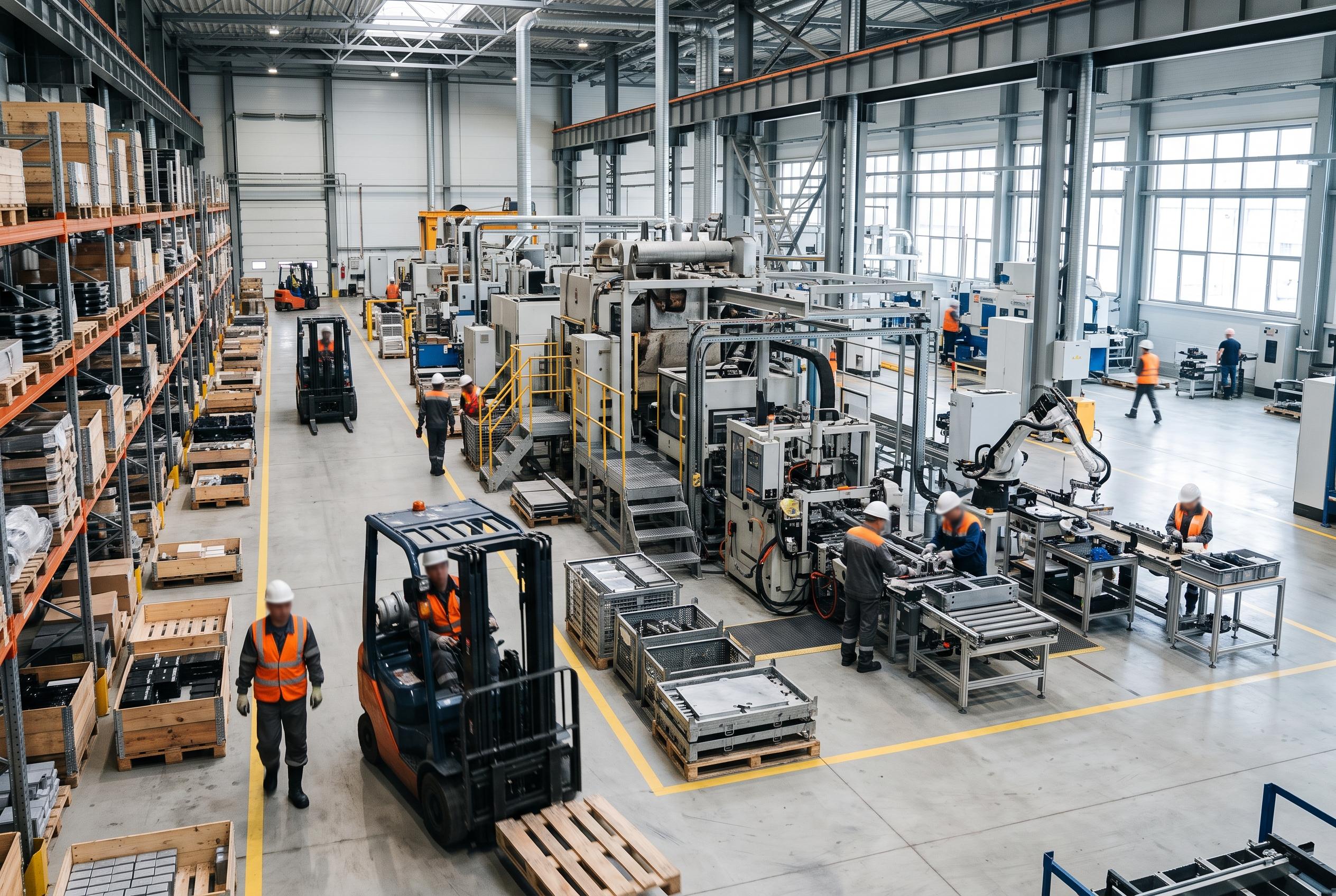
Manufacturers are turning to integrated production planning to tackle a familiar shop-floor headache: machines, warehouses, and transport fleets working to different rhythms. A new model tested in a machine-building plant links those resources across several planning horizons, helping raise equipment efficiency, smooth workloads, and reduce downtime without treating each department as an island.
The shop floor's hidden problem is coordination
A production line can look busy and still lose time in the gaps between tasks. A machine may finish a batch, but the next process waits for a pallet truck. The truck may be ready, yet the warehouse lacks the right space. Meanwhile, operators are left watching the clock, which is about as productive as it sounds.
The study, published in Frontiers in Mechanical Engineering, treats that tangle as one connected planning problem rather than a series of separate departmental chores. Researchers from Abylkas Saginov Karaganda Technical University and Peter the Great St. Petersburg Polytechnic University tested their approach in a machine-building operation running two shifts, 83 product groups, and 450 manufacturing operations.
Their integrated multi-criteria optimization model linked machine tools, storage locations, and transport vehicles across five time horizons. The result was a 19.31 percent reduction in overall downtime, alongside a 15.11 percent improvement in annual equipment efficiency.
Why separate planning creates expensive gaps
Traditional production planning often handles machines first, then transport, then storage. That sequence can produce sensible decisions inside each department, but it doesn't necessarily create a sensible factory. A machine schedule might be efficient on paper while leaving vehicles waiting, storage areas overloaded, or parts stranded between operations.
The researchers' framework passes decisions from one planning level to the next as constraints. Machine assignments influence storage requirements, storage arrangements shape transport movements, and transport schedules must reflect the time parts spend being processed. In other words, the model follows the physical reality of manufacturing rather than forcing the factory to fit neat organisational boxes.
That matters especially in machine-building, where products can take many steps and move between different types of equipment. A small mismatch in one area can ripple through the entire system, creating idle time that no single schedule can easily explain.
Pareto analysis keeps trade-offs visible
The model doesn't reduce every objective to one tidy score. Instead, it uses vector optimization and Pareto analysis to identify non-dominated alternatives. These are solutions where improving one goal would make at least another goal worse, such as maximising machine use while limiting transport delays and warehouse pressure.
For the annual allocation of operations across 17 machines, the researchers assessed 11 Pareto-optimal options. They also generated 23 alternatives for assigning work among three electric pallet trucks. That gives planners a menu of practical trade-offs instead of pretending there's one universally perfect answer.
This is a useful distinction for factory managers. The best schedule during a high-volume month may not be the best option when warehouse space is tight or a particular machine needs maintenance. Keeping those trade-offs visible makes the model more adaptable and gives decision-makers a clearer reason for choosing one plan over another.
The numbers show where the gains appeared
The biggest improvements weren't confined to one headline metric. Load variability fell by 6.78 percent on milling machines and 8.65 percent on grinding machines, helping reduce the stop-start rhythm that can make a shop floor feel busy but uneven.
Transport also benefited. Vehicle capacity utilization climbed by 37.06 percent, while vehicle downtime fell by 28.86 percent. At the quarterly level, equipment-load variability dropped by 34.68 percent, and downtime unevenness declined by 54.24 percent. Shift-level load variability fell by 36.59 percent.
Those figures point to a broader lesson: factories may not need more equipment first. They may need to use the equipment they already have more intelligently. A quieter warehouse aisle and a machine that no longer waits for its next load can add up to a surprisingly large operational gain.
Better scheduling still depends on better data
The model is designed to grow with a factory. New planning layers could represent automated guided vehicles, casting equipment, or automated storage and retrieval systems without rebuilding the entire structure from scratch. The researchers also point to possible links with enterprise resource planning and manufacturing execution systems, opening the door to more automated scheduling and predictive analysis.
But there's an important caveat. The researchers excluded machine and vehicle failure probabilities from annual planning because the plant didn't have dependable data on breakdowns. That may sound like a technical footnote, but it's a practical warning for manufacturers: sophisticated optimisation can't rescue unreliable inputs.
For companies considering this kind of system, the sensible starting point is an audit of operating data. Track actual processing times, vehicle movements, warehouse capacity, waiting periods, and breakdowns before chasing a clever algorithm. The model can then work with the factory's real behaviour, rather than an idealised version of it.
Integrated planning could become the new efficiency frontier
The study suggests that the next wave of manufacturing gains may come from coordination rather than another isolated machine upgrade. When production, logistics, and storage share a planning logic, fewer parts sit idle, fewer vehicles make empty trips, and supervisors spend less time solving avoidable emergencies.
It's a particularly timely idea as manufacturers face tighter delivery expectations, rising costs, and pressure to digitise. The machinery may still make the noise, but the smartest improvement could happen quietly in the planning system behind it.
Small scheduling decisions can create big shop-floor savings when they finally line up.
Disclaimer: This article may have been created with AI assistance and reviewed by our editorial team. It is provided for general informational purposes only. Readers should verify information independently before relying on this content.
