
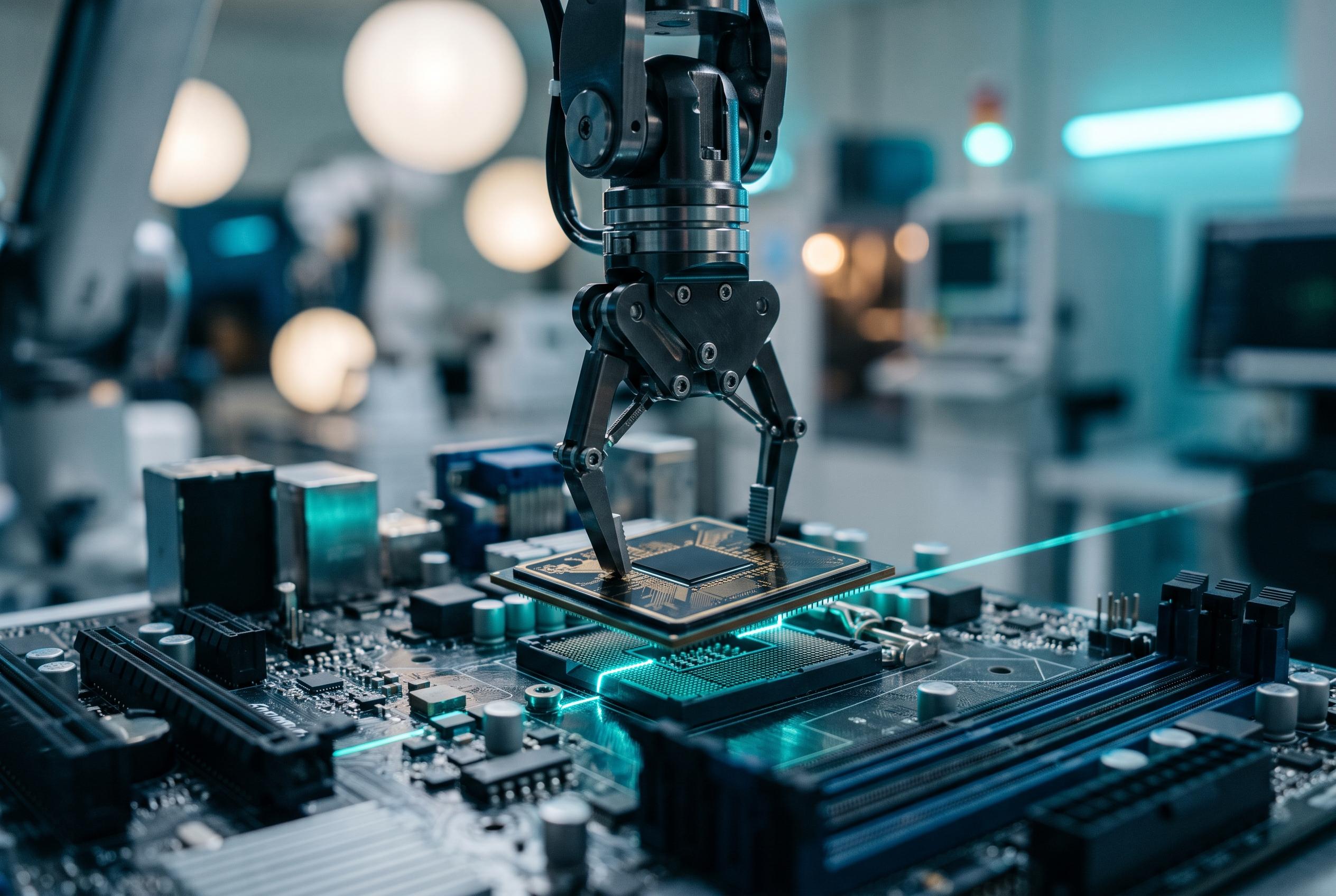
Manufacturers are turning to software-defined factories as AI hardware demand accelerates. Teradyne’s strategic investment in Bright Machines brings robotics, testing, and production software closer together, with the goal of helping US manufacturers build complex AI infrastructure faster, more flexibly, and with better data at every stage.
AI hardware needs a faster factory floor
AI infrastructure is becoming a manufacturing race, not just a computing race. As hyperscalers, chip companies, AI labs, and equipment makers expand their hardware programs, the ability to assemble and test products quickly can determine how soon those systems reach customers.
That pressure is especially sharp for complex electronics. Products change rapidly, production volumes can vary, and quality requirements leave little room for a bad batch or a long rework cycle. Industry coverage from IEN and Yahoo Finance identified Teradyne's investment as part of a wider push to strengthen AI infrastructure manufacturing.
The factory of the future, in other words, may need to behave less like a fixed assembly line and more like a programmable system. That's a useful shift when yesterday's hardware design can quickly become yesterday's news.
Teradyne and Bright Machines bring different strengths
Teradyne supplies automation, robotics, and testing technologies used across electronics production. Bright Machines takes a broader software-defined approach, covering manufacturing design, robotics, inspection, material movement, production intelligence, and operations.
The companies say their collaboration will explore how those capabilities can work together inside Bright Machines microfactories and customer facilities. Related reporting from MarketChameleon and Blackridge Research described the agreement as a strategic investment and collaboration aimed at US AI infrastructure production.
The appeal is fairly practical. A manufacturer could use robots for precise assembly, automated systems to load and unload test equipment, and autonomous tools to move components around the floor, all within a coordinated production environment. Less handoff between systems usually means fewer opportunities for information to get lost.
The real prize is the production data
Robots may be the most visible part of the announcement, but the data connection could be more important. Assembly records, inspection results, robot activity, material movements, and electrical test results can each tell a different part of the story.
Bright Machines' platform is intended to connect those streams with product genealogy and manufacturing intelligence. That could give manufacturers a continuous record for each unit, from design decisions through assembly and final electrical performance.
ITOpsTimes and Dealroom highlighted this integrated, data-driven approach as a central feature of the partnership. For manufacturers, it could make troubleshooting less of a detective story. If a product fails testing, engineers may have a clearer path back to the specific component, process step, or machine event involved.
Why software-defined manufacturing matters
Traditional automation often works beautifully until a product changes. Then engineers may need to reprogram equipment, redesign fixtures, or spend weeks validating a new process. That model becomes increasingly awkward when AI infrastructure products have short design cycles and frequent revisions.
The companies are betting that software-defined manufacturing can reduce that friction. Rather than rebuilding an entire line for every product update, manufacturers could reconfigure more of the process through software and reusable automation tools.
That doesn't mean every factory will instantly become autonomous. Skilled engineers, quality teams, and maintenance specialists will still matter, particularly for high-value electronics. But a more adaptable production system could help people spend less time on repetitive integration work and more time improving yield, reliability, and throughput.
A partnership built for high-mix production
The proposed combination is aimed at factories handling demanding, high-mix electronics rather than simple, uniform consumer goods. Board testing, robotic assembly, inspection, and material handling all need to work reliably when product designs and production schedules keep moving.
Bright Machines says it has deployed more than 130 microfactories across more than 10 countries and is already involved in AI infrastructure production in the United States. Teradyne's investment adds a stronger connection to robotics and automated test capabilities.
The outlook is promising, but execution will decide whether the idea scales. Integrating equipment, software, data standards, and customer workflows is rarely as tidy as a press release suggests. Still, the direction is clear: AI infrastructure makers want factories that can learn, adjust, and prove what happened to every unit they build.
What this could mean for AI supply chains
If the partnership delivers, manufacturers could bring new AI hardware designs into production more quickly while improving traceability and reducing manual intervention. That matters as demand for servers, networking equipment, accelerators, and other data center components continues to rise.
It could also strengthen domestic production capacity. A flexible microfactory model is easier to adapt than a giant, highly specialised line, which may help manufacturers respond to changing demand without committing to one product for years.
For now, Teradyne and Bright Machines are evaluating the opportunity rather than announcing a finished factory blueprint. But the message is unmistakable: the AI boom needs smarter physical infrastructure, and the next competitive advantage may come from how quickly a factory can change its mind.
A more adaptable factory could be the quiet engine behind the next wave of AI growth.
Disclaimer: This article may have been created with AI assistance and reviewed by our editorial team. It is provided for general informational purposes only. Readers should verify information independently before relying on this content.
