
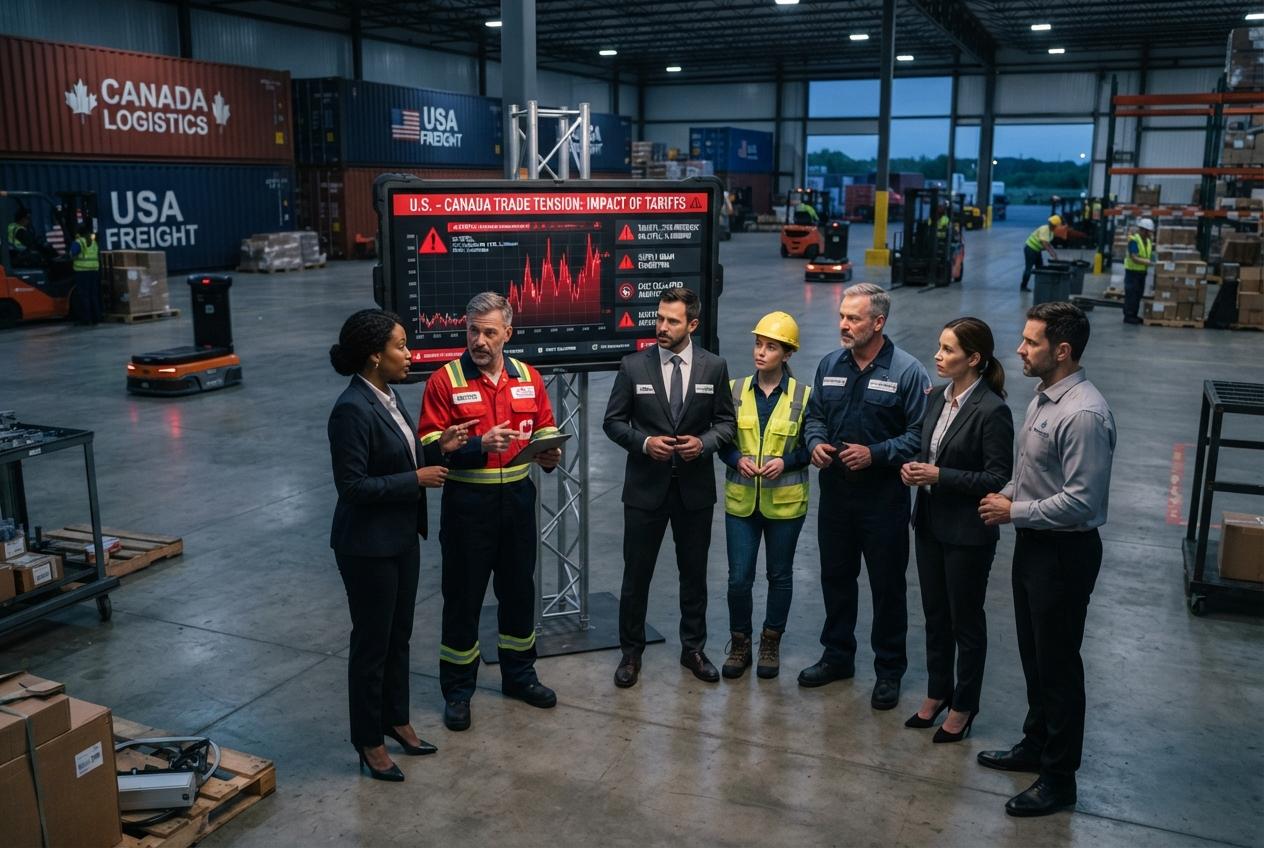
The collapse of trade negotiations between the US and Canada, accompanied by new tariffs and retaliatory measures, signals a significant shift in North American commerce, affecting manufacturers, logistics and consumers alike.
US trade officials said Saturday there are no immediate plans to reopen negotiations with Canada after talks collapsed and Washington’s new 50 percent tariffs on selected Canadian imports took effect just after midnight. Jamieson Greer, the US trade representative, told Fox News that no fresh discussions were scheduled, while defending the move as part of President Donald Trump’s broader effort to bring manufacturing back to the US and push back against what Washington views as foreign retaliation.
The clash marks a sharp escalation in one of the world’s most important commercial relationships. Reuters reported that the new duties cover about $20 billion in Canadian goods, including products that had previously enjoyed protection under the US-Mexico-Canada Agreement. Axios said the measures followed weeks of warnings from the Trump administration, which had threatened to use a rarely invoked section of the Tariff Act of 1930 targeting countries seen as discriminating against US businesses.
Canada responded quickly. Prime Minister Mark Carney said Ottawa will match Washington “dollar for dollar” starting September 8, with retaliatory tariffs aimed at industries ranging from steel and dairy to electronics, agricultural equipment, paper and appliances. The Associated Press reported that Carney framed the decision as a defense of Canada’s economy and an acknowledgment that the old trade relationship with the US has changed.
The breakdown leaves businesses on both sides of the border facing higher costs and fresh uncertainty in supply chains already under pressure. US Census data cited by Axios showed trade between the two countries reached $376 billion by mid-2026, underscoring how much is at stake for manufacturers, shippers and suppliers tied to North American commerce.
What this means for sourcing, logistics and electronics
For companies that rely on cross-border sourcing, the practical impact may show up long before any policy shift becomes visible in Washington or Ottawa. A tariff can alter the landed cost of a product overnight, but the reaction inside procurement teams often takes longer to unwind. Buyers may need to revisit supplier contracts, inventory assumptions, customs classifications and freight plans in order to keep operations stable.
That matters especially in electronics, where components are often sourced through multiple suppliers and passed through several stages of assembly before reaching consumers. Even when a tariff does not apply to every piece of a finished product, it can still affect the bill of materials, contract manufacturing decisions and the timing of shipments. A small increase in duty on one imported component can ripple across a much larger production line.
Logistics providers may also feel immediate pressure. When tariffs rise, shippers often accelerate imports ahead of deadline dates, delay nonessential orders or reroute distribution plans to minimize exposure. That kind of behavior can create bottlenecks at ports, warehouses and border crossings. In the short term, it can increase the need for customs brokerage support, documentation checks and freight visibility tools. In the longer term, it may encourage companies to rethink where they store inventory and how much buffer stock they maintain.
The lifestyle and mobile markets are also worth watching. Many consumer goods that people use every day, from kitchen appliances to phones, accessories and other personal electronics , depend on globally distributed sourcing networks. When trade policy becomes volatile, retailers can face difficult choices: absorb the cost, pass it on to consumers or look for alternative suppliers. Any of those options can affect pricing, promotions and product availability.
Why this dispute matters beyond tariffs
Trade conflicts are often discussed in terms of percentages and revenue, but the real effects usually appear in ordinary business decisions. A manufacturer may postpone an expansion because equipment costs rise. A distributor may change its replenishment cycle because cross-border trucking becomes less predictable. A retailer may adjust sourcing to a lower-volume supplier simply to reduce exposure. None of those changes requires a dramatic announcement, yet each can reshape the market over time.
For smaller businesses, the challenge can be even greater. Large corporations sometimes have legal teams, global procurement networks, and the cash flow needed to absorb tariff shocks. Smaller firms often have less room to maneuver. If they import niche parts or rely on a single Canadian supplier, the new duties could force quick pricing changes or inventory cuts. That is why policy headlines can matter so much to firms that are not directly named in the news story.
The uncertainty also affects planning. Businesses usually prefer stable rules when they make sourcing decisions, negotiate logistics contracts or forecast demand. When trade policy changes quickly, long-term planning becomes harder. Companies may delay commitments, reduce hiring, or hold off on capital spending until they know whether the situation is temporary or the start of a longer pattern. In that sense, the damage from uncertainty can be as significant as the tariff itself.
Practical questions companies may ask now
How should importers respond if they depend on Canadian inputs? They may need to review which products are affected, which are exempt, and how customs documentation should be updated. That includes verifying tariff codes and understanding how the duty is applied in practice.
Can suppliers simply be switched overnight? Usually not. Sourcing relationships often involve qualification requirements, lead times, compliance checks, and logistics coordination. A new supplier may look cheaper on paper but still cost more once freight, quality control and inventory risk are included.
Will consumers notice right away? Sometimes yes, sometimes no. Retail pricing can lag behind tariff changes, especially if businesses have existing inventory. But if the dispute continues, higher import costs can eventually reach the shelf price.
What should logistics teams watch most closely? Border timing, customs paperwork, warehousing capacity and freight scheduling. Even a short-lived policy shock can create congestion if many firms rush to move goods before deadlines.
Takeaways
- - The tariff dispute raises costs and uncertainty across North American commerce.
- - Sourcing decisions may need to be revisited quickly, especially for electronics and other imported goods.
- - Logistics disruptions can spread beyond the border itself, affecting ports, warehouses and delivery schedules.
- - Lifestyle and mobile products may face higher pricing pressure if companies pass along costs.
- - Businesses with flexible supplier networks and strong compliance processes may adapt more easily than those with limited options.
Frequently asked questions
Q: Does this mean trade talks are over? Not necessarily, but the article indicates there are no immediate plans to resume negotiations.
Q: Which sectors are most exposed? Steel, dairy, electronics, agricultural equipment, paper, appliances and other cross-border supply chains.
Q: Why do tariffs matter so much for sourcing? Because they change the total cost of bringing goods across a border, which can alter supplier choices and margins.
Q: What should companies focus on first? Inventory, customs classification, logistics timing and supplier communication.
Q: Is this only a government issue? No. The effects can quickly reach manufacturers, retailers, shippers and consumers.
Disclaimer: This article may have been created with AI assistance and reviewed by our editorial team. It is provided for general informational purposes only. Readers should verify information independently before relying on this content.
Source Reference Map
Inspired by headline at: [1]
Sources by paragraph:
