
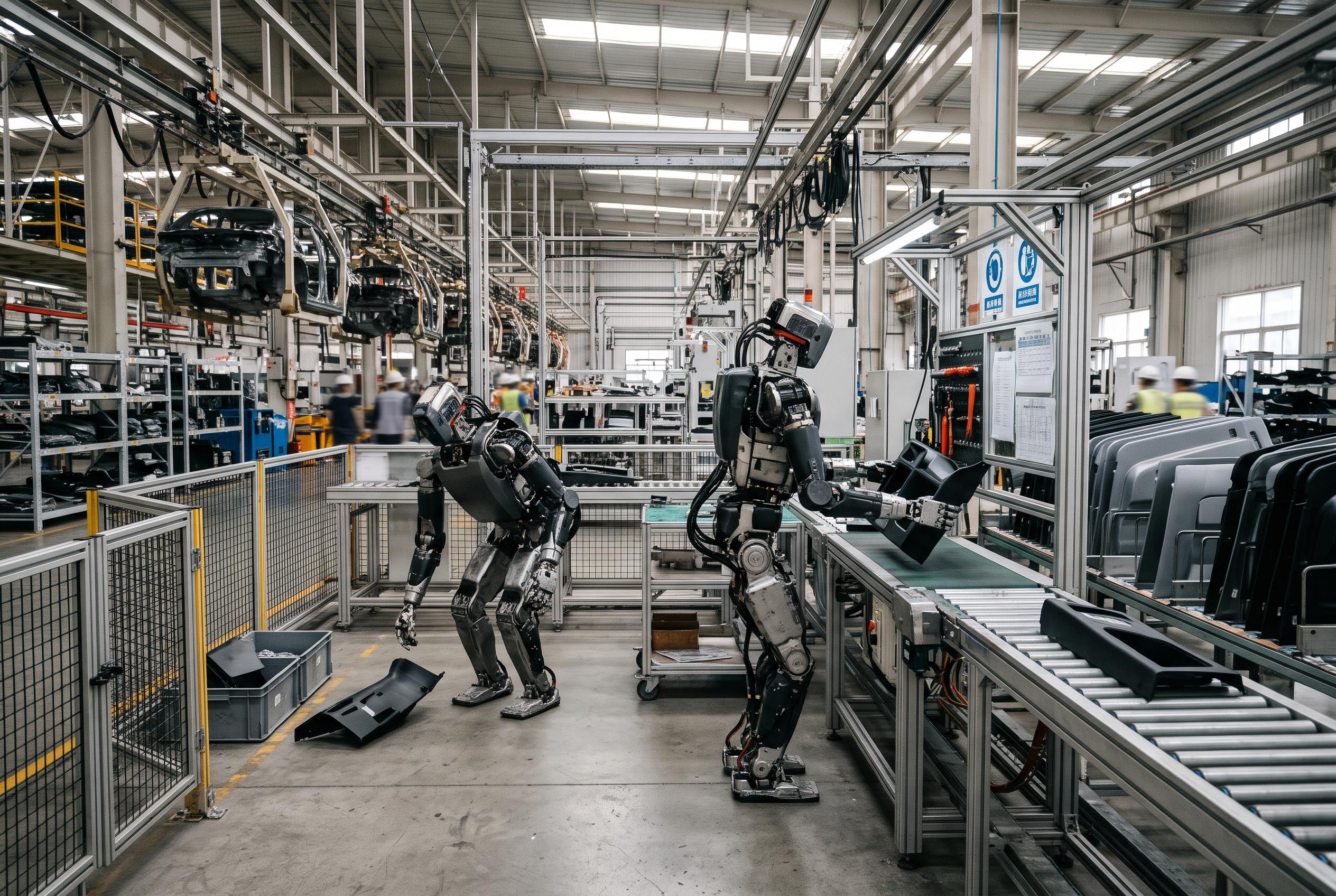
Two Xiaomi CyberOne 02 humanoid robots have taken on a full shift at the company’s car factory, sorting flexible interior panels into production order. The eight-hour milestone is intriguing, but the charging breaks, one reported dropped part and missing performance figures matter just as much as the headline.
An eight-hour shift, with a practical catch
Two full-size humanoid robots spent a reported eight hours sorting soft, awkward center-console panels at Xiaomi’s car factory. It’s a useful test because the job is less about a flashy one-off stunt and more about keeping parts moving in the right order beside an active production line.
The robots pulled panels from a container, turned them into the correct orientation and placed them in a rack according to the sequence of vehicles being assembled. Xiaomi described the run as an internship, a label that sounds modest but fits a trial of real factory work.
The headline needs a little unpacking, though. The published run included two charging breaks, so the available information doesn’t establish that either robot worked continuously for eight hours or explain how charging was handled.
Why panel sorting is a tougher test than it looks
The station handles panels that are large, flexible and randomly arranged in their container. That makes each cycle a small problem to solve: find the right piece, grasp it, turn it and place it in the matching slot without losing track of the production sequence.
The robots also had to work around autonomous mobile carts delivering materials. Xiaomi says they adjusted their movements and coordinated with the factory system, including waiting when a cart was swapped out. It’s the sort of unglamorous cooperation that matters when a machine shares space with a busy line.
Xiaomi CEO Lei Jun has presented the humanoid as a general-purpose machine that can adapt to different jobs without hardware changes. This trial offers a glimpse of that ambition, but a successful demonstration at one station isn’t proof that the same robot can move easily between many roles.
The charging breaks and dropped panel tell their own story
The run’s cumulative work counter showed breaks at 3 hours 2 minutes and 6 hours 3 minutes. Those timings come from the video’s displayed counter, not a published wall-clock log, and Xiaomi hasn’t provided battery capacity, charging time or details about whether packs can be swapped.
One panel reportedly landed on the floor during the second half of the run, after which a wheeled robot retrieved it. That’s a useful reminder that recovering from a mishap is different from preventing one, and the public information doesn’t show how many interventions or errors occurred overall.
There’s no need to treat one dropped part as a verdict on the technology. But in a factory, reliability is measured across repeated cycles, not just by the length of a shift, and Xiaomi hasn’t yet released the wider incident record for this test.
What Xiaomi’s earlier factory numbers can, and can’t, show
Xiaomi has previously reported success rates for other factory tasks. In March, the company said its robots achieved a 90.2% success rate at a self-tapping nut station during a three-hour run; later figures included 98% at nut loading and 90% at separate sorting and box-folding tasks.
Those numbers offer context, but they’re not a scorecard for the new panel-sorting shift. The tasks, dates and conditions differ, and none of those rates tells readers how many panels the CyberOne 02 pair handled this time or how often people stepped in.
Xiaomi’s robotics work also includes XR-1, an embodied model trained using large collections of human and robot manipulation demonstrations. That may help explain the broader push toward adaptable machines, though training claims alone can’t tell us how smoothly a robot performs on a production line day after day.
A promising factory trial still needs a rate card
The eight-hour run is a meaningful step because it took place at a real station in a real automotive plant, rather than in a controlled showcase alone. Still, the useful next questions are straightforward: How many parts were sorted? What was the success rate? How much human help was needed?
Until those figures arrive, it’s best to read the shift as evidence of endurance across a reported work period, not proof of uninterrupted operation or production-ready performance. That’s less dramatic than the headline, but more useful for anyone trying to understand what factory robots can actually do today.
A full shift is a start; repeatable results will make the stronger case.
Disclaimer: This article may have been created with AI assistance and reviewed by our editorial team. It is provided for general informational purposes only. Readers should verify information independently before relying on this content.
