Download App
Better Online and Trade Show Sourcing Experiences.Scan the QR code to download.
Learn More
Hot Topics
by Vianie Li & Cecile de Veyra
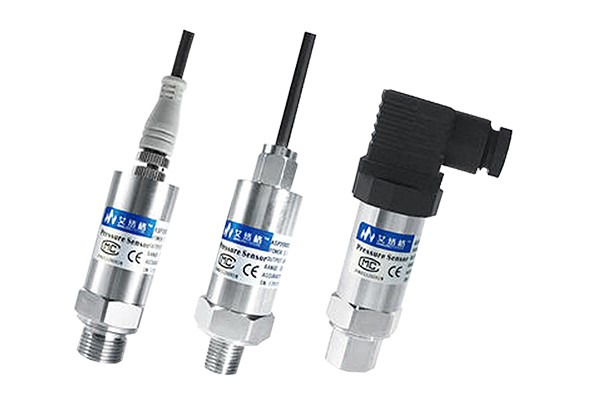
From smart devices to smart homes, buildings and factories to autonomous cars and smart cities, the trend continues to gain headway as technology adds more computing capability to these things. At the core of this development are sensors, the data collectors. They are one of the fast-growing categories, already on the scale of $205.2 billion in 2021 and forecast to reach $411.2 billion by 2026 at 14.9 percent CAGR, according to BCC Research’s latest report.
Pressure sensors, one of the major types, will have a CAGR of 7.3 percent over the same period based on a projected total of $8.322 billion. According to Mordor Intelligence, increasing use in many applications, including aerospace, automotive, healthcare and consumer goods, is fueling this uptick.
China’s pressure sensors are enjoying a similar trend, expected to be sustained by developments in Industry 4.0, 5G communication, the Internet of Things, AI and self-driving vehicles. In 2021, this sector reached $1.49 billion, according to SensorExpert, a Chinese sensor industry portal, and will increase annually by 5 to 10 percent until 2024.
China-made pressure sensors offer high sensitivity, reliability and stability in small and light designs at low cost. These are widely used in consumer electronics, medical, automotive and chemical industries. Compared to products made by foreign companies, however, they still lag behind in technology. Most Chinese manufacturers currently focus on entry-level and midrange units.
Recognizing this gap and the market opportunity it can cost, many will aim for comparable pressure sensors in the coming years to compete for attention in the midrange and high-end segments.
They are also looking at trends, noting buyer reception to dual-function types or those capable of pressure and temperature sensing, and smart units integrating MCUs that enable auto-compensation, communication and diagnosis.
Others, such as SNM Technology, have developed models that use high-performance materials. This company replaced ordinary metal film with nano film to prevent creep, hysteresis and aging and achieve stability at less than 0.1 percent FS per year after 10 million cycles.
For the same reason, MEMS technology will remain a priority on the development agenda of Chinese suppliers in the years ahead. This is because such pressure sensors will be in greater demand in smartphones, wearable electronic devices, smart home products and the automotive industry. Their market will reach $2 billion worldwide in 2023, according to Yole Développement. In China, this category was at $610 million in 2019 and is projected to hit $1.06 billion by 2026 at a CAGR of 10.2 percent based on EMIS data.
China’s manufacturing pool for pressure sensors consists mostly of small and midsize companies. MEMSening, Novosense, Kunshan Shuangqiao and Wuxi Sencoch are some of the major players.
For these suppliers, exports account for 10 to 50 percent of shipments. Main destinations are Europe, North America and the Asia-Pacific region, with products also sent to the Middle East and other markets.
Key cities where many Chinese companies gather include Wuxi, Kunshan, Changzhou, Ningbo, Shenzhen, Dongguan and Xi’an.
Widely manufactured in China are gauge, differential and absolute pressure sensors used in consumer electronics, medical devices, automotive, industrial control and other industrial systems.
Available units have a pressure sensing range of 0 to 300MPa. Typical electrical properties are 9 to 36VDC rated voltage, 4 to 20mA output current, 0 to 10VDC output voltage, 100Mohm insulation resistance and -40 to 120 C operating temperature.
For applications that require sensors with sealed enclosures, there are water-resistant variants with an IP65 to IP68 rating.
Customization is commonly practiced, accounting for 20 percent to as much as half of shipments.
As quality guarantee, products from most Chinese manufacturers carry safety approvals such as CE, RoHS and UL. Others have additional compliance certifications from ANSI, ASTM and JIS.
Stainless steel, ceramic film, resistors, insulators and cases are some of the key materials and components used in the production of pressure sensors. They are sourced domestically or from foreign companies, depending on the requirement.
Although their supply is stable, costs are still fluctuating and may continue to affect product prices. In 2021, many Chinese manufacturers of pressure sensors raised their quotes by 5 to 10 percent to cover the slight increase in material and labor costs.
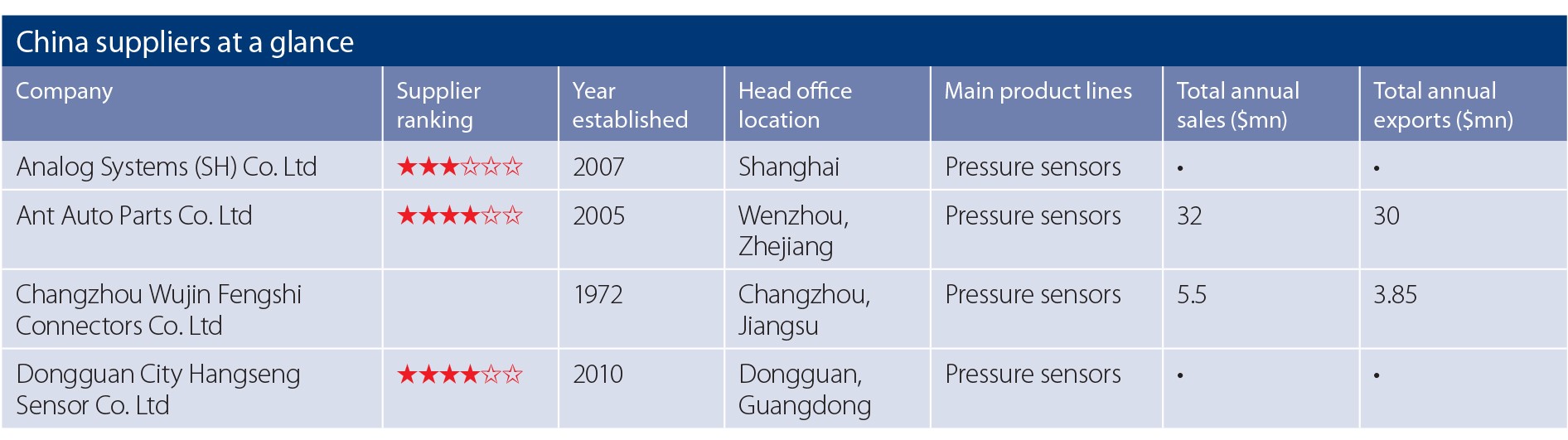
The ASP2002EV0-S032ME pressure sensor from Analog Systems (SH) Co. Ltd has 0 to 2,000kPa to 20MPa measuring range, 300 percent FS overload and 400 percent FS burst pressure, 1 percent accuracy, ≤15ms response time and -30 to 80 C operating temperature. Its operating voltage and current are 0 to 5V, 0.5 to 4.5V or 1 to 5V (9 to 30VDC) and 4 to 20mA.
The minimum order required is 10 units for delivery within 15 days.
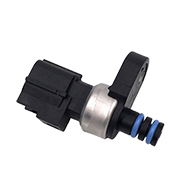
For automotive applications, the 4799758-6045 is a transmission pressure sensor from Ant Auto Parts Co. Ltd. It has 12VDC voltage and 0.3 to 0.5W power ratings.
An order of at least 10 units is required. Lead time is seven days.
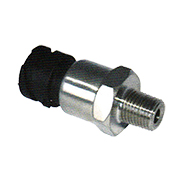
Changzhou Wujin Fengshi Connectors Co. Ltd’s ASP2006BI model is a hygienic pressure sensor with a flush diaphragm connection. This IP65- or IP67-rated unit meets RoHS and CE requirements.
The 10-unit minimum order requirement has a lead time of seven days.
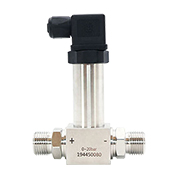
From Dongguan City Hangseng Sensor Co. Ltd, the HS805 pressure sensor measures liquid, gas and steam, and has up to 100kPa to 60MPa measuring range and 0.2 or 0.5 percent FS accuracy. Its operating temperature is -40 to 85 C. This IP65-rated unit has 10.5 to 55VDC or 10.5 to 30VDC voltage and 4 to 20mA output current.
An order of at least 100 units is required for delivery within seven days.
More Sourcing News
Read Also

关注 “环球资源外贸” 官方微信,获取实时外贸资讯
iOS & Android
iOS & Android(Mainland China)
Copyright © 2026 Publishers Representatives Limited. All rights reserved.




